
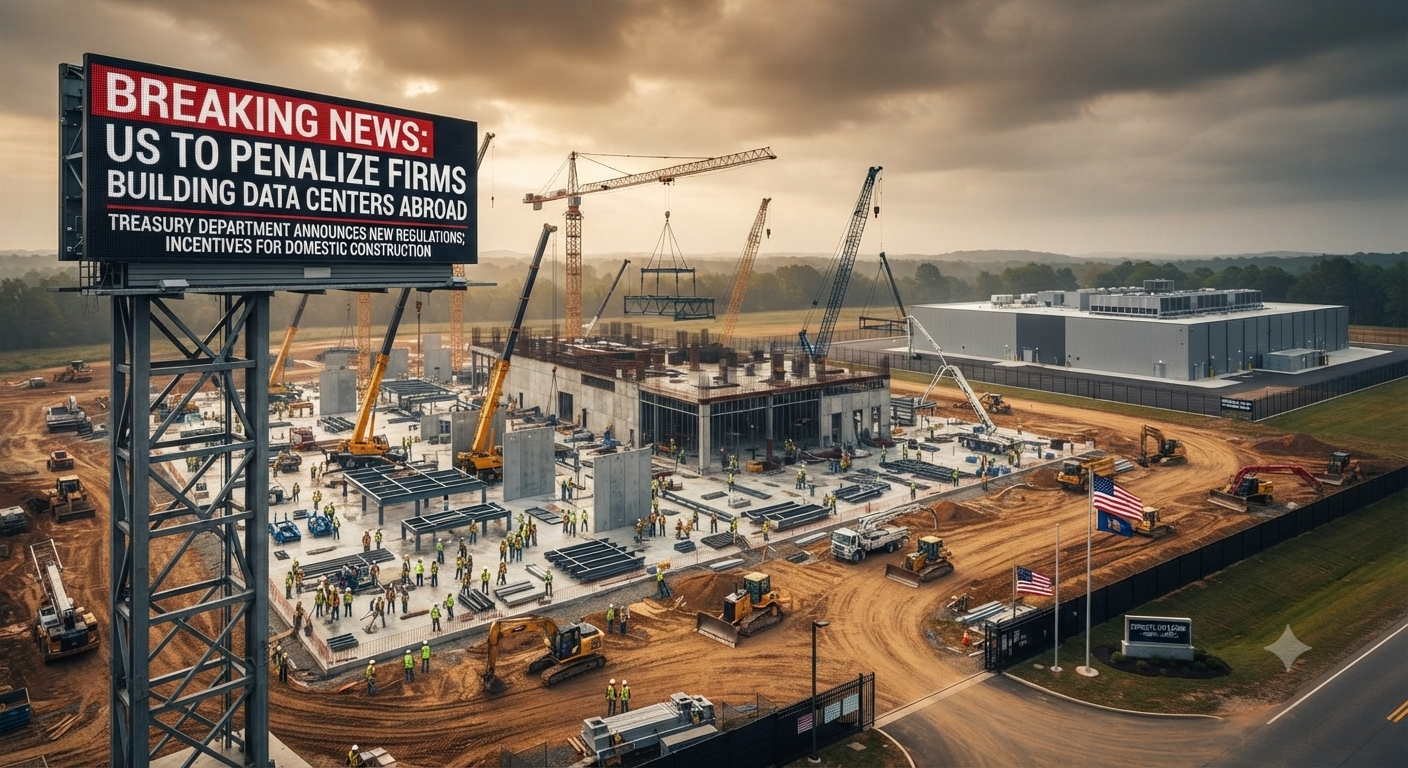
President Donald Trump announced on November 20, 2026, that the United States intends to penalize American firms building data centers abroad. Speaking at a White House news conference after his Asia trip, he stated the country would not permit companies to construct these facilities outside its borders and vowed to levy a substantial tax on those that proceed. The goal, he explained, is to strengthen the U.S. artificial intelligence sector in its competition with China.
Data centers form the backbone of the AI expansion, supplying the intensive computing resources required to train and operate sophisticated models. A penalty on foreign construction could disrupt the global rollout of this infrastructure. Several major U.S. developers, including Equinix and Digital Realty, already operate facilities internationally. Operators often site centers near end users to minimize latency for time-critical applications such as payment processing, while long-distance data transfers increase costs significantly.
Trump has consistently supported expanding data center capacity inside the United States. That stance has met resistance from many voters and local communities worried about rising electricity demand, higher utility bills, and other neighborhood effects. The announcement also sits against recent Commerce Department actions that tightened restrictions on advanced AI chip exports to several Southeast Asian nations. Those steps aim to close pathways that allow China to obtain restricted technology through third countries. Although the U.S. already prohibits direct sales of the most advanced chips to China, Chinese firms have continued gaining access by renting computing capacity at data centers located in countries permitted to import the hardware.
By discouraging overseas builds, the administration seeks to keep more of the critical AI compute footprint and the associated economic activity on American soil. Industry observers note the practical challenges: global cloud providers rely on distributed networks for performance, regulatory compliance, and market reach. Details on how any tax or penalty would be structured or enforced have not yet been released, leaving companies and investors assessing potential impacts on future investment plans.