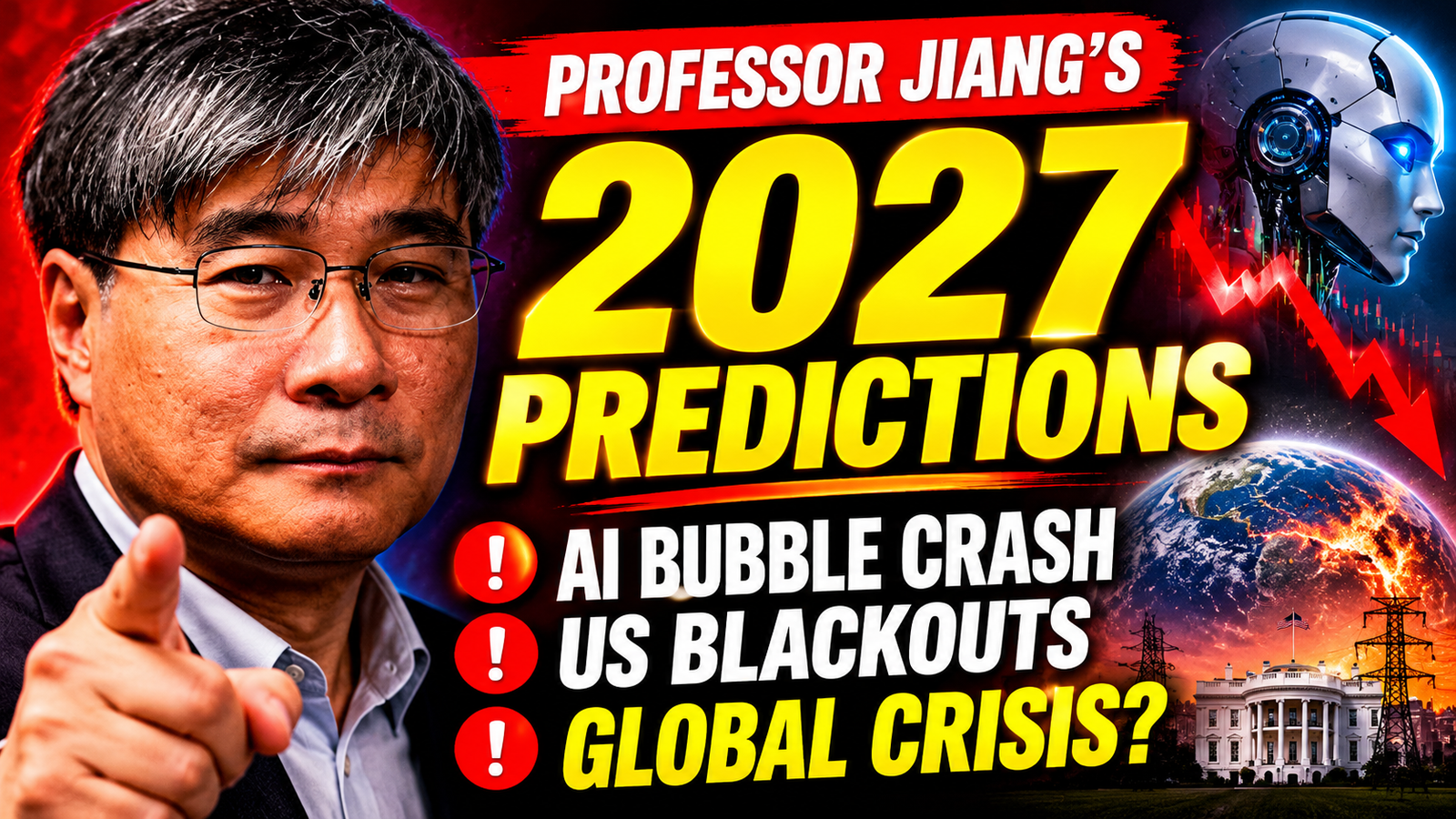
Could 2027 bring an AI market collapse, a deepening US debt crisis and serious disruption to essential infrastructure? Professor Jiang believes the world is approaching a period of economic and political instability.
Some of his forecasts focus specifically on 2027, while others extend into 2028 and beyond. Here are the major predictions and the reasoning behind them.
1. The AI Bubble Could Burst in 2027
One of Jiang’s biggest predictions is that the artificial intelligence investment boom could face a major collapse.
He identifies three reasons:
- Expensive infrastructure: Building and operating AI data centres requires enormous capital investment.
- Uncertain profitability: AI companies have yet to demonstrate business models capable of consistently covering their infrastructure costs.
- Shrinking investment liquidity: Jiang argues that geopolitical instability in the Middle East could reduce investment from Gulf economies, including Saudi Arabia, Qatar and Kuwait.
His concern is that AI companies depend on continuous funding to maintain their expansion. If investment slows while operating costs remain high, the financial pressure could become unsustainable.
Jiang suggests the bubble could burst as early as 2027.
2. A Government Bailout of the AI Industry
Jiang goes beyond predicting an AI market crash. He argues that a collapse could create an opportunity for government intervention.
His proposed scenario is that the US government could step in to rescue struggling AI infrastructure companies by treating major data centres as strategically important or military-related assets.
This would potentially transfer some financial risk from private companies to taxpayers while allowing private businesses to retain commercial benefits.
He compares this possibility with the response to the 2008 financial crisis, when governments intervened to stabilise major financial institutions.
This is Jiang’s interpretation of a possible political and economic strategy, not evidence of a confirmed government plan.
3. Japan’s Financial Problems Could Spread Globally
Another major concern in the interview is Japan’s role in global financial markets.
Jiang focuses on the Japanese yen carry trade, through which Japanese institutions have borrowed cheaply and invested in overseas assets, including US Treasury securities.
He argues that rising energy costs and economic pressure could weaken the yen and force Japanese investors to bring capital back home.
If that happened, Japan might reduce its purchases of US debt or sell some existing holdings.
Jiang believes this could increase pressure on US borrowing costs and deepen America’s sovereign debt problems.
His wider argument is that the global financial system depends heavily on interconnected sources of liquidity. A disruption in one major economy could create consequences far beyond its borders.
4. US Blackouts Could Become a Major Political Issue
One of Jiang’s most alarming forecasts concerns electricity infrastructure.
He believes the United States could experience serious power disruptions during 2027 or 2028, potentially around the 2028 presidential election or the 2026–2028 political cycle discussed in the interview.
He connects this possibility to vulnerabilities involving electricity grids, financial systems and data centres.
Jiang also speculates that infrastructure disruptions could be used to distract the public during a period of economic and political turmoil.
However, he does not provide independently verified evidence of a planned blackout or deliberate false-flag operation. This should be treated as speculation, not an established forecast.
5. Economic Crisis Could Increase Political Dependence on Strong Leaders
Jiang also makes a prediction about political psychology.
He argues that when people experience prolonged fear, insecurity and instability, they may become more dependent on leaders who project strength and promise protection.
He uses a hypothetical scenario involving a prolonged Iran conflict, US military involvement, domestic protests and possible conscription to illustrate how voters might rally around a familiar leader during a crisis.
His central argument is that fear can change political behaviour: people may prioritise perceived security over competence or policy performance.
He discusses this as a possible trajectory extending into 2028, rather than a definite 2027 event.
6. A Digital Financial System Could Expand Government Influence
Jiang questions whether cryptocurrency and digital financial infrastructure could help the United States manage its debt burden.
He discusses dollar-backed stablecoins, including Tether and Circle, which hold US Treasury-related reserves.
His argument is that these instruments could create additional demand for US government debt by allowing consumers and investors internationally to hold dollar-linked digital assets.
He is sceptical that this approach can solve America’s underlying debt problems.
He also raises concerns about the growing relationship between digital finance, government influence and economic control. However, he does not establish that Americans will be forced to use digital currency in 2027.
7. A Staged Alien Invasion Could Be Used to Justify Global Control
Perhaps the most extraordinary idea discussed in the interview is Jiang’s belief that powerful elites could stage an alien invasion or similar extraordinary event.
He suggests that a manufactured external threat could create public fear and encourage support for stronger international coordination, potentially including a one-world government.
He also discusses the possibility of blending an alien narrative with religious or messianic imagery.
Importantly, Jiang does not provide evidence that such an operation is being planned or assign it a confirmed 2027 date. This is one of his most speculative claims and should not be confused with his economic forecasts.
Predictions Jiang Explicitly Rejected
The interview also contains several predictions put to Jiang by the host that he did not agree with.
He rejected the suggestions that:
- Western governments would solve ageing problems through widespread voluntary euthanasia of older people.
- The first nuclear war would begin over an attack that never happened.
- Governments would introduce a compulsory birth draft forcing people to have children.
These rejections matter because they distinguish Jiang’s own positions from every scenario discussed during the interview.
Why Does Professor Jiang Believe These Events Could Happen?
When asked how he develops predictions, Jiang explained that his approach is based on pattern recognition.
He looks at existing political, economic and social developments and projects how they might continue.
For example, his AI bubble forecast comes from the relationship between rising infrastructure costs, dependence on investment and uncertain profitability. His financial concerns come from the interconnectedness of Japan, US debt markets and global liquidity.
Whether his conclusions prove correct is another question. The reasoning behind each forecast should be evaluated separately from the prediction itself.
Final Thoughts: Is 2027 a Turning Point?
Professor Jiang’s 2027 outlook is built around a possible combination of economic pressure, AI investment instability, energy disruption and political insecurity.
His most concrete time-specific forecasts are an AI investment downturn and possible US infrastructure disruption. His wider scenarios involving government bailouts, political dependence and global financial restructuring extend beyond 2027.
The alien invasion theory is considerably more speculative and has no verified evidence behind it.
The central question is not whether every prediction will come true. It is whether the economic and political pressures Jiang identifies will intensify enough to produce a broader crisis.
2027 will provide an opportunity to assess how accurate his pattern recognition really is.
Credit: Jack Neel and Predictive History