The world’s largest corporations are no longer just businesses—they have become economic, political, and technological power centers. With market values exceeding $1 trillion, many companies now influence national economies, global supply chains, and even geopolitics. As their influence grows, experts increasingly classify these corporate giants into three distinct “tribes” based on how they are governed and the role they play in society.
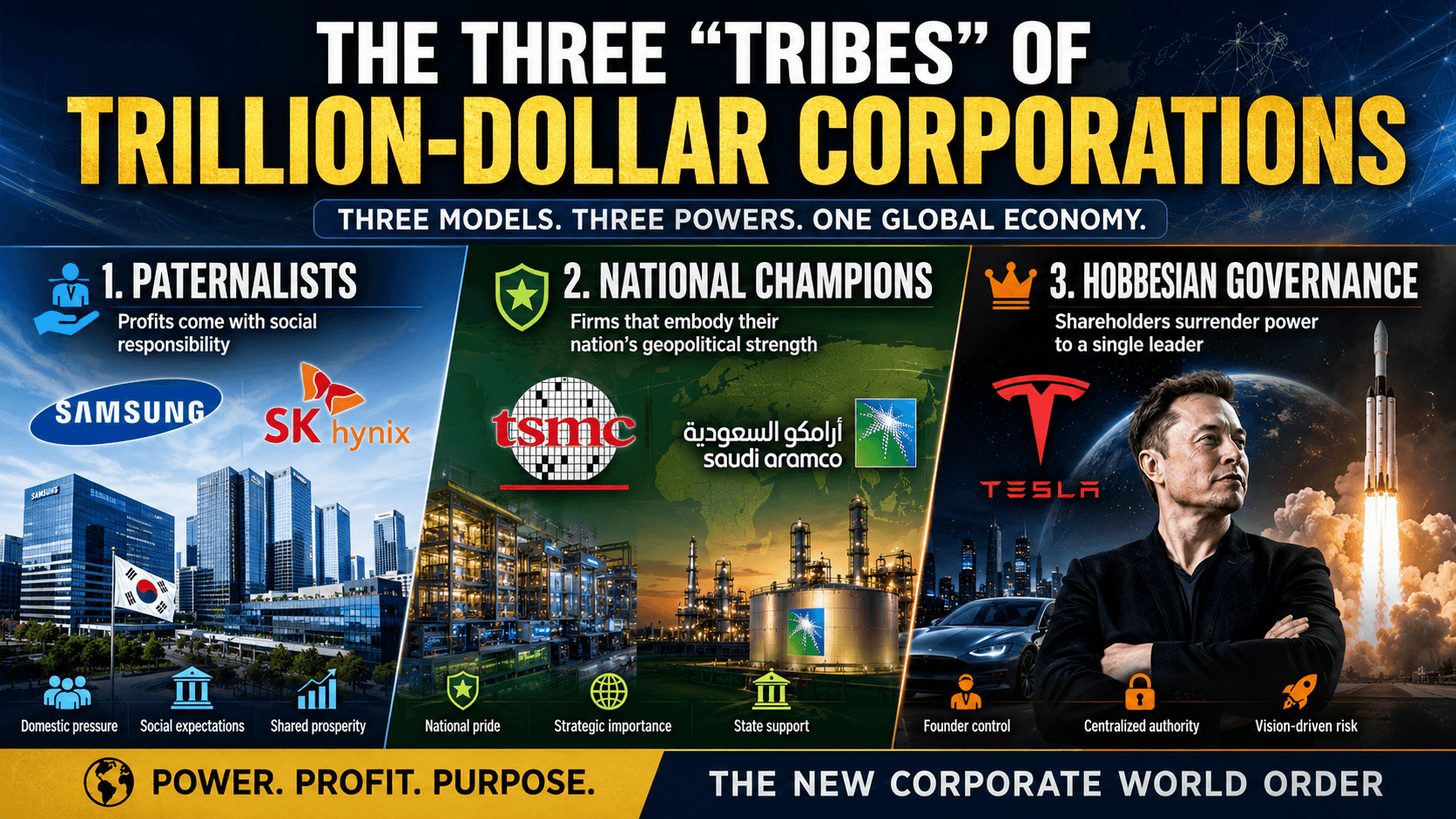
1. Paternalists: Profits Come with Social Responsibility
Some trillion-dollar companies operate under intense public expectations that their success should benefit society.
South Korean firms such as Samsung Electronics and SK Hynix are often viewed as Paternalists. Their enormous profits are closely watched by the public, labor unions, and policymakers, who expect these firms to create jobs, invest in domestic industries, improve wages, and support national innovation.
Unlike companies focused solely on maximizing shareholder returns, paternalist corporations face pressure to balance profitability with broader social obligations. Their business decisions often carry significant economic and political consequences at home.
2. National Champions: Companies That Represent Their Country
A second group consists of corporations whose success is deeply tied to their nation’s strategic interests.
Examples include TSMC of Taiwan and Saudi Aramco of Saudi Arabia.
TSMC manufactures most of the world’s advanced semiconductor chips, making it central to global technology supply chains and Taiwan’s geopolitical importance. Saudi Aramco, meanwhile, remains one of the world’s largest energy producers and a pillar of Saudi Arabia’s economy and international influence.
These firms are often called National Champions because they do far more than generate profits—they strengthen national security, technological leadership, exports, and diplomatic leverage. Governments frequently support such companies through industrial policies, infrastructure, research funding, or strategic partnerships.
3. Hobbesian Governance: Founder-Controlled Empires
The third tribe reflects a growing concentration of decision-making power within a single individual.
Companies such as Tesla and SpaceX, led by Elon Musk, are often cited as examples of Hobbesian Governance. The term draws inspiration from philosopher Thomas Hobbes, who argued that stability often depends on a powerful sovereign authority.
In these companies, investors willingly surrender much of their influence to visionary founders, trusting them to make bold, long-term decisions. Rather than traditional corporate governance based on broad shareholder oversight, authority becomes highly centralized around a single leader. Recent scholarship has also explored Hobbesian ideas as a framework for understanding modern corporate authority.
Supporters argue this model enables rapid innovation and decisive leadership. Critics, however, warn that concentrating authority in one individual may reduce transparency, weaken accountability, and increase governance risks.
Why This Classification Matters
These three corporate models illustrate that trillion-dollar companies are no longer governed by a single formula. Their governance increasingly reflects the economic and political environments in which they operate.
- Paternalists balance shareholder returns with social expectations.
- National Champions advance national economic and geopolitical interests.
- Hobbesian firms prioritize founder-led vision and centralized authority.
The growing diversity of corporate governance reflects a broader shift in how businesses interact with governments, markets, and society. Scholars increasingly argue that modern corporations should be viewed not only as profit-making entities but also as institutions with significant political and social influence.
The Core Impact
As trillion-dollar corporations continue to expand their influence, they are reshaping global governance alongside governments. Their decisions increasingly affect technological innovation, supply-chain security, employment, national competitiveness, and even international relations. Understanding these three “tribes” offers valuable insight into how corporate power is evolving in the twenty-first century—and why the future of capitalism may depend as much on governance models as on financial performance.