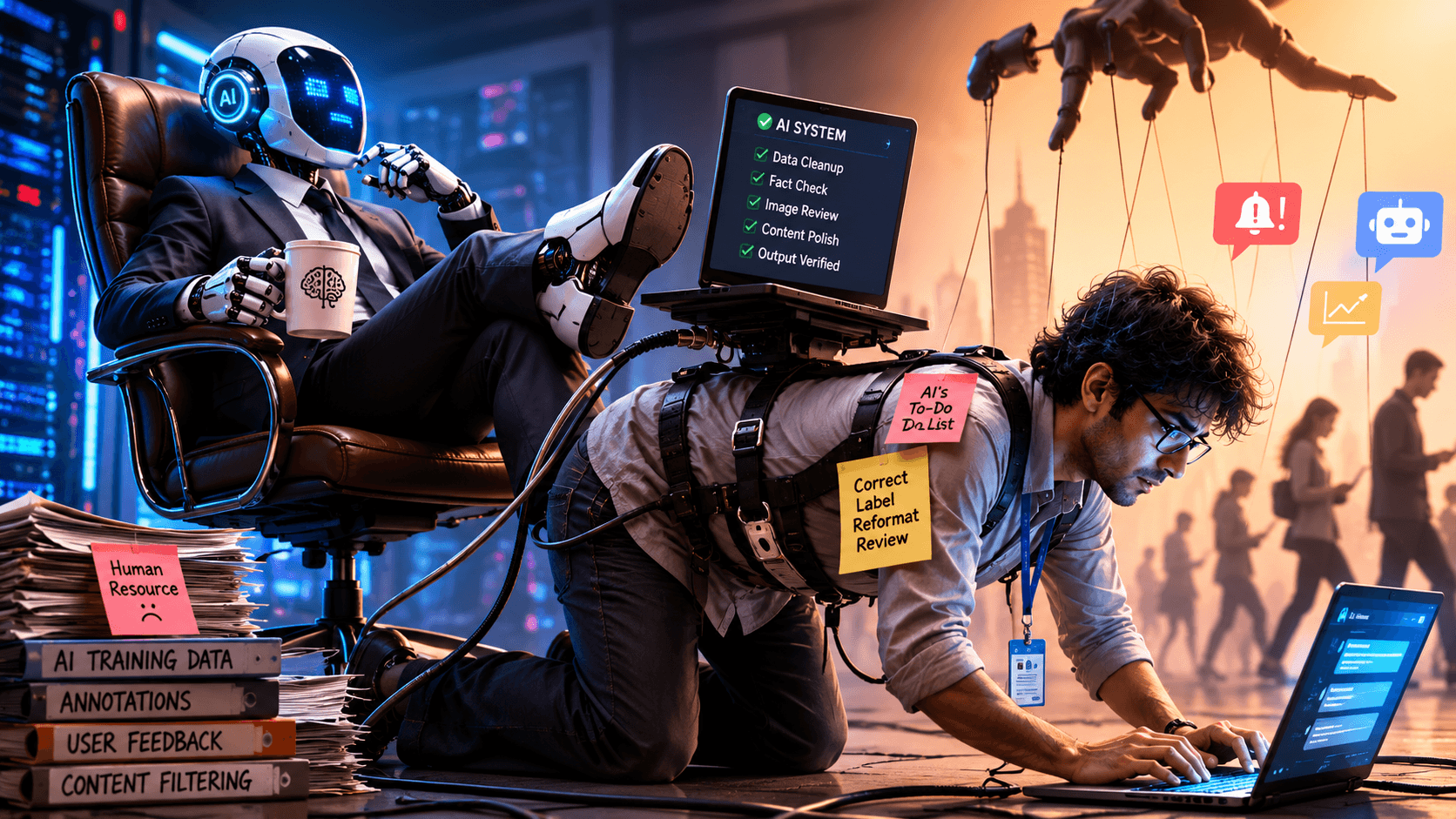
Artificial intelligence is often promoted as a tool that boosts human productivity. But a growing concept known as the Reverse Centaur suggests the opposite may be happening. Instead of AI serving people, humans are increasingly being forced to serve AI systems—following algorithmic instructions, correcting machine errors, and adapting their work to meet the needs of software.
Popularized by author Cory Doctorow in his 2026 book The Reverse Centaur’s Guide to Life After AI, the term has become a powerful metaphor for the changing relationship between humans and intelligent machines.
What Is a Reverse Centaur?
A Reverse Centaur describes a person who becomes an assistant to an AI system, rather than using AI as a tool.
The idea contrasts with the traditional Centaur model, where humans remain in control while AI enhances their abilities. In a Reverse Centaur, the relationship is reversed—the machine dictates the workflow, and the human functions as what Doctorow calls a “squishy meat appendage”, carrying out tasks the AI cannot perform on its own.
Centaur vs. Reverse Centaur
| Centaur | Reverse Centaur |
|---|---|
| AI assists humans | Humans assist AI |
| Human makes final decisions | AI increasingly directs decisions |
| Technology augments human skills | Humans adapt to machine requirements |
| Human judgment comes first | Algorithmic rules dominate workflows |
The distinction is not about whether AI is used, but who remains in control.
How Does It Work in Real Life?
The Reverse Centaur effect is already visible across many industries.
Examples include:
- Warehouse employees whose schedules and movements are dictated by AI software.
- Delivery drivers constantly monitored by routing algorithms and productivity scores.
- Customer support agents required to follow AI-generated responses.
- Data annotators spending hours correcting AI outputs and training future AI models.
- Office workers reformatting documents simply because AI tools require structured inputs.
In these situations, humans often spend more time serving AI systems than benefiting from them.
Why Are Experts Concerned?
Researchers warn that excessive dependence on AI could gradually reduce human autonomy and professional judgment.
Potential risks include:
- Declining critical thinking.
- Blind trust in AI recommendations.
- Loss of workplace creativity.
- Constant algorithmic surveillance.
- Reduced employee decision-making.
- Increased workplace stress from machine-generated performance targets.
Instead of empowering workers, poorly designed AI systems may simply automate management and intensify monitoring.
The Economics Behind Reverse Centaurs
Critics argue that the trend is driven as much by economics as by technology.
Many companies adopt AI primarily to reduce labor costs, increase productivity, and satisfy investors. In this model, AI is not always introduced to help employees—it is deployed to standardize work, automate supervision, and replace or tightly control human decision-making.
Doctorow argues this reflects a broader pattern in digital platforms, where maximizing efficiency and shareholder value often takes priority over improving the user or worker experience.
Can AI Avoid Creating Reverse Centaurs?
Not all AI leads to human subordination.
When designed responsibly, AI can:
- Automate repetitive work.
- Improve medical diagnosis.
- Assist scientific research.
- Enhance creativity.
- Help workers make faster and better decisions.
The challenge is ensuring AI remains a tool under human supervision, rather than becoming the system humans are expected to obey.
Why It Matters
As AI becomes embedded in workplaces, governments, healthcare, and education, the central question is no longer whether AI will replace jobs. It is whether humans will retain agency, judgment, and control over increasingly intelligent systems.
The concept of the Reverse Centaur serves as a warning that the future of AI should not be measured only by efficiency or automation. The real goal should be to build technologies that augment human intelligence, preserve human dignity, and keep people—not algorithms—at the center of decision-making.
Key Takeaway
The Reverse Centaur is one of the most important emerging ideas in the AI era. It reminds us that the success of artificial intelligence should be judged not by how many human tasks it controls, but by how effectively it empowers people to think, create, and make better decisions.