Do visit: Generation Year Calculator
When was Gen Z born? Am I a Millennial or Gen Z? What generation comes after Generation Alpha?
These are common questions as generational labels increasingly appear in discussions about technology, education, employment, consumer behaviour and popular culture.
Each generation grows up during a different period of social, economic and technological change. From the post-World War II Baby Boomers to children growing up with artificial intelligence, these experiences help explain how society evolves.
Here is a complete guide to generation names, birth years and their defining characteristics, including the latest Generation Beta cohort.
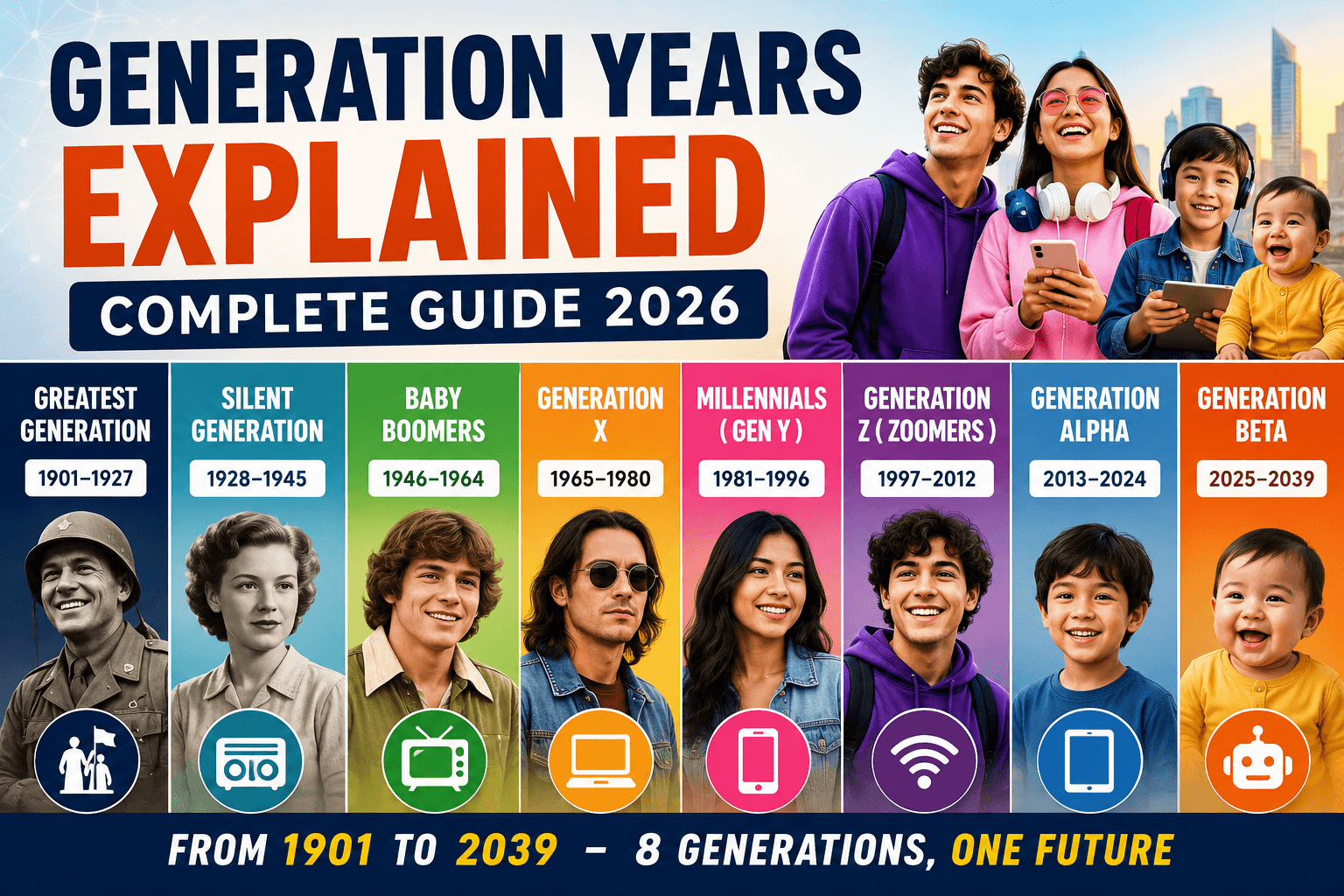
Generational Timeline: All Generations and Birth Years
The following timeline presents commonly used birth-year ranges. Some dates, particularly for Generation Alpha and Generation Beta, differ across demographic researchers.
| Generation | Birth Years | Also Known As |
|---|---|---|
| Greatest Generation | 1901–1927 | GI Generation |
| Silent Generation | 1928–1945 | Traditionalists |
| Baby Boomers | 1946–1964 | Boomers |
| Generation X | 1965–1980 | Gen X |
| Millennials | 1981–1996 | Generation Y |
| Generation Z | 1997–2012 | Gen Z, Zoomers |
| Generation Alpha | Around 2010/2013–2024 | Gen Alpha |
| Generation Beta | 2025–2039 | Gen Beta |
Note: These are commonly cited demographic classifications, not official or universally agreed birth-year boundaries. The Alpha starting year is particularly disputed. McCrindle, which introduced the Alpha and Beta naming framework, defines Alpha as 2010–2024 and Beta as 2025–2039.
When Was Gen Z Born? (1997–2012)
Generation Z, commonly called Gen Z or Zoomers, includes people born between 1997 and 2012 under the widely used Pew Research Center classification.
In November 2026, Gen Z members are approximately 13 to 29 years old, depending on their birthdays.
Unlike Millennials, who experienced the transition from traditional media to digital technology, Gen Z grew up in an environment where smartphones, social media, online entertainment and high-speed internet were already becoming part of everyday life.
Key Characteristics of Generation Z
- Digital-first lifestyles and communication.
- Early exposure to smartphones and social media.
- Growing familiarity with artificial intelligence tools.
- Interest in flexible working arrangements and digital careers.
- Greater visibility of conversations around mental health and climate change.
- Participation in online communities and the creator economy.
However, these are broad cultural trends rather than characteristics shared by every Gen Z individual.
Who Are Millennials (Generation Y)?
Millennials, also known as Generation Y, were born between 1981 and 1996.
They experienced one of the biggest technological transitions in modern history: the shift from landline telephones, desktop computers and physical media to smartphones, social networks and cloud-based services.
Many Millennials remember a childhood before widespread internet access but entered adulthood during the rapid expansion of digital technology.
Today, they occupy significant positions in the global workforce, business, government and entrepreneurship.
What Is Generation Alpha? (Around 2010–2024)
Generation Alpha refers to children born during the early decades of the 21st century.
According to McCrindle’s classification, Generation Alpha includes those born between 2010 and 2024. Other commonly circulated timelines place its starting year in 2013.
This generation is growing up with touchscreen devices, streaming platforms, artificial intelligence, smart assistants and increasingly digital education systems.
The COVID-19 pandemic also influenced the childhood experiences of many members of this generation, particularly through remote learning and changes in social interaction.
What Is Generation Beta? (2025–2039)
Generation Beta is the newest generational category, beginning with children born in 2025.
McCrindle defines Generation Beta as people born between 2025 and 2039.
Unlike previous generations, Gen Beta is expected to experience artificial intelligence, robotics, autonomous transportation and advanced digital systems from early childhood.
AI-powered education, personalised healthcare and smart infrastructure could become ordinary parts of their lives.
However, these are projections rather than established characteristics. The technologies and social conditions that will ultimately shape Generation Beta remain uncertain.
What Are the Greatest Generation, Silent Generation and Baby Boomers?
Before Millennials and Gen Z, several generations experienced major historical transformations.
Greatest Generation (1901–1927)
Also known as the GI Generation, this group experienced the Great Depression and World War II. Many members served in the military or contributed to wartime industries and post-war reconstruction.
Silent Generation (1928–1945)
Born during the Great Depression and World War II, this generation grew up during periods of economic uncertainty and significant social change. The name is commonly associated with its reputation for traditional values and institutional stability.
Baby Boomers (1946–1964)
Baby Boomers were born during the significant increase in birth rates following World War II. They witnessed the expansion of television, major civil rights movements, economic growth and the emergence of modern consumer culture.
Generation X (1965–1980)
Gen X grew up during the expansion of personal computers, cable television and early video games. Its members experienced the transition from an analogue childhood to an increasingly digital adulthood.
Why Do Generational Birth Years Matter?
Generational classifications help researchers understand how people experience historical events, technological developments and economic conditions at different stages of life.
Businesses use these categories to study consumer preferences, while employers examine changing workplace expectations. Governments and policymakers may also consider generational differences when evaluating education, housing, employment and retirement trends.
However, a generation should not be treated as a fixed personality type. Two people born in the same year can have very different experiences depending on their country, economic circumstances, education and family background.
Pew Research Center has also emphasised that generational boundaries are not an exact science. They are analytical tools rather than rigid scientific divisions.
Frequently Asked Questions About Generations
1. When was Gen Z born?
Gen Z generally includes people born between 1997 and 2012.
2. What generation am I if I was born in 2000?
You belong to Generation Z.
3. What generation am I if I was born in 1995?
You are generally classified as a Millennial (Generation Y), under the 1981–1996 classification.
4. What generation comes after Gen Z?
Generation Alpha is generally considered the generation following Gen Z, although its starting birth year varies across classification systems.
5. What generation comes after Gen Alpha?
Generation Beta follows Generation Alpha. Its proposed birth-year range is 2025–2039.
6. How old is Gen Z in 2026?
People born between 1997 and 2012 are approximately 13–29 years old in November 2026.
7. What is the difference between Millennials and Gen Z?
Millennials experienced the transition from an offline to a digital world, while Gen Z grew up with smartphones, social media and internet-connected technology already widely available.
8. What is the newest generation in 2026?
Generation Beta is the newest named generational cohort, covering children born from 2025 onwards under the McCrindle classification.
Final Thoughts
From the Greatest Generation to Generation Beta, every age group has experienced a different combination of historical events, technological developments and social changes.
Understanding these generational timelines provides a useful starting point for exploring how society, culture and technology evolve. But birth years alone cannot define an individual’s personality, beliefs or behaviour.