
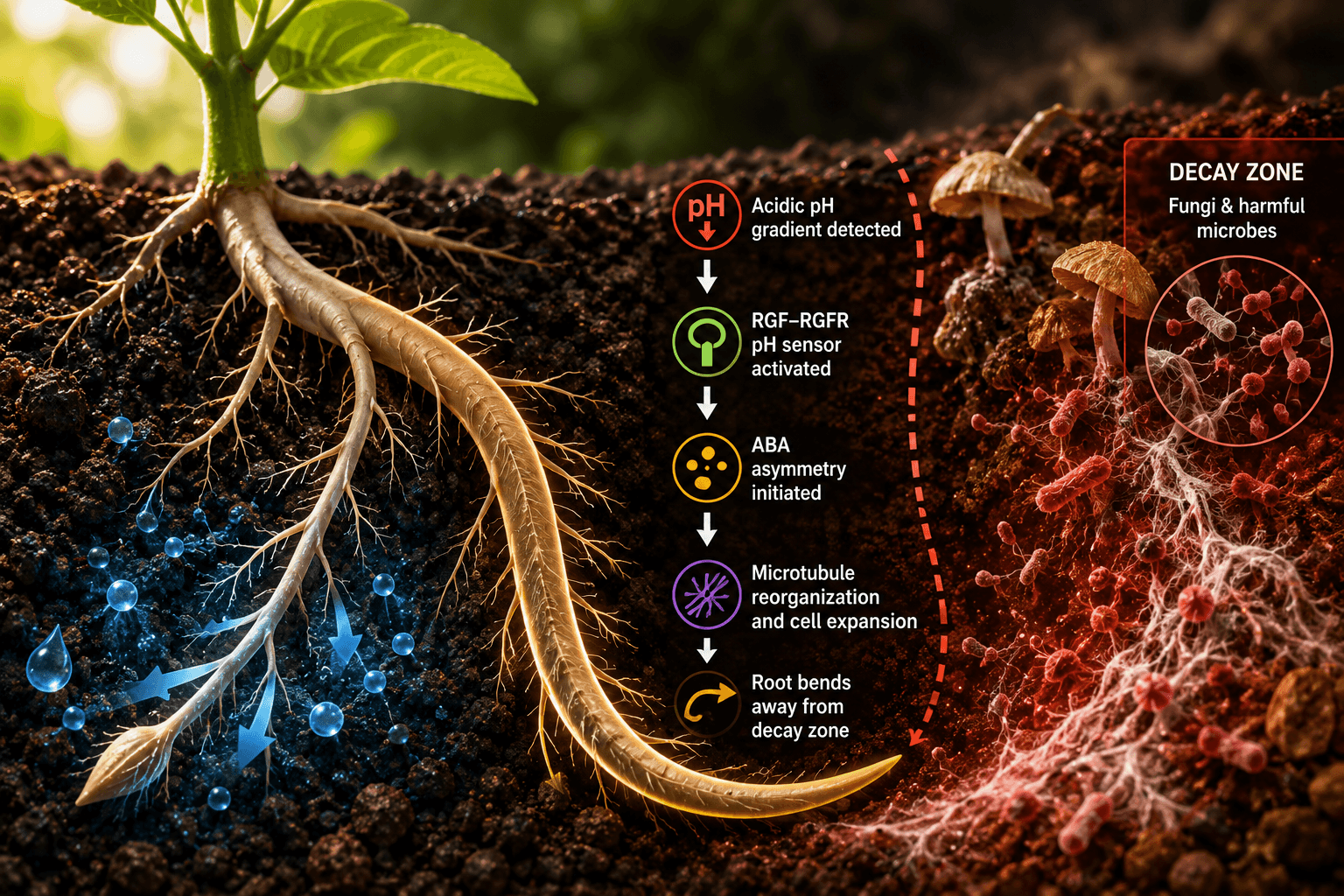
Plants may appear motionless, but beneath the soil they constantly make critical survival decisions. In a landmark study published in Science (2026), researchers identified a previously unknown plant behavior called Saprotropism—the remarkable ability of roots to detect underground decay and actively grow away from it before harmful microbes can attack.
The discovery reveals that plant roots are far more intelligent than previously believed, using chemical signals in the soil to avoid dangerous environments.
What Is Saprotropism?
Saprotropism is a newly discovered plant tropism in which roots bend away from decaying plant material to escape hostile microbial zones.
Unlike familiar tropisms such as phototropism (growth toward light) or gravitropism (growth in response to gravity), saprotropism is triggered by microbial activity beneath the soil, making it the first known tropism driven by underground decomposition.
Why Do Roots Avoid Decaying Plants?
Dead leaves, roots, and fallen fruits are broken down by fungi and microbes, helping recycle nutrients into the soil. However, these decomposition zones also become hotspots for pathogens capable of infecting living roots.
Researchers found that when roots came into direct contact with decaying plant material, their growth slowed dramatically, immune responses were activated, and overall plant health declined.
Instead of entering these dangerous zones, roots change direction long before physical contact occurs.
How Do Plant Roots Detect Danger?
The study found that fungi—not bacteria—play the key role.
As fungi decompose dead plant material, they release organic acids and phenolic acids that spread through the surrounding soil. These chemicals create stable acidic pH gradients, forming an invisible warning signal.
Plant roots continuously monitor these pH changes and use them as a natural navigation system to identify risky environments.
Interestingly, researchers observed that roots responded strongly to decaying plant matter but showed little or no avoidance toward animal-derived decay, which failed to produce the same acidic soil conditions.
The Hidden Molecular Navigation System
Scientists also uncovered the biological mechanism behind saprotropism.
Root epidermal cells contain a specialized RGF–RGFR (Root Meristem Growth Factor–Receptor) sensing system that detects acidic soil.
Once activated:
- The sensor recognizes uneven soil acidity.
- It creates an asymmetric distribution of the plant hormone Abscisic Acid (ABA).
- ABA reorganizes tiny structural fibers called microtubules.
- Root cells expand unevenly, causing the root tip to twist and bend away from the decay zone.
Unlike many other plant tropisms that rely mainly on the hormone auxin, saprotropism is primarily controlled by ABA, making it a unique biological pathway.
A New Type of Plant Intelligence
For more than a century, scientists recognized several plant tropisms:
- Phototropism – response to light
- Gravitropism – response to gravity
- Hydrotropism – growth toward water
- Thigmotropism – response to touch
- Halotropism – avoidance of high salt
- Saprotropism – avoidance of microbial decay
The discovery expands the scientific understanding of how plants actively interpret their surroundings instead of simply reacting to physical conditions.
Why Saprotropism Matters
Saprotropism reveals a previously unknown form of plant–microbe–soil communication. By sensing chemical signals released during fungal decomposition, roots can avoid infection before it begins.
The discovery could help scientists develop crops with stronger natural resistance to soil-borne diseases, reduce dependence on fungicides, improve root health, and boost agricultural productivity. It also opens a new frontier in plant biology by showing that roots possess sophisticated underground navigation systems shaped by millions of years of evolution.
Key Takeaway
Saprotropism demonstrates that plant roots do far more than absorb water and nutrients. They continuously monitor underground chemical landscapes, detect hidden microbial threats, and intelligently reroute their growth to maximize survival—making this one of the most significant plant biology discoveries in recent years.