South Korea has unveiled an ambitious long-term technology strategy called the “Seven Major SEED” initiative, aiming to build new engines of economic growth beyond its traditional strengths in semiconductors and artificial intelligence.
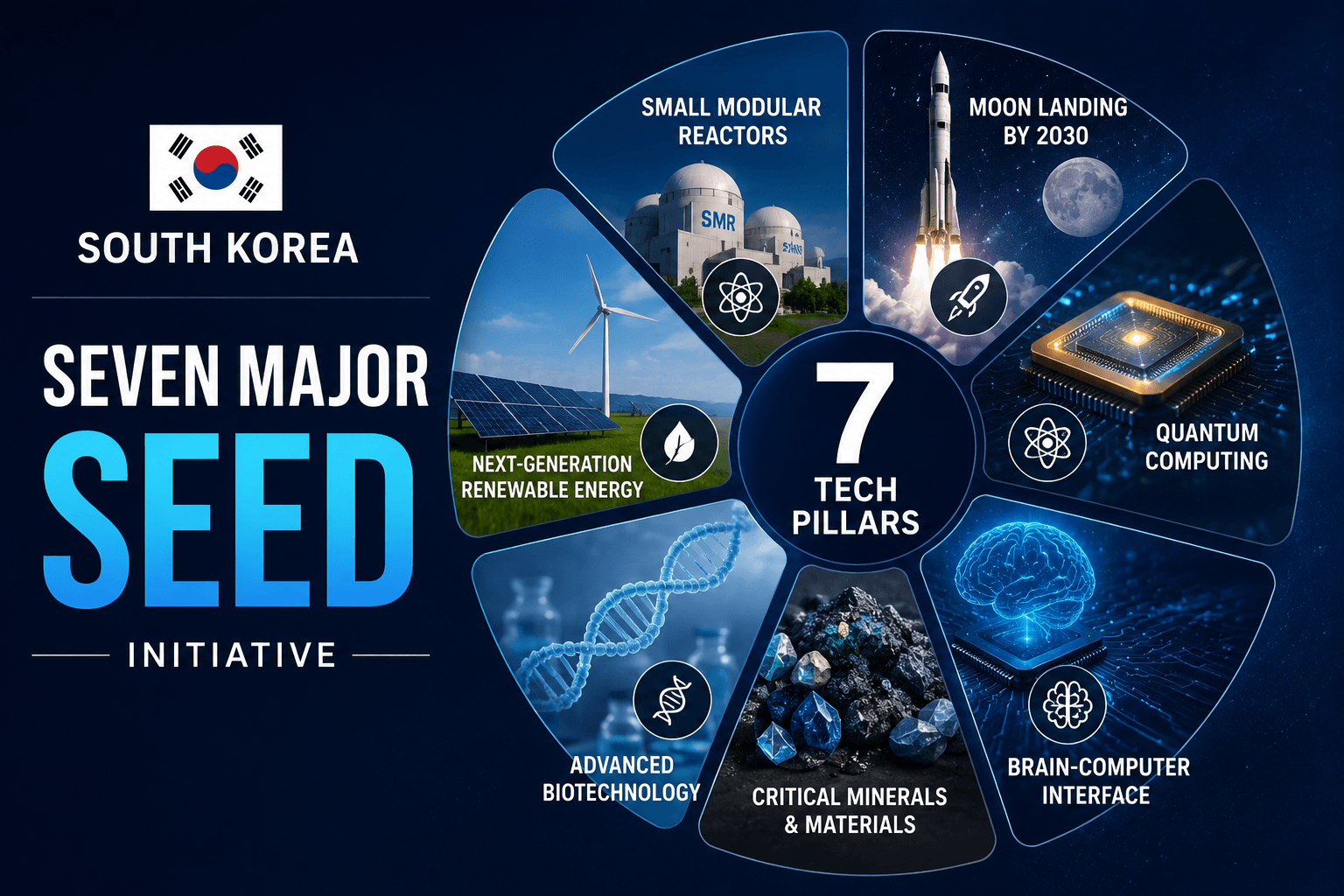
Announced at a Blue House meeting chaired by President Lee Jae Myung, the initiative focuses on seven strategic technology areas: small modular reactors (SMRs), fusion energy, next-generation renewable energy, quantum technology, space and aviation, advanced biotechnology, and critical minerals and materials supply chains.
Key Targets Under Seven Major SEED
The roadmap sets several high-profile deadlines:
- Moon landing by 2030
- Domestic 100-qubit quantum computer by 2029
- Commercial deployment of indigenous SMRs by 2035
- Commercialisation of brain-computer interface (BCI) products by 2035
The initiative reflects a wider global race in technologies increasingly viewed as essential not only for economic competitiveness but also for energy security, national security and technological sovereignty.
From Semiconductors to New Strategic Technologies
South Korea is already a major global force in memory chips, electronics and advanced manufacturing. But policymakers are now looking beyond semiconductors as slowing long-term growth and intensifying competition reshape the global technology landscape.
The Seven Major SEED strategy is designed to plant capabilities today that could become dominant industries over the next 10 to 20 years.
Space is among its boldest ambitions. A successful moon landing by 2030 would place South Korea among a small group of nations with advanced independent lunar capabilities. Meanwhile, investment in quantum computing could strengthen the country’s future capabilities in cryptography, scientific research and advanced industrial computing.
Energy is another major pillar. South Korea plans to develop indigenous small modular reactor technology, while also pursuing fusion and next-generation renewable energy. The focus on SMRs comes as countries worldwide search for reliable low-carbon electricity sources capable of supporting increasingly energy-hungry industries, including AI data centres.
Why Critical Minerals Matter
The inclusion of critical minerals and materials highlights another major geopolitical challenge: control over the supply chains needed for batteries, semiconductors, renewable energy systems and defence technologies.
As competition for minerals such as lithium, cobalt, rare earths and other strategic materials intensifies, countries are increasingly seeking secure and diversified supply chains. South Korea’s strategy aims to strengthen its position across these future industrial ecosystems rather than relying heavily on external sources.
Science Minister Bae Kyung-hoon described the programme as an effort to nurture technologies that could make South Korea difficult to rival in the coming decades.
The message behind the initiative is clear: the next technology race will not be won by AI chips alone. Countries are now competing simultaneously in quantum computing, clean energy, biotechnology, space and critical resources.
For South Korea, the “Seven Major SEED” initiative is a long-term bet that today’s research projects could become tomorrow’s strategic industries—and perhaps reshape the country’s technological position by the 2030s.