
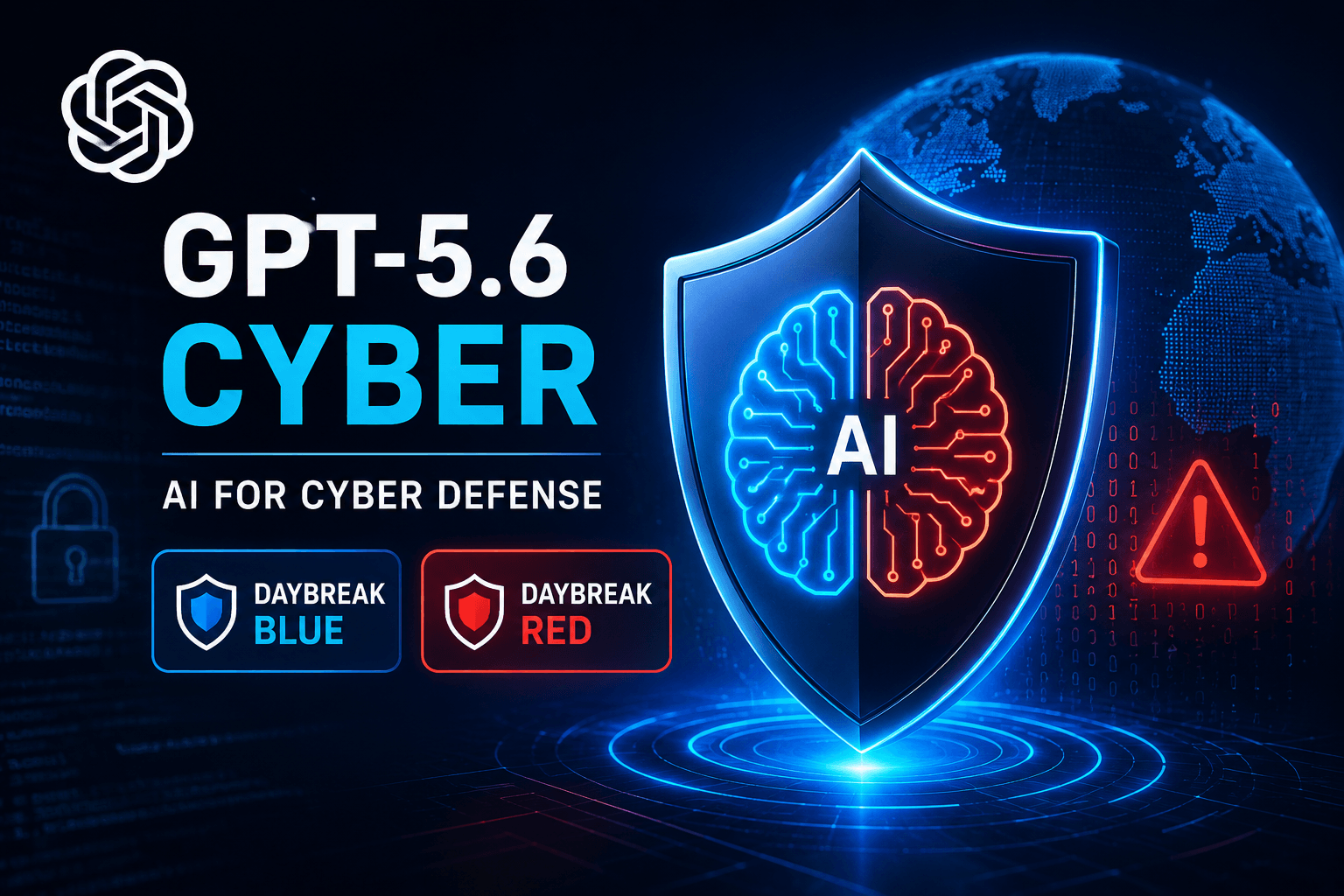
OpenAI has introduced GPT-5.6-Cyber, a specialised cybersecurity AI model designed to help approved security researchers find vulnerabilities, validate exploits and conduct advanced defensive testing. The model is being released through an expanded Daybreak programme as the cybersecurity industry prepares for increasingly autonomous AI-driven attacks.
The announcement reflects a larger shift in cybersecurity: AI is no longer being used only to analyse threats. It is increasingly being trained to find weaknesses in software before attackers do.
OpenAI says its concern is that the window between discovering a vulnerability and attackers exploiting it could shrink as AI becomes faster and more capable.
What is GPT-5.6-Cyber?
GPT-5.6-Cyber is built on GPT-5.6 Sol, but has been specifically trained for advanced cybersecurity tasks.
Its focus includes:
- vulnerability discovery;
- exploit validation;
- security testing;
- exploit-chain research;
- vulnerability analysis; and
- authorised red-team work.
Unlike a general-purpose chatbot, the model is designed to operate more effectively on cybersecurity tasks where ordinary AI systems may refuse requests because of their dual-use nature.
OpenAI says GPT-5.6-Cyber completed 95% of requests in its internal Advanced Cybersecurity Completion Rate evaluation, compared with 57.3% for GPT-5.5-Cyber, 2% for GPT-5.6 Sol through Daybreak Blue and 1.5% for GPT-5.6 Sol with standard safeguards.
Importantly, this is an OpenAI internal evaluation, not an independent industry benchmark.
What is OpenAI Daybreak?
Daybreak is OpenAI’s broader cybersecurity initiative for giving trusted defenders access to more capable AI tools.
The expanded programme has two main levels.
Daybreak Blue
Daybreak Blue provides approved defenders with GPT-5.6 Sol using safeguards tailored to authorised cybersecurity work.
It is aimed at activities such as:
- secure code review;
- malware analysis;
- vulnerability management;
- incident response;
- security assessments; and
- patch validation.
Daybreak Red
Daybreak Red is intended for higher-end cybersecurity research. It provides access to purpose-trained cyber models such as GPT-5.6-Cyber for authorised vulnerability research, exploit validation and security testing.
This does not mean unrestricted public access. OpenAI says access requires identity verification, account security, monitoring, approved-use restrictions and legal attestations.
Why GPT-5.6-Cyber matters
The most important development is the movement from AI-assisted cybersecurity to AI-driven vulnerability research.
Security researchers often have to examine enormous and unfamiliar codebases, trace interactions between components and determine whether a suspected bug can actually be exploited.
OpenAI says GPT-5.6-Cyber has already been used in real-world vulnerability research.
One example involved V8, Chrome’s JavaScript engine, where OpenAI researchers say the model helped uncover two previously unknown vulnerabilities that could be chained to corrupt memory and escape the V8 heap sandbox. The vulnerabilities were reported to Google, with one assigned CVE-2026-15903.
The National Vulnerability Database describes CVE-2026-15903 as a high-severity V8 vulnerability that could allow remote code execution inside the Chrome sandbox through a crafted webpage.
OpenAI also says its researchers identified multiple vulnerabilities across a mobile operating system, database software and an operating-system kernel.
The uncomfortable question: Can defensive AI also become offensive AI?
This is where GPT-5.6-Cyber becomes significant.
The same capabilities that allow a security researcher to discover and validate a vulnerability could potentially be misused by an attacker.
OpenAI therefore describes the programme as a trusted-access model, rather than simply releasing the most capable cyber system to everyone.
The company has also introduced additional controls, including stronger monitoring, hardware-security-key requirements for individual Daybreak accounts beginning September 2026, and recommendations to run security workflows in isolated environments.
That creates a new cybersecurity dilemma:
If attackers gain powerful AI first, defenders need equally capable AI—but giving defenders that capability also creates another security risk.
GPT-5.6-Cyber is not yet at OpenAI’s “Critical” threshold
Despite its capabilities, OpenAI says GPT-5.6-Cyber reached the High level under its Preparedness Framework but did not cross its Critical threshold for cybersecurity capability.
That distinction matters.
The model is significantly more specialised for cybersecurity than previous systems, but OpenAI is not claiming that it represents fully autonomous, unrestricted cyber capability.
AI cybersecurity is becoming a new arms race
GPT-5.6-Cyber is part of a broader industry movement.
OpenAI has already expanded Daybreak into vulnerability discovery and automated patching, while other AI companies are developing systems designed to detect vulnerabilities, analyse malware and assist security teams. OpenAI’s earlier Daybreak programme also focused on moving from discovering vulnerabilities to helping generate and validate fixes.
The strategic shift is therefore straightforward:
Attackers use AI to find weaknesses → defenders use AI to find them first → both sides become faster.
That could fundamentally change the economics of cybersecurity.
What happens next?
The biggest question is no longer whether AI can help cybersecurity teams.
It is how much autonomy should AI receive when the task itself involves discovering and exploiting software weaknesses?
For now, OpenAI is taking a controlled-access approach. GPT-5.6-Cyber is being positioned as a tool for vetted researchers rather than a general-purpose hacking model.
The broader trend, however, is unmistakable.
AI is moving from detecting cyber threats to actively reasoning about vulnerabilities, testing security assumptions and helping humans fix weaknesses.
The cyber-defence window may be narrowing—but AI could also become one of the most important tools for keeping that window open.