
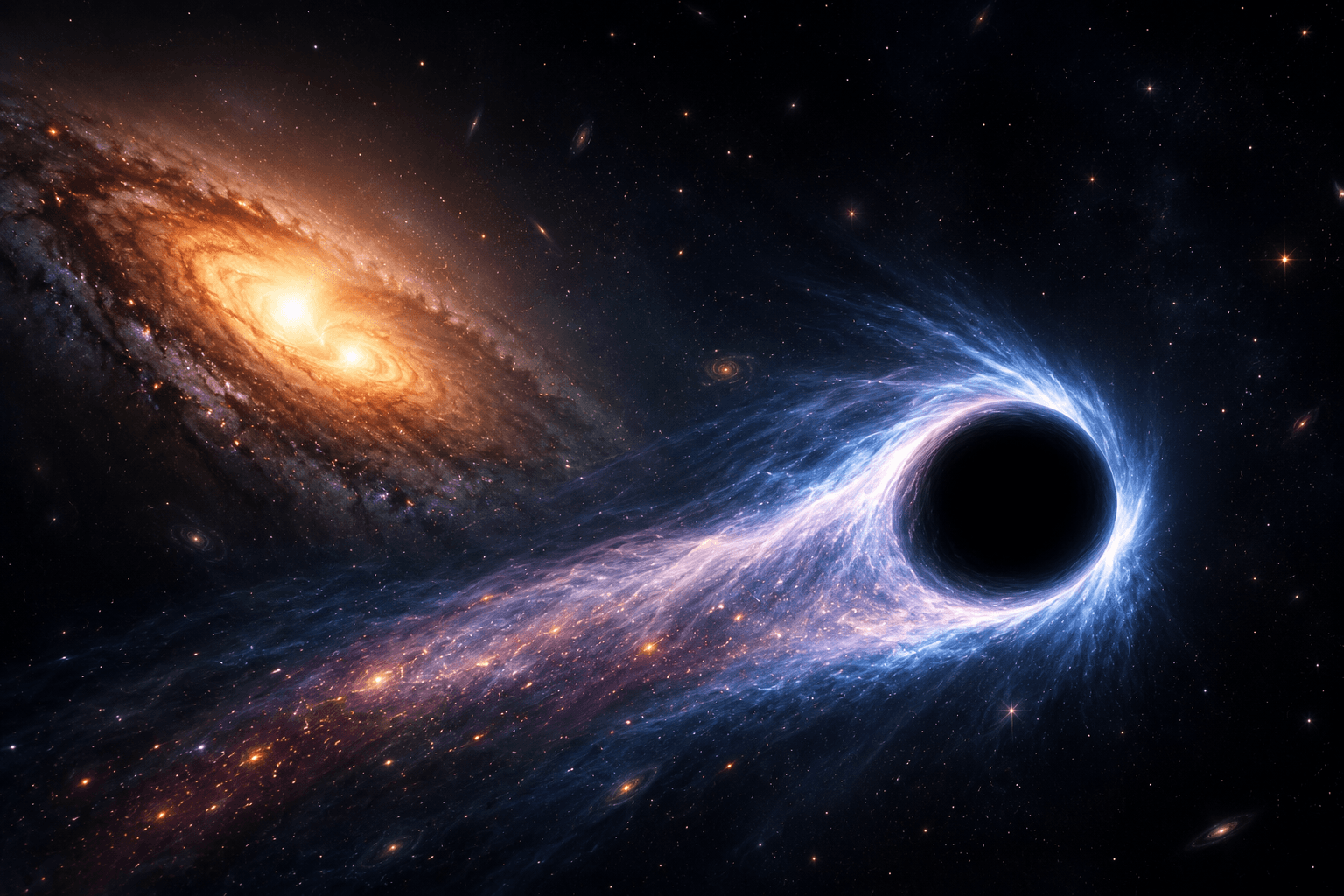
Astronomers have uncovered one of the most extraordinary cosmic objects ever observed—RBH-1, a runaway supermassive black hole racing through intergalactic space at nearly 1,000 km/s. Unlike most supermassive black holes, which sit quietly at the centers of galaxies, RBH-1 appears to have been violently ejected from its home. New research suggests this cosmic escape can reveal the hidden history of an ancient collision between two giant black holes.
What is RBH-1?
RBH-1 is a supermassive black hole (SMBH) containing millions or billions of times the Sun’s mass. It was identified using observations from the James Webb Space Telescope (JWST) and the Hubble Space Telescope (HST) after astronomers noticed a massive object speeding away from its host galaxy.
The black hole is believed to have been traveling for around 70 million years, leaving behind a trail of stars and gas as it moves through space.
Why Is It Running Away?
According to a new study published in Physical Review Letters, RBH-1 was likely launched during one of the most energetic events in the universe—a merger of two supermassive black holes.
When galaxies collide, their central black holes eventually spiral toward each other and merge. During the final moments, the system emits enormous amounts of gravitational waves, predicted by Albert Einstein’s General Theory of Relativity.
If these gravitational waves are emitted unevenly in different directions, they produce a powerful gravitational-wave recoil, often called a “kick.”
In rare cases, this kick is so strong that it ejects the newly formed black hole from the galaxy altogether.
Researchers estimate such kicks can reach 5,000 km/s, while RBH-1 currently travels at nearly 1,000 km/s.
Reconstructing a 70-Million-Year-Old Cosmic Crime Scene
Instead of simply observing RBH-1, researchers treated it like a forensic investigation.
Using millions of computer simulations based on Einstein’s equations and numerical relativity, they worked backward to determine what kind of merger could have produced such a fast-moving black hole.
Their findings suggest:
- The two original black holes likely had a mass ratio smaller than 6:1.
- The larger black hole was spinning extremely rapidly.
- The binary system probably exhibited precession, meaning its orbital axis changed direction before the merger.
- The violent merger produced the gravitational-wave kick that expelled RBH-1 from its galaxy.
This is one of the first times astronomers have successfully reconstructed the likely properties of an ancient black hole merger using a runaway black hole.
Why This Discovery Matters
RBH-1 is important because it provides direct evidence for one of Einstein’s most fascinating predictions.
It also opens a completely new way to study events that happened tens of millions of years ago, even when the original galaxies have long since evolved.
Instead of observing the merger directly, scientists can now “rewind the cosmic clock” by analyzing the runaway black hole left behind.
A New Tool for Gravitational-Wave Astronomy
The study arrives at an exciting time for astronomy.
NASA and ESA’s LISA (Laser Interferometer Space Antenna) mission, planned for the 2030s, will detect low-frequency gravitational waves produced by merging supermassive black holes across the universe.
Discoveries like RBH-1 will complement LISA’s observations by linking gravitational-wave signals with visible astronomical evidence.
Future observatories—including the Nancy Grace Roman Space Telescope, JWST, and next-generation ground-based telescopes—are expected to discover many more recoiling black holes.
Why Supermassive Black Holes Matter
Supermassive black holes are central to galaxy evolution. Their gravity influences star formation, galactic structure, and even the distribution of gas over billions of years.
Understanding how these giants merge helps scientists answer fundamental questions about:
- How galaxies grow over cosmic time.
- How gravitational waves shape the universe.
- How extreme physics predicted by Einstein operates in reality.
Conclusion
RBH-1 is more than a runaway black hole—it is a cosmic messenger from an ancient galactic collision. By decoding its speed, motion, and properties, astronomers have reconstructed a dramatic event that occurred roughly 70 million years ago.
As new space telescopes and gravitational-wave observatories come online, RBH-1 may become the first member of an entirely new class of objects that allow scientists to investigate the hidden history of galaxy mergers. In doing so, this remarkable black hole is helping transform gravitational-wave astronomy from simply detecting cosmic events into reconstructing the universe’s forgotten past.