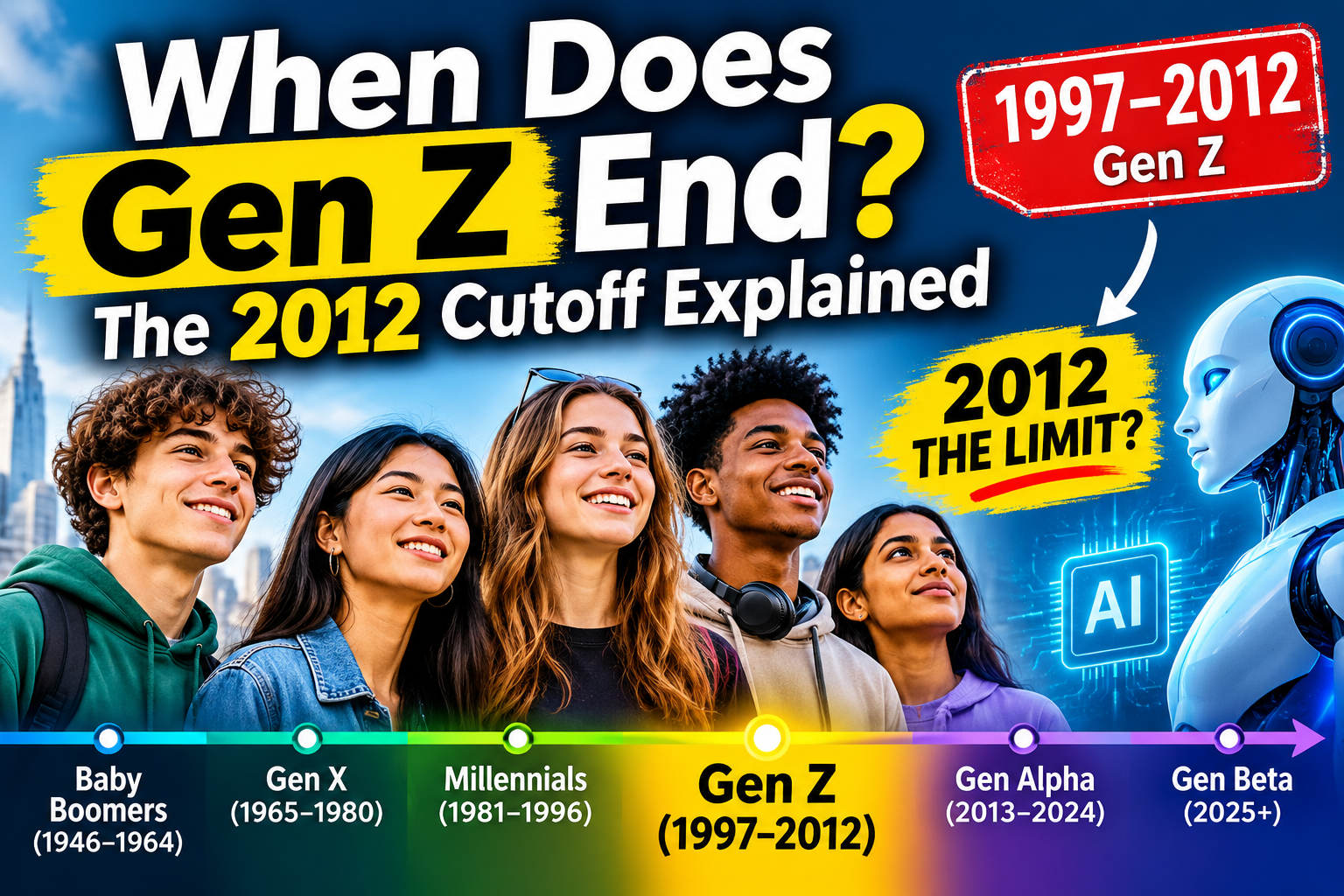
Generation Z generally ends with people born in 2012. According to the widely used demographic classification, Gen Z includes individuals born between 1997 and 2012. Those born from 2013 onward are generally classified as Generation Alpha.
In 2026, Gen Z members are approximately 13 to 29 years old, depending on their birthdays. However, generational boundaries are conventions rather than scientifically fixed definitions, and some researchers use slightly different birth-year ranges.
Gen Z Birth Years: A Generational Breakdown
Here is how the commonly recognized generations are classified:
| Generation | Birth Years |
|---|---|
| Baby Boomers | 1946–1964 |
| Generation X | 1965–1980 |
| Millennials | 1981–1996 |
| Generation Z | 1997–2012 |
| Generation Alpha | 2013–2024 (approx.) |
| Generation Beta | 2025 onward (proposed) |
The 1997 starting point is associated with Pew Research Center’s generational framework. The 2012 endpoint is widely adopted in subsequent demographic classifications, although it is not a scientifically definitive boundary established by Pew.
Why Does Gen Z End in 2012?
The 1997–2012 classification creates an approximately 16-year generational span, similar to the commonly used Millennial range of 1981–1996.
However, generational identities are shaped by shared historical experiences, technology and cultural developments, not simply birth dates.
People born around 1995–1998 are sometimes called Zillennials, reflecting their connection to both Millennials and Gen Z. Similarly, those born between 2010 and 2012 may share experiences with Generation Alpha.
What Makes Generation Z Different?
Gen Z is widely described as the first digital-native generation. Its members grew up during the expansion of smartphones, social media, online communities and instant communication.
Several characteristics distinguish their formative experiences:
- Digital culture: Social media, short-form videos, memes and online communities influence communication and entertainment.
- Economic uncertainty: Rising living costs, competitive employment markets and financial insecurity shape career expectations.
- Mental health awareness: Conversations about anxiety, emotional well-being and work-life balance have become more visible.
- Social awareness: Climate change, equality, diversity and institutional accountability are prominent public discussions.
- Technological adaptation: Artificial intelligence is increasingly influencing education, creativity and professional opportunities.
These are broad generational trends, not characteristics shared by every individual.
Why Is Gen Z Politically Active in 2026?
Gen Z’s growing political visibility is another defining development. Youth-led movements across countries, including Serbia, Nepal and India, have highlighted concerns about corruption, unemployment, education, economic inequality and political accountability.
Digital platforms help young people share information, organize campaigns and connect with wider movements.
However, each protest has its own political context and demands. Gen Z is not a single unified political group.
Gen Z vs. Generation Alpha: What’s the Difference?
The main distinction is their formative technological environment.
Gen Z experienced the expansion of smartphones, social media and digital communication. Generation Alpha has generally grown up with these technologies already integrated into everyday life, alongside greater exposure to artificial intelligence and digital learning tools.
Under the commonly used classification, 2012 belongs to Gen Z, while 2013 marks the beginning of Generation Alpha.
Frequently Asked Questions
1. What year does Gen Z end?
Gen Z generally ends in 2012.
2. Is 2012 Gen Z or Gen Alpha?
2012 is considered Gen Z under the commonly used 1997–2012 classification.
3. How old is Gen Z in 2026?
Gen Z members are approximately 13–29 years old in 2026.
4. Who comes after Gen Z?
Generation Alpha generally follows Gen Z, beginning in 2013.
5. What is Gen Z also called?
Gen Z is informally known as Zoomers.
Final Thoughts
Generation Z ends in 2012 under the most widely used demographic classification. However, its influence extends far beyond a birth-year range.
From digital transformation and changing workplace expectations to youth activism and artificial intelligence, Gen Z is helping shape the social, economic and technological landscape.
The 2012 cutoff defines where Gen Z ends demographically, but its influence on the future is only beginning.