
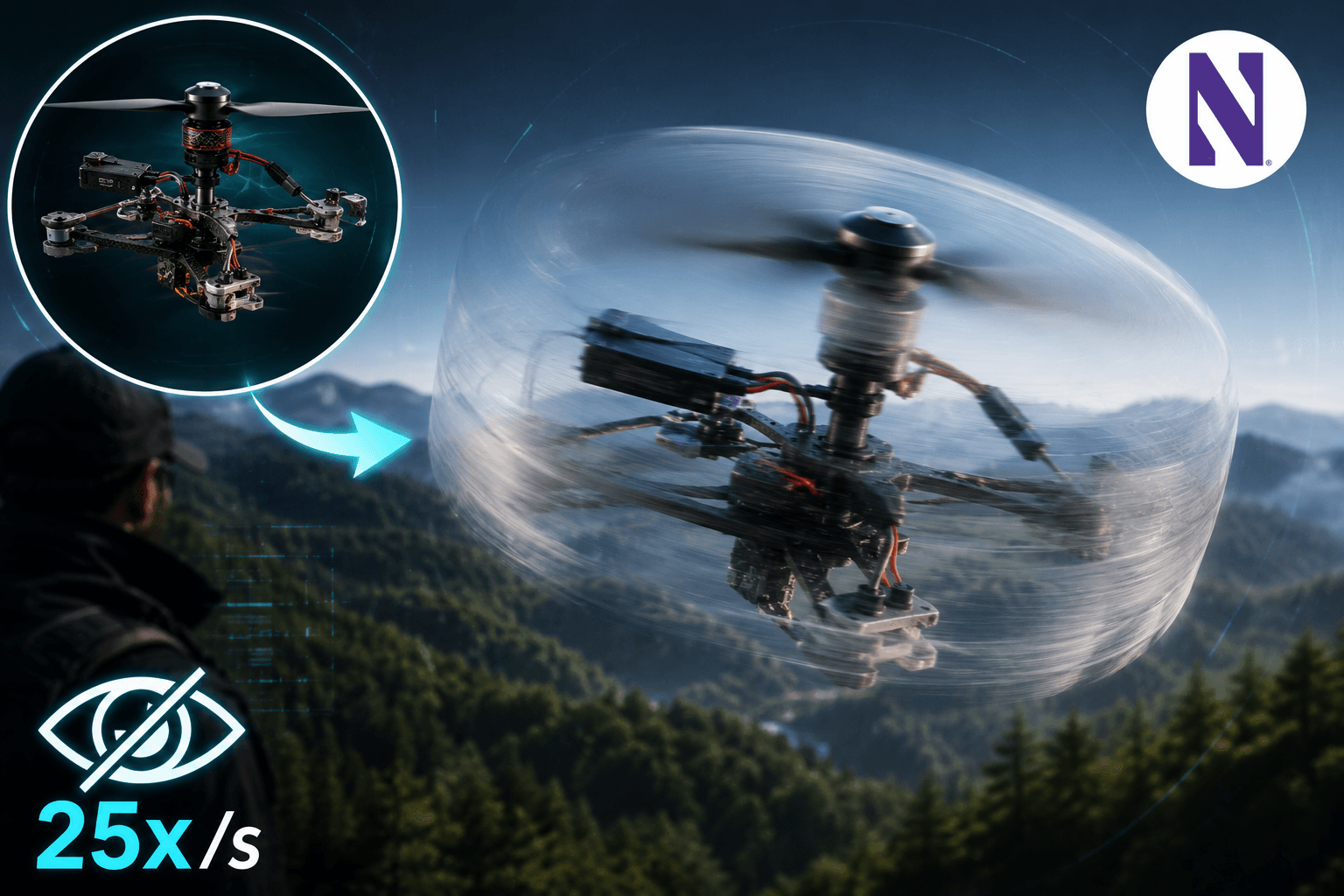
Invisibility has long been one of the biggest goals in military and surveillance technology. While most researchers focus on camouflage or advanced cloaking materials, engineers at Northwestern University have taken a completely different approach: make the drone spin so fast that the human eye can barely see it.
The result is Phantom Twist, an experimental drone that appears almost invisible—not by hiding, but by exploiting the limits of human vision.
How Does Phantom Twist Become “Invisible”?
Instead of blending into its surroundings, Phantom Twist relies on motion blur.
The drone rotates its entire body 15 to 25 times per second (up to 1,500 RPM). At these speeds, the brain averages the rapidly moving parts with the background, making the aircraft appear as little more than a faint blur.
Unlike conventional quadcopters, where the central body remains stationary while four propellers spin, Phantom Twist features:
- One propeller
- One motor
- Entire body rotates in the opposite direction
- Almost no stationary structure for the eye to focus on
The result is a drone that is around 10 times less visually noticeable than a conventional drone of similar size.
AI Helped Design the Drone
Developing such a unique aircraft required more than clever engineering.
Researchers used AI-driven optimization algorithms to generate nearly 20,000 possible drone layouts. The system evaluated the placement of batteries, motors, electronics, counterweights, and structural components to maximize both flight stability and visual invisibility.
Each design was then simulated against hundreds of real-world backgrounds using a computer vision model that mimics human visual perception.
Only the 500 least-visible designs advanced to the next stage before engineers selected the final prototype.
Why Is It So Hard to See?
Several design choices contribute to the illusion:
- Open-frame architecture with large empty spaces
- Components positioned at different heights and angles
- Minimal overlap during rotation
- Extremely rapid spinning creates continuous motion blur
Instead of appearing as a recognizable object, the drone visually blends into the background.
Potential Applications
Although still a research prototype, Phantom Twist could be useful in several civilian and scientific fields:
- Wildlife monitoring without disturbing animals
- Environmental and wetland surveys
- Infrastructure inspection
- Search-and-rescue operations
- Precision agriculture
- 360-degree aerial imaging, since a spinning camera can capture panoramic views
The technology could also inspire future low-visibility reconnaissance drones for defense applications.
Current Limitations
Despite its impressive design, Phantom Twist is far from deployment-ready.
Current challenges include:
- Requires an external optical tracking system for stable flight
- Exposed carbon-fiber rods and wires remain partially visible
- Produces the characteristic buzzing sound of drones
- Limited payload capacity compared to traditional quadcopters
Researchers suggest future versions may incorporate quieter propulsion systems, transparent materials, onboard navigation, and autonomous flight.
A New Direction in Stealth Technology
Traditional stealth systems attempt to hide an object using coatings, colors, or radar-absorbing materials. Phantom Twist demonstrates an entirely different philosophy—hide through motion rather than camouflage.
As autonomous drones become increasingly important for civilian, industrial, and military missions, designs that reduce visual detection without relying on expensive cloaking technologies could represent a new frontier in aerial robotics.
While Phantom Twist is still an experimental prototype, it shows that sometimes the best way to disappear is not to stand still—but to move so fast that the human eye simply cannot keep up.