Open and Closed AI Models With Examples

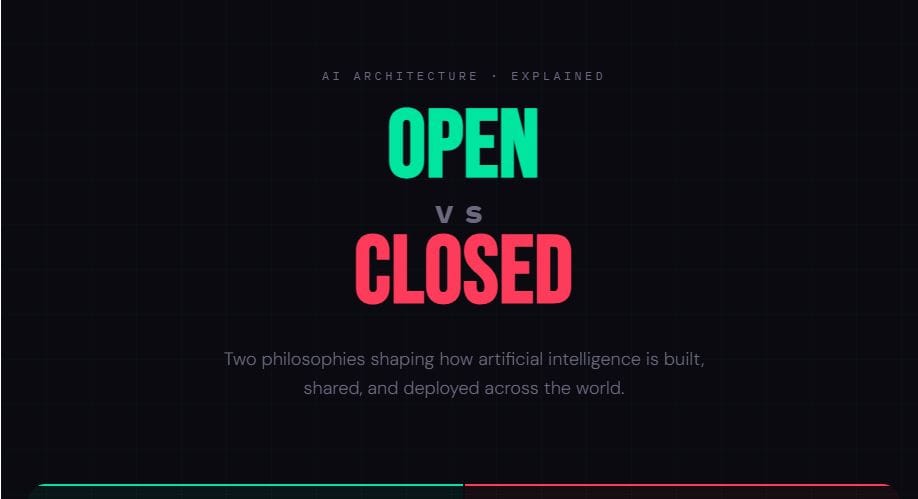
AI Architecture · Explained

Open vs Closed

Two philosophies shaping how artificial intelligence is built, shared, and deployed across the world.

What’s the difference?
Open Source / Open Weight
Open Models

The model weights — billions of numerical parameters learned during training — are released publicly. Anyone can download, run, fine-tune, and redistribute the model. The underlying architecture and, often, the training code are also visible.

🔓
Proprietary / API-Only
Closed Models

The model weights are private and never released. Users interact exclusively through an API or product interface. The developer retains full control over access, modification, and monetization. Internal details are trade secrets.

🔐
Side-by-Side Comparison
Dimension🟢 Open🔴 Closed
AccessDownload & run locally — no API neededAPI-only; requires account & payment
CostFree to use (compute costs only)Pay-per-token or subscription fees
PrivacyData never leaves your own hardwarePrompts sent to provider’s servers
CustomizationFull fine-tuning, RLHF, quantization, mergingLimited to system prompts & fine-tune APIs (if offered)
PerformanceFrontier gap narrowing fastStill leads most benchmarks (2025)
Safety ControlsGuardrails can be modified or removedProvider enforces consistent policies
TransparencyWeights & code inspectable by researchersInternal architecture is opaque
ReliabilitySelf-hosted; you manage infrastructureProvider manages scaling & uptime
Iteration SpeedCommunity-driven; rapid experimentationControlled release cycle
Notable Models
Open / Open-Weight
Llama 3 / 3.1 / 3.2
Meta AI · Community licence
Mistral / Mixtral
Mistral AI · Apache 2.0
Falcon 180B
TII UAE · Open licence
Qwen 2.5 / Qwen-VL
Alibaba Cloud · Apache 2.0
DeepSeek R1
DeepSeek · MIT licence
Phi-3 / Phi-4
Microsoft Research · MIT
Gemma 2
Google · Gemma licence
Closed / Proprietary
GPT-4o / o1 / o3
OpenAI · API-only
Claude 3 / 4 family
Anthropic · API + claude.ai
Gemini 1.5 / 2.0 Ultra
Google DeepMind · API-only
Grok 2 / 3
xAI · API + X platform
Command R+
Cohere · Enterprise API
Nova / Titan
Amazon Bedrock · API-only
Copilot / Phi (hosted)
Microsoft · Products & API
Key Tradeoffs
🛡️
Safety & Alignment
OPENResearchers can audit weights and probe for hidden behaviors; but bad actors can strip safeguards.
CLOSEDProvider consistently enforces safety policies; but users must trust the company’s claims.
🏢
Enterprise & Compliance
OPENOn-premise deployment satisfies strict data-residency and air-gap requirements.
CLOSEDRobust SLAs, SOC 2 certifications, legal agreements — but data leaves the building.
Raw Capability
OPENTop open models rival mid-tier closed ones but rarely match the frontier.
CLOSEDFrontier closed models still lead on reasoning, coding, and multimodal tasks (2025).
💸
Economics
OPENZero API cost; GPU compute only. Economical at high volumes once infrastructure is set up.
CLOSEDPay-as-you-go with zero setup; expensive at very high token volumes.
🌍
Geopolitics & Power
OPENDistributes AI capability globally; reduces dependency on a handful of US tech firms.
CLOSEDConcentrates power; raises concerns about access inequality and single points of failure.
🔬
Research & Innovation
OPENEnables academic research, reproducibility, and rapid community iteration on base models.
CLOSEDResearch is internal; external researchers rely on API access and published papers alone.
The Openness Spectrum
Fully Open Semi-Open Fully Closed
Llama 3.1 Mistral 7B DeepSeek R1 Falcon 40B Gemma 2 Phi-3 (weights, no data) Qwen 2.5 GPT-4o Claude 3.5+ Gemini Ultra Grok 3

“Open” is not binary. Some models release weights but not training data or code. Others use restrictive non-commercial licences. The term “open source AI” remains actively debated — the Open Source Initiative published its first formal AI definition in 2024, requiring training data disclosure for full compliance.