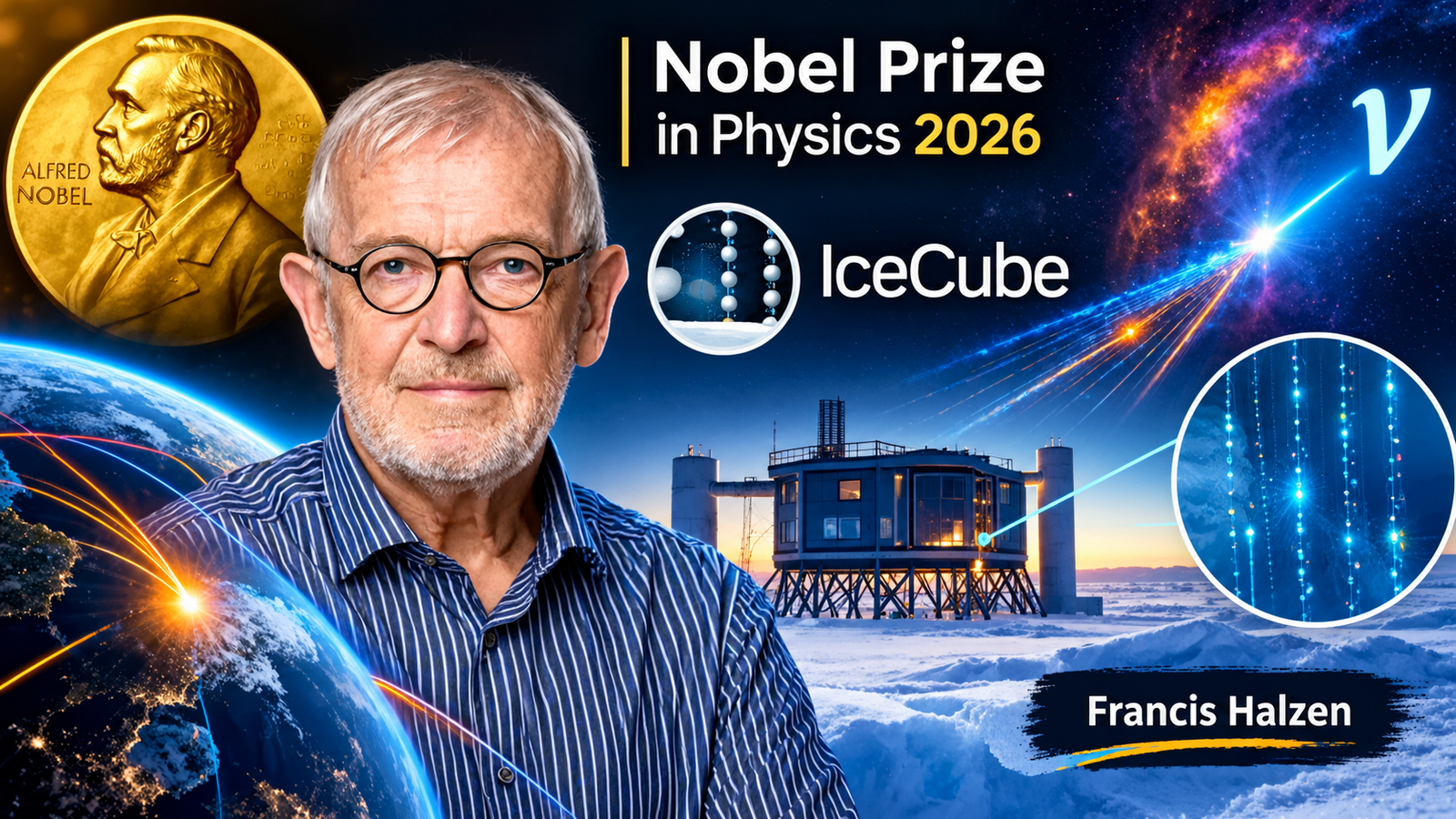
The Nobel Prize in Physics 2026 has been awarded to Belgian-born physicist Francis Halzen of the University of Wisconsin–Madison for his decisive contributions to the IceCube Neutrino Observatory and the discovery of high-energy neutrinos of astrophysical origin.
The breakthrough began with an unusual idea: use a vast block of Antarctic ice as a detector for some of the most elusive particles in the universe.
What Are Neutrinos?
Neutrinos are extremely difficult to detect because they interact only very weakly with matter. Trillions pass through our bodies every second without producing any noticeable effect.
But their extreme elusiveness makes them scientifically valuable.
Unlike charged cosmic rays, high-energy neutrinos can travel enormous distances without being deflected by magnetic fields or losing much of their energy. Their paths can therefore point scientists back toward violent events deep in the cosmos.
IceCube: A Telescope Buried in Ice
Halzen proposed using the South Pole’s transparent, stable ice to detect neutrinos in 1988. When a neutrino occasionally collides with an atomic nucleus, it can produce a tiny flash of light.
IceCube uses thousands of light sensors buried deep beneath the Antarctic surface to capture these flashes.
Completed in 2011, the observatory occupies roughly one cubic kilometre of ice. Its enormous size is necessary because high-energy cosmic neutrino interactions are exceptionally rare.
A New Way to See the Universe
IceCube researchers subsequently detected high-energy neutrinos originating far beyond our Solar System, opening a new era of neutrino astronomy.
These particles could help scientists investigate cosmic particle accelerators and extreme environments that conventional telescopes cannot fully reveal.
The Nobel committee says Halzen’s scientific vision and leadership helped create a new kind of astronomy. Continued IceCube observations could eventually uncover previously unknown cosmic phenomena.