
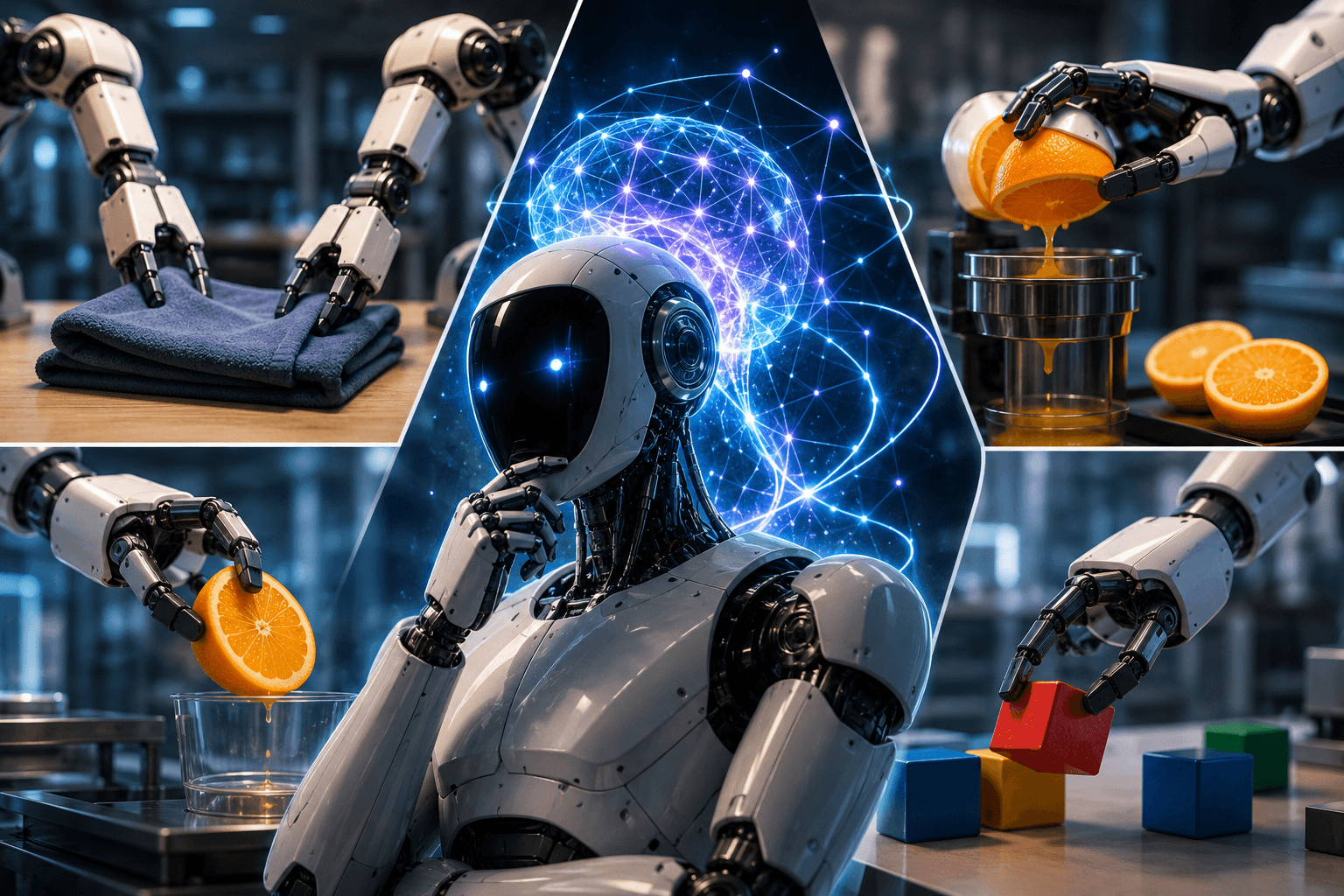
Artificial intelligence is making robots smarter than ever, but one major challenge has remained: real-world reliability.
A robot may perform perfectly inside a laboratory yet fail when faced with unexpected obstacles, moving objects, or changing environments. Now, researchers from the Shanghai Qi Zhi Institute have introduced RL-100, a new AI training framework that dramatically improves how robots learn, adapt, and recover from mistakes.
Published in Science Robotics, the study demonstrates robots completing 1,000 consecutive real-world tasks without failure—a milestone that could accelerate the deployment of robots in factories, hospitals, restaurants, and even homes.
What Is RL-100?
RL-100 is a new robot learning framework that combines Imitation Learning and Reinforcement Learning (RL) to make robots more dependable outside controlled laboratory environments.
Instead of relying only on human demonstrations, robots continue learning from their own experience, improving every time they encounter new situations.
Think of it like learning to ride a bicycle.
- Watching someone ride helps you get started.
- Actually riding yourself teaches balance.
- Falling a few times makes you much better.
RL-100 gives robots this same ability.
The Problem with Today’s Robots
Most modern robots learn by observing humans.
This method, called Imitation Learning, works well for repetitive tasks but has limitations.
For example, a robot trained to fold towels may struggle if:
- the towel is crumpled,
- lighting changes,
- someone bumps the robot,
- or objects are placed differently.
Since human demonstrations cannot cover every possible scenario, robots often fail when reality differs from training.
Researchers call this the “last-mile problem”—bridging the gap between laboratory success and dependable real-world operation.
How RL-100 Works
The new framework teaches robots in three stages.
1. Learn from Humans
Robots first watch demonstrations and imitate human actions.
This gives them a strong starting point for tasks such as:
- folding clothes,
- preparing food,
- operating machines,
- picking up objects.
2. Learn from Past Experience
Next, robots review thousands of previous attempts.
Using offline reinforcement learning, they analyze which decisions produced the best outcomes.
Before updating the robot’s behavior, RL-100 evaluates whether the new strategy is genuinely better, preventing poor learning updates.
3. Learn While Working
Finally, the robot continues learning while performing real tasks.
If something unexpected happens—a dropped object, a shifted tool, or an accidental push—the robot adjusts and remembers the solution for future attempts.
Instead of repeating mistakes, it gradually becomes more reliable.
A 100% Success Rate
To test RL-100, researchers trained robotic arms to perform challenging manipulation tasks involving different types of materials.
These included:
- folding towels,
- squeezing oranges,
- placing fruit,
- handling deformable objects,
- manipulating liquids,
- handling granular materials,
- coordinating two robotic arms simultaneously.
The results were remarkable.
Across 1,000 real-world trials, the robots completed every task successfully.
The researchers also reported that some robots finished tasks as fast as—or even faster than—experienced human teleoperators.
In one public demonstration, an orange-juicing robot operated continuously for around seven hours without a single failure.
Why RL-100 Is Different
Unlike conventional robot training methods, RL-100 focuses on recovering from failure.
If a towel slips from the robot’s hand or an orange moves unexpectedly, the robot doesn’t simply stop.
Instead, it adjusts its actions and continues.
This ability is essential for real-world deployment because everyday environments are rarely perfect.
Potential Applications
The technology could improve robots across many industries.
Manufacturing
- Assembly lines
- Precision machining
- Electronics production
- Quality inspection
Healthcare
- Hospital logistics
- Medicine delivery
- Surgical assistance
- Laboratory automation
Food Industry
- Cooking robots
- Beverage preparation
- Fruit processing
- Restaurant automation
Homes
- Laundry folding
- Kitchen assistance
- Cleaning
- Elder-care support
As labor shortages continue to affect many countries, reliable service robots are becoming increasingly important.
A Growing Trend in AI Robotics
RL-100 arrives during a period of rapid progress in Physical AI.
In 2026, major technology companies have intensified investment in robots capable of understanding and interacting with the physical world.
Recent developments include:
- NVIDIA’s Isaac GR00T platform, designed to train humanoid robots using foundation AI models.
- Google DeepMind’s Gemini Robotics, which combines advanced language understanding with robotic control.
- Figure AI, Agility Robotics, and Tesla Optimus, all working toward commercially viable humanoid robots.
- China’s continued expansion of robotics research through institutes and companies developing industrial and household automation.
Rather than building an entirely new robot, RL-100 introduces a smarter way to train existing robots, making it compatible with many robotic platforms.
Why This Breakthrough Matters
Many robots already possess excellent hardware.
The bigger challenge has been software.
Robots need to:
- adapt to change,
- recover from mistakes,
- learn continuously,
- and improve without requiring engineers to reprogram every new situation.
RL-100 addresses exactly these problems.
Researchers believe the framework could significantly reduce the time required to deploy robots in real workplaces while increasing reliability and reducing maintenance costs.
What’s Next?
The research team now plans to combine RL-100 with Vision-Language-Action (VLA) models—the next generation of AI systems that allow robots to understand spoken instructions, images, and physical actions together.
Future work will also focus on:
- cluttered environments,
- longer and more complex tasks,
- autonomous failure detection,
- safer exploration,
- and reducing the need for human supervision during training.
If successful, future robots may not only follow instructions but also understand context, recover independently from mistakes, and continually improve through experience.
Key Highlights
| Feature | RL-100 |
|---|---|
| Developed by | Shanghai Qi Zhi Institute |
| Published in | Science Robotics |
| Core Technology | Imitation Learning + Reinforcement Learning |
| Success Rate | 1,000 successful tasks out of 1,000 |
| Real-world Demo | Orange-juicing robot ran for ~7 hours without failure |
| Key Advantage | Learns from mistakes and adapts to changing environments |
| Future Goal | Train next-generation Vision-Language-Action robots |
Conclusion
RL-100 represents an important step toward making robots truly dependable in the real world. By combining human demonstrations with continuous reinforcement learning, the framework enables machines to adapt, recover, and improve far beyond their initial training. While laboratory performance has long been impressive, the true test of robotics lies in unpredictable environments—and RL-100 shows that robots can now bridge that gap. As the technology evolves alongside AI-powered humanoid robots and foundation models, it could play a pivotal role in shaping the next generation of intelligent assistants across homes, hospitals, factories, and public spaces.