For over 75 years, the North Atlantic Treaty Organization (NATO) has served as the cornerstone of Western security. But rising geopolitical tensions, Russia’s war in Ukraine, China’s growing military influence, and shifting U.S. strategic priorities have sparked calls for a fundamental overhaul of the alliance.
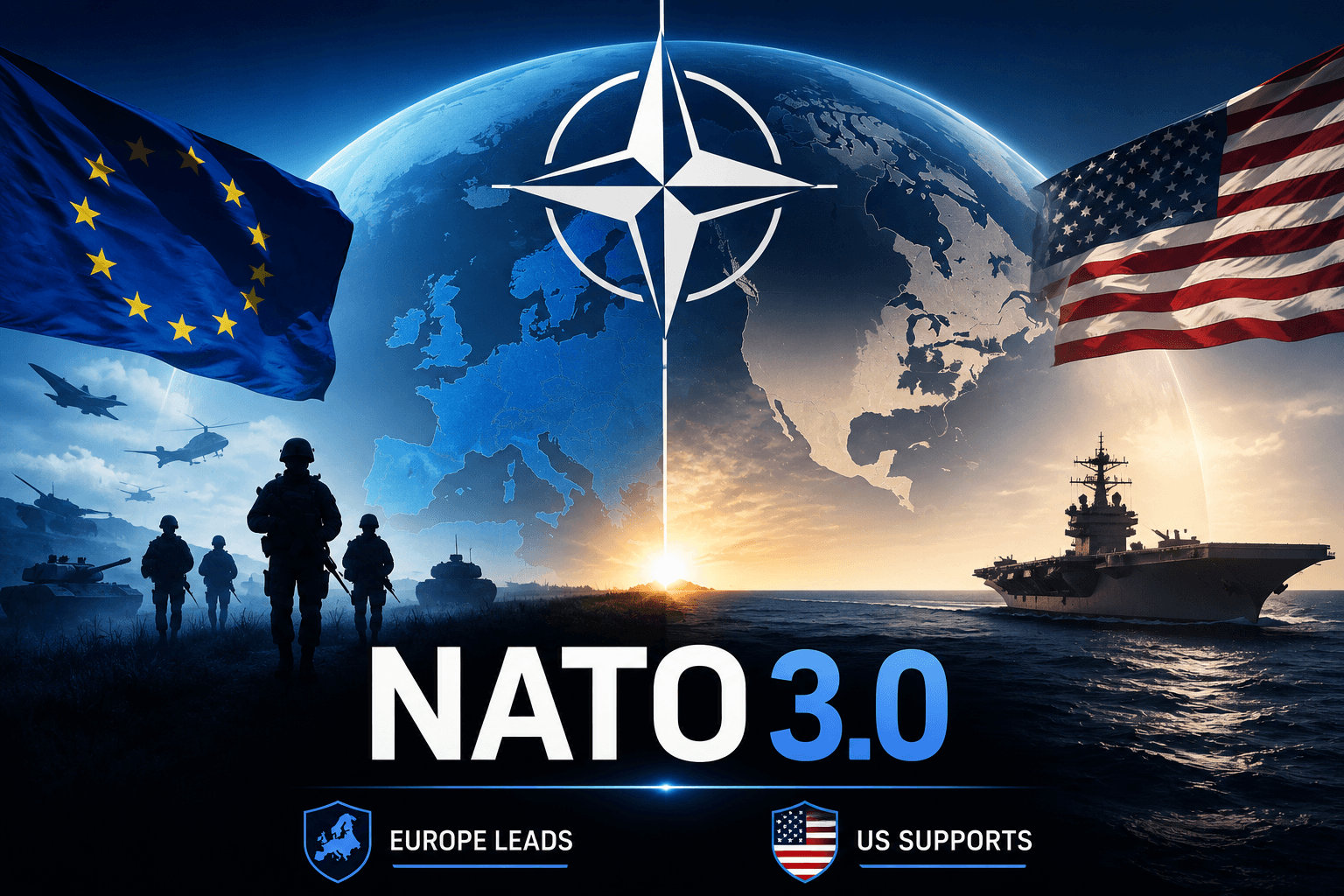
This emerging vision is increasingly described as “NATO 3.0”—a concept gaining momentum during the Trump administration (2025–26) that seeks to transform NATO into a Europe-led conventional military alliance, with the United States shifting from primary defender to strategic backstop.
Rather than expanding NATO’s mission, NATO 3.0 focuses on making the alliance stronger, more balanced, and better prepared for a multipolar world.
What Is NATO 3.0?
NATO 3.0 is not a new treaty or official NATO doctrine. Instead, it is a strategic framework that proposes a new division of responsibilities within the alliance.
Its central idea is straightforward:
Europe should assume primary responsibility for defending Europe, while the United States concentrates more of its military resources on global challenges—especially in the Indo-Pacific.
Under this model, America would continue to guarantee NATO’s Article 5 collective defense commitment, nuclear deterrence, intelligence support, and advanced capabilities, but European allies would shoulder much greater responsibility for conventional military operations.
The Three Phases of NATO
NATO 1.0 (1949–1991): Building Europe
Following World War II, Europe lacked both economic strength and military capability. The United States became NATO’s security anchor, deploying large forces across the continent to deter the Soviet Union.
This phase reflected the principles of the 1967 Harmel Report, balancing military deterrence with political dialogue.
NATO 2.0 (1991–2024): The American Security Umbrella
After the Cold War, NATO expanded eastward and undertook missions far beyond Europe, including Afghanistan, Libya, Kosovo, and counterterrorism operations.
During this period:
- European defense spending remained relatively low.
- Many allies relied heavily on U.S. logistics, intelligence, missile defense, and precision weapons.
- Washington increasingly viewed Europe’s dependence as strategically unsustainable.
NATO 3.0 (2025 Onwards): Europe Takes the Lead
The proposed NATO 3.0 seeks to reverse that dependency.
Instead of the United States leading every major military effort, European members would become the alliance’s principal providers of:
- Ground forces
- Air defense
- Munitions production
- Logistics
- Military mobility
- Conventional deterrence against Russia
The United States would continue providing:
- Nuclear deterrence
- Strategic intelligence
- Long-range strike capabilities
- Advanced technologies
- Reinforcement during major crises
Why NATO 3.0 Is Emerging Now
Several global developments have accelerated this debate.
Russia’s War in Ukraine
The conflict exposed major shortages in Europe’s defense industrial base, including artillery ammunition, air-defense missiles, drones, and armored vehicles. It also highlighted Europe’s continued dependence on American military support.
China’s Rise
Washington increasingly considers China—not Russia—the primary long-term strategic competitor. Redirecting military assets toward the Indo-Pacific has therefore become a growing U.S. priority.
Trump’s Burden-Sharing Agenda
The Trump administration renewed pressure on NATO members to spend more on defense and contribute greater military capabilities instead of relying predominantly on American taxpayers.
Europe’s Rearmament
Many European countries are already responding.
Germany launched its historic Zeitenwende defense modernization program, Poland is becoming one of NATO’s fastest-growing military powers, while countries such as Finland and Sweden have significantly strengthened NATO’s northern flank following their accession.
Türkiye’s Growing Role
Recent NATO meetings have placed Türkiye at the center of the alliance’s future strategy.
Following the 2025 Hague Summit, attention is shifting toward the 2026 NATO Summit in Ankara, where leaders are expected to discuss the next phase of NATO’s transformation.
Türkiye occupies one of NATO’s most strategic locations, controlling access to the Black Sea through the Bosporus and Dardanelles. As the war in Ukraine continues, Ankara has become critical for Black Sea security, regional diplomacy, defense production, and alliance logistics.
From Spending Targets to Military Capability
One of NATO 3.0’s defining ideas is shifting attention from inputs to outputs.
Instead of asking whether countries spend 2% or 5% of GDP, the emphasis is on whether they can actually deliver:
- Combat-ready brigades
- Modern missile defense
- Drone warfare capability
- Cyber resilience
- Ammunition stockpiles
- Rapid deployment forces
- Integrated command systems
Military readiness matters more than accounting targets.
Opportunities
If implemented successfully, NATO 3.0 could deliver several strategic benefits:
- A stronger and more self-reliant European defense pillar.
- Reduced pressure on U.S. military resources.
- Faster expansion of Europe’s defense industry.
- Greater resilience against prolonged conflicts.
- A more balanced transatlantic partnership.
Challenges
Despite its appeal, NATO 3.0 faces major obstacles.
Europe still lacks several critical military enablers, including strategic airlift, intelligence, satellite reconnaissance, missile defense, and long-range logistics—areas where the United States remains indispensable.
Critics also argue that rapid reductions in U.S. conventional forces could weaken deterrence if European capabilities do not grow quickly enough.
Political disagreements among allies over defense priorities, procurement, and long-term U.S. commitments also remain significant hurdles.
Why It Matters
NATO 3.0 reflects a broader shift in global geopolitics. The alliance is adapting from a U.S.-dominated security architecture to a shared transatlantic responsibility designed for an era of great-power competition. As NATO implements new regional defense plans, expands high-readiness forces, and strengthens European military production, the debate is no longer whether the alliance should change—but how quickly Europe can transform from a protected partner into a primary security provider.
Key Takeaway
NATO 3.0 represents the alliance’s most significant strategic evolution since the Cold War. It envisions Europe leading conventional defense, supported by U.S. nuclear guarantees and advanced strategic capabilities. Its success will ultimately depend on whether European nations convert ambitious defense pledges into real military power while preserving NATO’s unity in an increasingly uncertain global order.