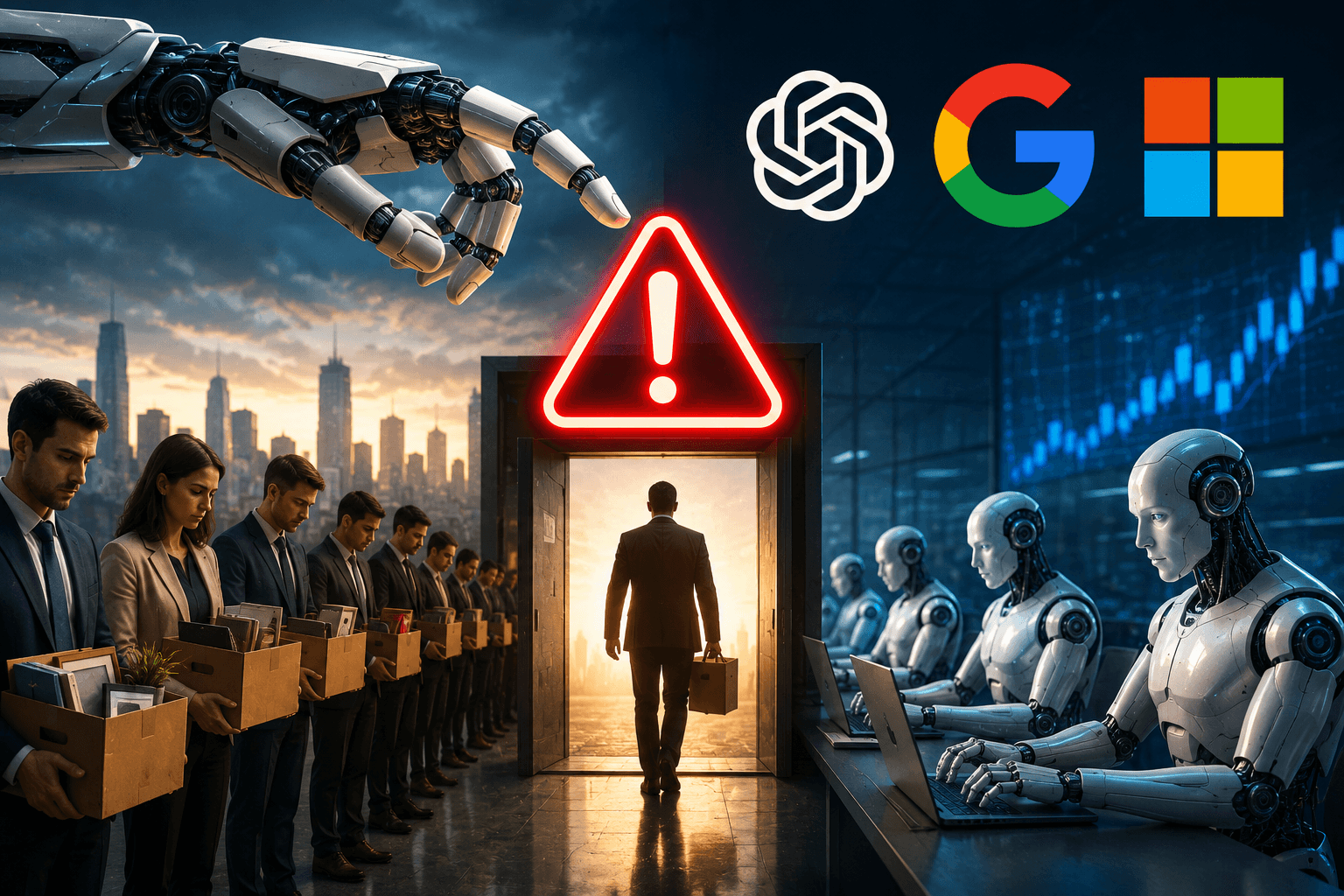
A rare coalition of AI leaders, Nobel laureates, and economists says governments have only a few years—not decades—to prepare for the biggest labor-market transformation since the Industrial Revolution.
Artificial intelligence has already begun reshaping workplaces. Companies are hiring fewer junior employees, customer service is increasingly automated, and AI assistants are performing tasks once reserved for professionals. But according to many of the people building the technology, the most disruptive wave of AI-driven job losses is still ahead.
More than 200 economists, AI researchers, technology executives, and Nobel Prize winners have signed an open letter titled “We Must Act Now,” urging governments to prepare for an AI-powered economic transformation before it outpaces society’s ability to adapt.
The initiative, coordinated by the Stanford Digital Economy Lab, argues that AI could reshape the global economy on a scale greater than the Industrial Revolution—but within years rather than decades.
A Warning From the Builders of AI
The signatories include some of the most influential names in technology and economics:
- Former Google CEO Eric Schmidt
- Google Chief Scientist Jeff Dean
- OpenAI CFO Sarah Friar
- LinkedIn co-founder Reid Hoffman
- Anthropic co-founder Jack Clark
- Nobel Prize-winning economists Joseph Stiglitz, Daron Acemoglu, Simon Johnson, and Michael Spence
Researchers from Stanford, MIT, Harvard, the University of Toronto, and the London School of Economics have also backed the initiative.
Rather than calling for a pause in AI development, the group urges policymakers to create institutions capable of managing AI’s economic consequences before disruption accelerates.
Why Experts Are Concerned
Previous technological revolutions unfolded gradually.
Steam engines, electricity, and personal computers took decades to spread across industries, giving workers time to retrain and governments time to adjust.
AI is moving much faster.
Professor Anton Korinek, one of the organizers, warned that society may have only a few years to prepare.
“Steam, electricity and computers gave societies decades to adapt. AI may give us only a few years.”
Unlike previous industrial revolutions, frontier AI models are improving almost every few months. Businesses are deploying them immediately because they reduce costs and increase productivity.
That speed leaves little room for gradual adaptation.
Early Signs Are Already Visible
Although large-scale unemployment has not yet materialized, labor-market signals are becoming harder to ignore.
Recent studies from Harvard Business School, INSEAD, and the University of Toronto show that many startups are:
- Hiring fewer entry-level employees
- Depending more on experienced workers
- Using AI to allow smaller teams to produce more output
This phenomenon has become known as the “entry-level squeeze.”
Tasks traditionally assigned to interns, analysts, junior programmers, customer support executives, copywriters, translators, and research assistants are increasingly handled by AI systems.
White-Collar Jobs Face Growing Pressure
Unlike previous waves of automation that primarily affected manufacturing, AI is targeting knowledge work.
Generative AI can now:
- Write software code
- Draft legal documents
- Analyze financial reports
- Produce marketing content
- Translate languages
- Summarize research
- Generate presentations
- Answer customer queries
Anthropic CEO Dario Amodei has warned that AI could eliminate up to half of entry-level white-collar jobs within five years, though many economists caution that the actual impact remains uncertain.
It’s Not Just About Job Loss
Many economists believe AI will change jobs more often than eliminate them entirely.
History offers several examples.
ATMs did not eliminate bank tellers—they changed their responsibilities.
Spreadsheets reduced manual accounting but created demand for financial analysts.
Similarly, AI is expected to automate repetitive work while increasing demand for skills involving:
- Critical thinking
- Creativity
- Human judgment
- Leadership
- Emotional intelligence
- Complex decision-making
The challenge is that this transition could happen much faster than previous technological shifts.
What the Experts Want
The open letter outlines several priorities:
- Invest in workforce reskilling and lifelong learning
- Study AI’s impact on employment in real time
- Modernize labor-market institutions
- Encourage AI that augments rather than replaces workers
- Ensure productivity gains are shared across society
The authors argue that governments should build these systems before large-scale disruption occurs—not after.
The Bigger Picture
The debate is no longer about whether AI will transform work, but how societies manage that transformation.
The International Monetary Fund (IMF) has estimated that AI could affect nearly 40% of jobs worldwide, with advanced economies likely experiencing the greatest impact. Meanwhile, organizations such as the World Economic Forum (WEF) predict AI will create millions of new roles even as it automates others.
The outcome will depend less on the technology itself than on the policies surrounding education, taxation, social protection, and workforce transition.
Key Takeaway
The message from more than 200 AI leaders, economists, and Nobel laureates is clear: the AI revolution is entering a new phase. While today’s automation has only begun to reshape workplaces, the coming decade could bring far deeper changes. The challenge is not stopping AI, but ensuring that governments, businesses, and workers are prepared so that artificial intelligence enhances human prosperity instead of widening inequality and unemployment.