
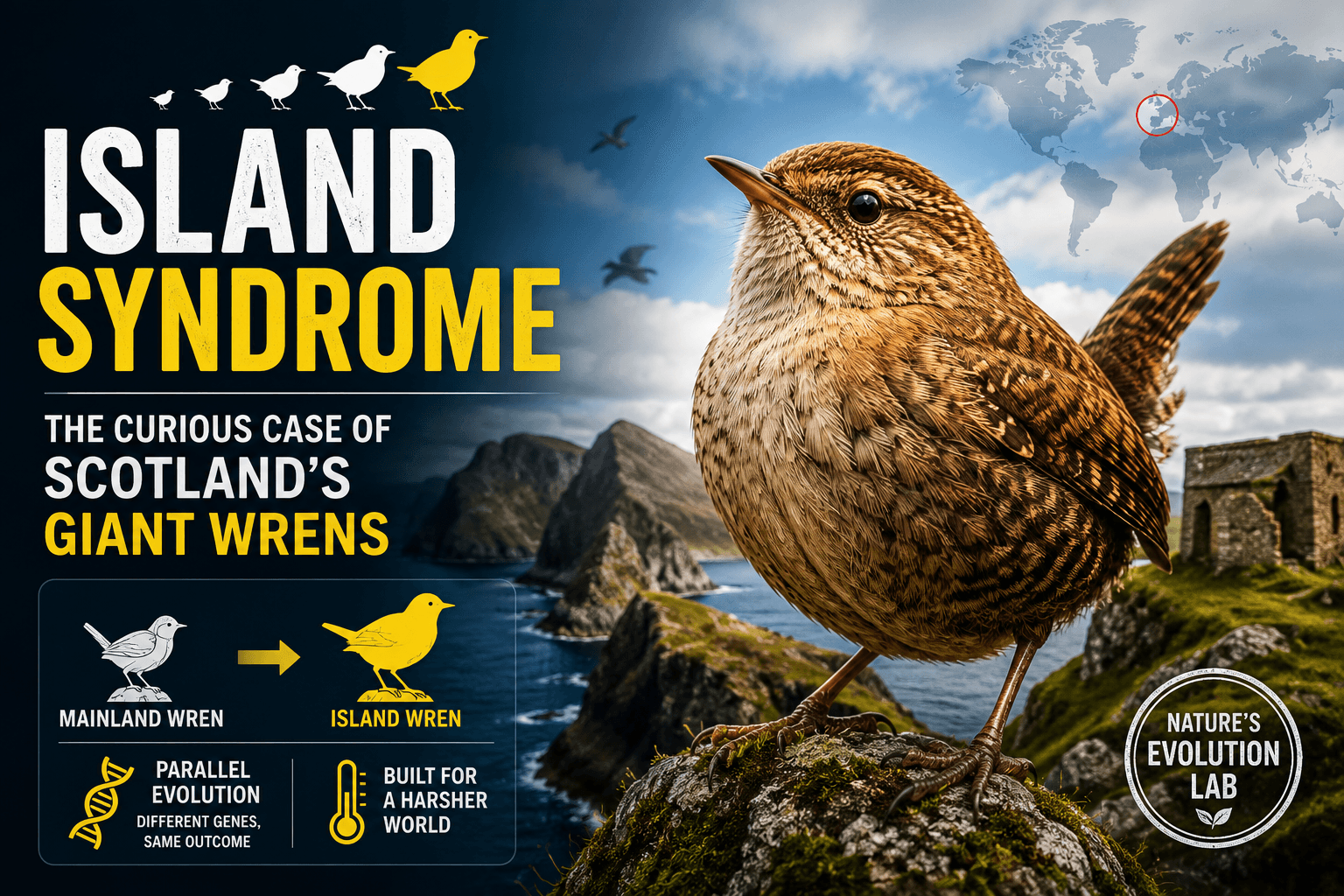
In the remote islands of St Kilda and Shetland, one of Britain’s smallest birds has evolved into an unexpected giant. A new study published in the Evolutionary Journal of the Linnean Society reveals that these island wrens have become significantly larger than their mainland relatives, offering one of the world’s clearest examples of Island Syndrome.
The discovery highlights how isolation can reshape wildlife in surprising ways.
What Is Island Syndrome?
Island Syndrome refers to the unique evolutionary changes that occur when animals become isolated on islands. Limited predators, fewer competitors, restricted habitats, and different food resources create new survival pressures, causing species to evolve differently from their mainland ancestors.
One well-known concept linked to island syndrome is the “Island Rule”:
- Large animals often evolve into smaller forms (island dwarfism).
- Small animals frequently become much larger (island gigantism).
Scotland’s Giant Wrens
Researchers studied wren populations from Shetland, St Kilda, Fair Isle, and the Outer Hebrides. While birds from Fair Isle and the Outer Hebrides showed only slight differences, the wrens of St Kilda and Shetland stood out.
The largest island wrens were almost twice as heavy as the smallest mainland wrens, placing them among the top 25% of the most extreme cases of island gigantism ever recorded.
Scientists believe the larger body size may help the birds:
- Retain heat in Scotland’s harsh, windy climate.
- Exploit a wider range of food sources.
- Survive with fewer natural predators.
A Remarkable Evolutionary Surprise
Perhaps the most fascinating finding was genetic.
Although both St Kilda and Shetland wrens evolved into similarly large birds, they achieved this through different genetic pathways. In other words, two isolated populations independently evolved the same solution—a striking example of parallel evolution.
This suggests evolution can reach similar outcomes using different biological mechanisms.
Island Syndrome Around the World
Scotland’s wrens are not the only animals transformed by island life.
- Dodo (Mauritius): Descended from flying pigeons but evolved into a large, flightless bird after predators disappeared.
- Komodo Dragon (Indonesia): The world’s largest lizard evolved on isolated Indonesian islands with little competition.
- Galápagos Giant Tortoises (Ecuador): Became enormous due to abundant vegetation and the absence of large predators.
- Channel Island Fox (California, USA): Evolved into a much smaller version of the mainland gray fox, demonstrating island dwarfism.
- Flores “Hobbit” (Homo floresiensis), Indonesia: An extinct human relative believed to have evolved smaller body size because of limited island resources.
These examples show that islands act as natural laboratories of evolution, where species rapidly adapt to unique ecological conditions.
Why This Research Matters
The study provides valuable insights into how wildlife responds to isolation, climate, and environmental change. As habitat fragmentation increases worldwide due to urbanization and climate change, understanding island evolution may help scientists predict how species adapt to shrinking or isolated habitats.
It also demonstrates that evolution is not always predictable—different populations can arrive at the same adaptation through entirely different genetic routes.
Key Takeaway
The giant wrens of St Kilda and Shetland are living proof of Island Syndrome, where geographic isolation drives extraordinary evolutionary change. By growing nearly twice as large as their mainland relatives, these birds reveal how nature continually reshapes life to match local environments. Their story reminds us that even the smallest creatures can unlock some of evolution’s biggest mysteries.