
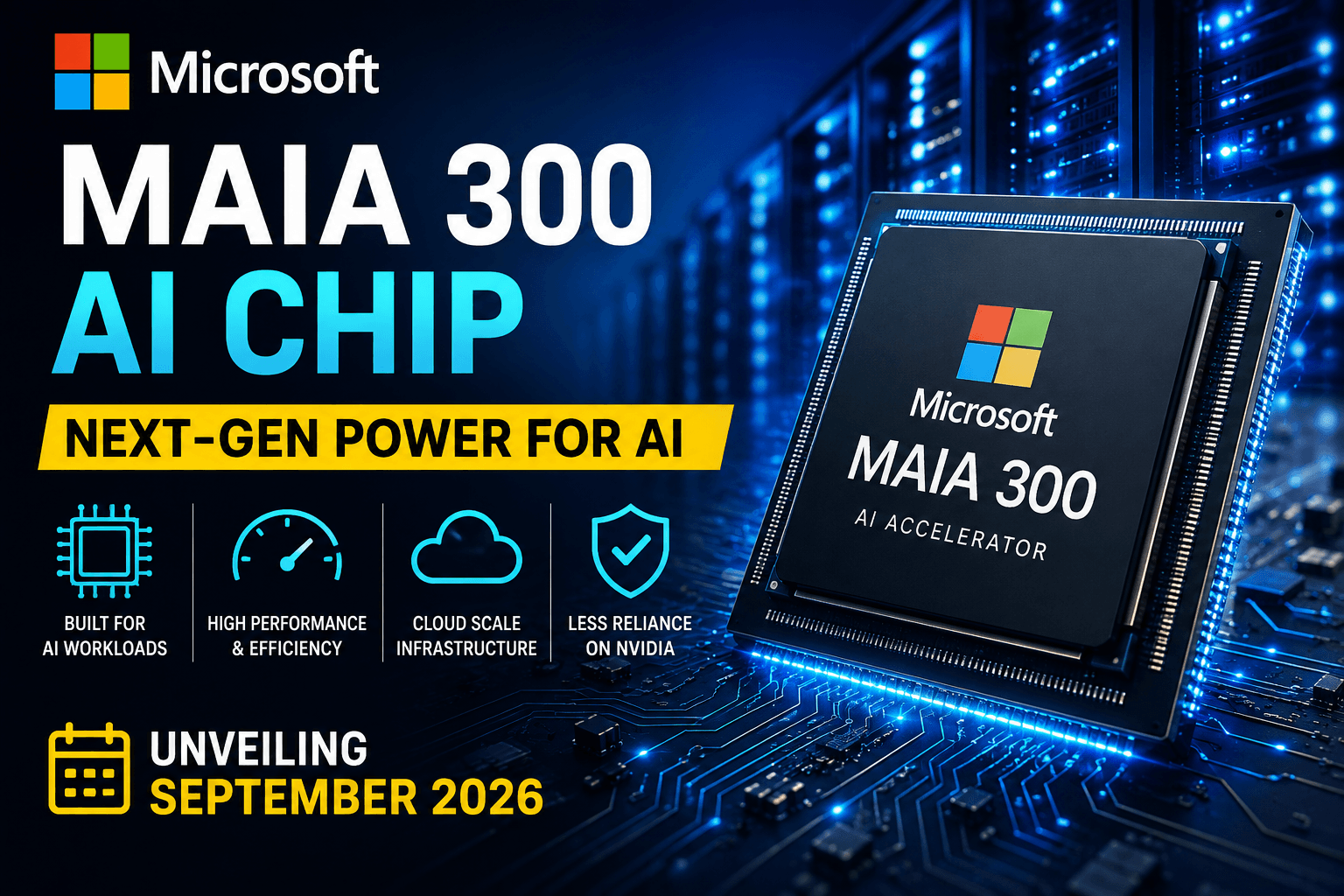
Microsoft is preparing to take another major step in the race to control the hardware powering artificial intelligence. The company is reportedly planning to unveil its next-generation Maia 300 AI accelerator as early as September 2026, according to The Information, potentially intensifying competition with Nvidia, Google and Amazon.
The move is strategically important. The AI boom has created enormous demand for specialised processors, while hyperscalers are increasingly developing their own silicon to reduce dependence on Nvidia and control the cost and performance of AI infrastructure.
Why Maia 300 matters
Microsoft introduced its first Maia AI accelerator in 2023 and launched Maia 200 in January 2026. Maia 200 was built by TSMC using a 3-nanometre process and incorporated substantial SRAM memory designed to improve performance for AI workloads involving large numbers of simultaneous users.
Maia 300 represents the next stage of that strategy.
According to the reported plans, Microsoft has been discussing manufacturing capacity with TSMC for potentially more than 300,000 Maia 300 processors for delivery in 2027. The company could ultimately seek capacity for more than one million chips, although production constraints and component availability remain potential obstacles.
Microsoft has not confirmed those volumes. Its Azure Maia leadership said reported figures did not reflect the full scale of the company’s programme.
The bigger AI-chip battle
The significance of Maia 300 goes beyond Microsoft.
Google is already commercialising its custom Tensor Processing Units (TPUs), while Amazon is expanding its Trainium family of AI processors. Both companies are attempting to shift more AI workloads onto internally designed hardware.
This creates a new competitive layer in the AI industry: winning may depend not only on having the best model, but also on controlling the chips, memory, networking and data centres underneath it.
For Microsoft, the stakes are particularly high because Azure must support rapidly growing AI workloads from its own services and customers.
The company has also reportedly been seeking major cloud customers, including Anthropic, to adopt Maia hardware. Wider adoption would help Microsoft spread development costs and make its custom silicon ecosystem more valuable.
Nvidia is still the benchmark
Despite the rise of custom chips, Nvidia remains the dominant force in AI acceleration, supported by its powerful hardware-software ecosystem.
Microsoft’s strategy is therefore unlikely to mean abandoning Nvidia altogether. Instead, custom Maia processors could allow Microsoft to choose the most economical hardware for specific workloads while retaining flexibility across Azure.
That distinction is increasingly important as AI inference—the process of generating responses from trained models—becomes a much larger part of computing demand.
Why this matters for AI’s future
The AI industry is entering an era where compute economics may be as important as model intelligence.
More efficient custom processors could lower the cost of running AI agents, copilots and large-scale inference services. They could also give cloud companies greater control over supply chains at a time when advanced semiconductor capacity is strategically important.
With Google, Amazon and Microsoft all developing their own accelerators, the next phase of the AI race may be fought not only in model benchmarks—but inside the world’s semiconductor fabs and hyperscale data centres.
Maia 300 could therefore be less about one new chip and more about Microsoft’s attempt to own a larger piece of the AI computing stack.