For decades, “telepathy” belonged to science fiction. In 2026, researchers are trying to turn a version of it into an engineering problem.
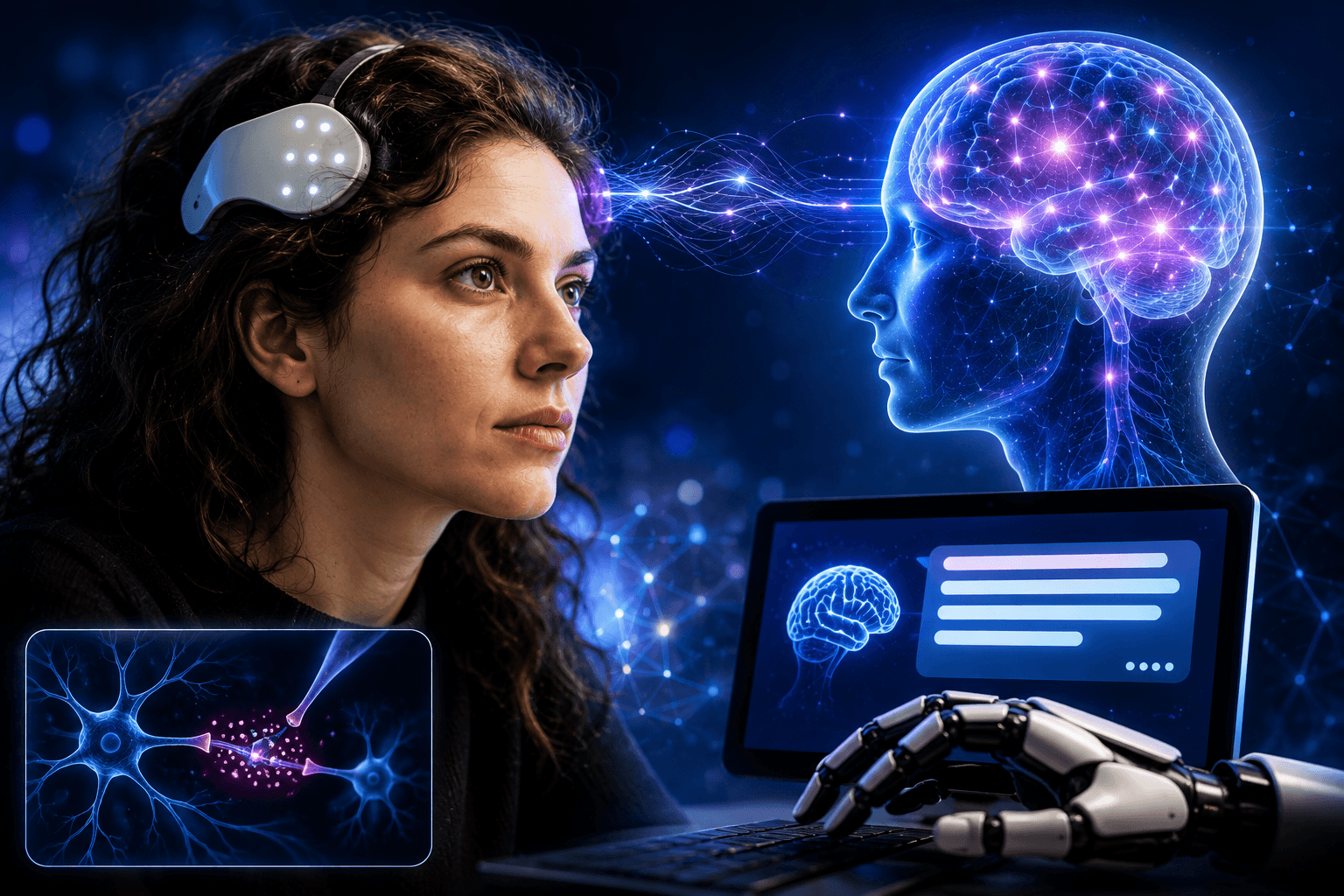
The emerging technology is non-invasive brain-computer interfaces (BCIs)—systems that use sensors outside the skull to capture patterns of brain activity and AI models to translate those signals into language.
One name attracting attention is Naomi Bashkansky, a young AI-alignment researcher associated with OpenAI and a former world-level chess competitor. A reported move from AI safety toward a startup called Conduit has been framed as a dramatic bet on “thought-to-text” technology. However, this part of the story should be treated cautiously: Bashkansky’s own website still lists her as an OpenAI alignment researcher, so the reported transition has not been independently established by the sources currently available.
The larger technological trend, however, is very real.
From Brain Signals to Language
The basic idea is surprisingly straightforward.
A person wears a neural-recording system. Sensors detect patterns associated with brain activity. An AI model then learns the statistical relationship between those signals and language.
The goal is not necessarily to “read every thought.” Instead, researchers are attempting to decode intended communication—for example, what someone is trying to type or say.
Conduit says it collected around 10,000 hours of neuro-language data from thousands of people to train thought-to-text systems. Its research describes models that use neural signals recorded immediately before a person types or speaks, attempting to capture semantic content before it becomes ordinary language.
That distinction matters. Today’s systems are nowhere close to unrestricted mind reading.
Meta Is Already Showing What Is Possible
The strongest recent evidence comes from Meta’s Brain2Qwerty research.
In June 2026, Meta released Brain2Qwerty v2, a non-invasive system designed to decode sentences from EEG and magnetoencephalography (MEG) recordings. The model was trained using about 22,000 sentences from nine participants who typed while their brain activity was recorded.
Meta reported 61% average word accuracy, with the best-performing participant reaching 78%.
That is an impressive research result—but it is not consumer telepathy.
The current system requires sophisticated MEG equipment, extensive participant-specific training and controlled experiments. Meta itself presents the technology primarily as a potential route toward communication assistance for people who cannot speak or move normally.
Why AI Changes the Equation
The breakthrough is not simply better brain sensors.
It is the combination of neural data + deep learning + language models.
Brain signals are noisy. Human language is structured. A language model can use context and probability to transform imperfect neural predictions into more coherent sentences.
This is similar to what modern speech recognition does with imperfect audio—but the signal here is vastly harder to interpret.
And that creates a huge data problem.
Conduit’s 10,000-hour dataset is ambitious, but neural recordings are considerably more difficult to collect than ordinary speech. People also have highly individual brain patterns. A system that works well for one person may perform poorly for another.
The Real Prize Is Not Telepathy
The biggest opportunity may be human-AI interaction.
Imagine silently formulating a command and having an AI assistant execute it. Imagine a programmer communicating with an AI without typing. Or, more importantly, imagine someone who has lost the ability to speak being able to communicate through a computer.
That is why non-invasive BCIs could become one of the most important AI-adjacent technologies of the next decade.
But the technology also creates an entirely new privacy category: neural data.
Passwords can be changed. Brain activity cannot.
As AI becomes better at interpreting neural signals, questions about consent, data ownership, surveillance and “mental privacy” will move from philosophy into law and product design.
The race, therefore, is not really to build a machine that can read minds.
It is to build an interface where the distance between thinking something and telling a machine becomes almost zero.
And that could fundamentally change what a computer—or an AI assistant—means to its user.