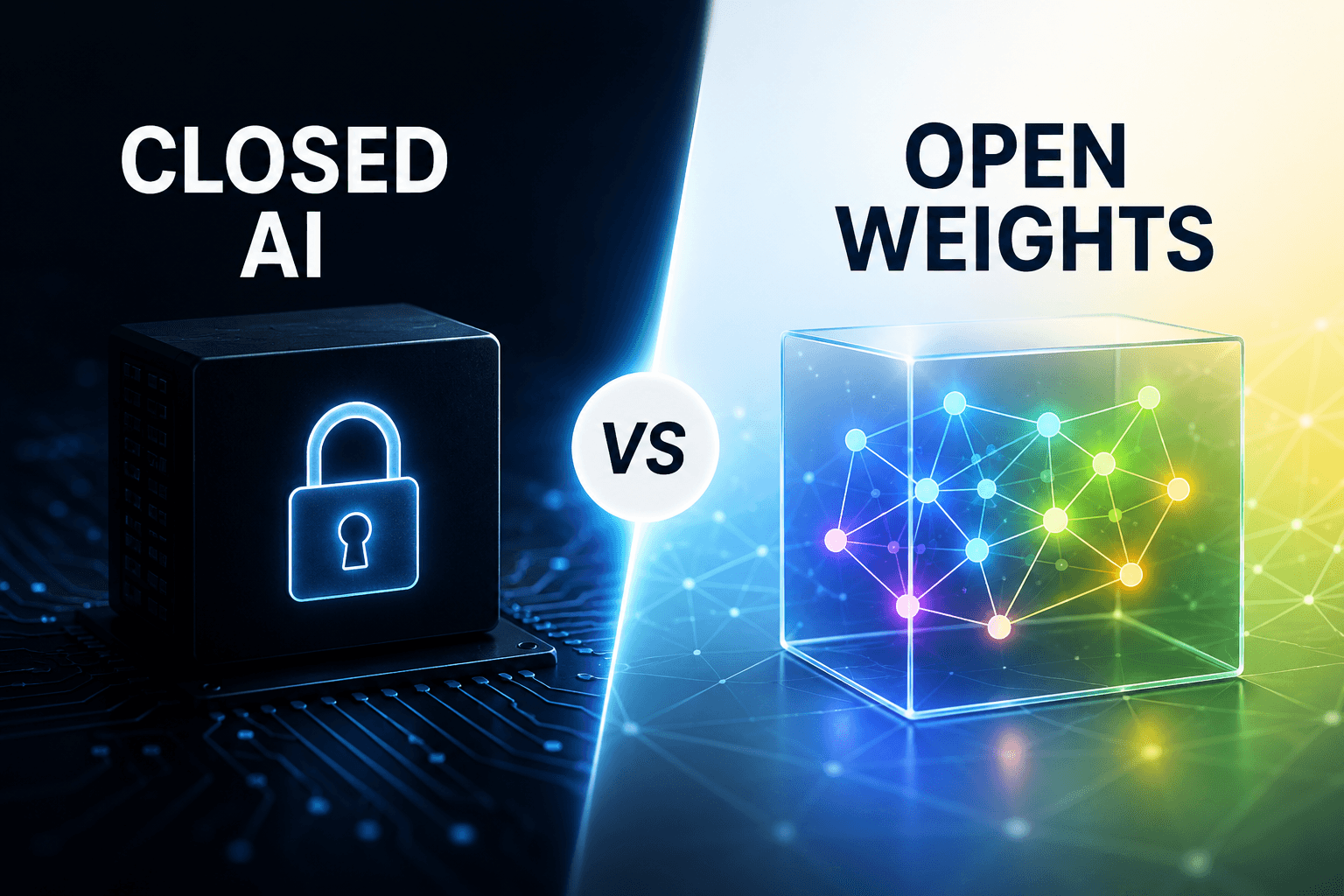
Artificial intelligence is entering a new phase in which who controls an AI model may matter almost as much as how intelligent it is.
The most advanced AI systems are increasingly being offered as commercial services rather than downloadable software. Users can interact with them through products or APIs, but they generally cannot inspect, download or independently modify the underlying model weights. These are broadly described as closed AI models or proprietary AI models.
At the same time, companies including Meta, Google and OpenAI have released or backed open-weight models that allow developers to download and run model weights under specified licences.
That divide is becoming one of the central debates in the AI industry.
What are closed AI models?
A closed AI model is an AI system whose core model components are controlled by its developer and are not publicly released for unrestricted inspection, modification or redistribution.
The most important distinction is the model weights.
Weights are the numerical parameters learned during training. They encode much of the model’s learned behaviour. In a closed model, those weights remain under the control of the company or organisation that developed the system.
Users may receive access through:
- a chatbot;
- an application;
- an API;
- an enterprise platform; or
- another controlled interface.
But access to the model does not necessarily mean ownership or access to its underlying technology.
Leading closed AI models
These models are generally accessed through a company’s product or API, while their underlying weights are not publicly released.
- GPT-5.6 Sol — OpenAI
- Claude Fable 5 — Anthropic
- Gemini 3.1 Pro — Google
- Grok 4.5 — xAI
Closed AI does not mean that nobody can use it
This is where the terminology can become confusing.
A model can be highly accessible while still being closed.
For example, a company may allow millions of people to use an AI model through a website or API while keeping its weights, training infrastructure and other proprietary components private.
The user gets access to intelligence as a service, rather than possession of the model itself.
This resembles cloud computing: you can use enormous computing resources without owning the servers.
How are closed AI models different from open-weight models?
The simplest distinction is control.
| Feature | Closed AI model | Open-weight model |
|---|---|---|
| Model access | Usually through controlled services | Weights can be downloaded |
| Weights | Generally private | Publicly available |
| Local deployment | Usually unavailable | Often possible |
| Modification | Limited by provider | Can often be customised |
| Fine-tuning | Provider-dependent | Greater flexibility |
| Provider control | High | Lower after release |
| Transparency | Generally lower | Greater at model level |
| Safety controls | Provider can update/restrict access | Users can modify the model |
However, open-weight does not automatically mean fully open-source.
A model may publish its weights while keeping some combination of training data, datasets, development infrastructure or other components proprietary.
OpenAI itself now distinguishes its open-weight gpt-oss models from its broader model portfolio. The company says gpt-oss weights are available under Apache 2.0, can be run on infrastructure controlled by users and can be customised.
Why do companies keep AI models closed?
There are several reasons.
1. Protecting intellectual property
Training frontier AI models can require enormous amounts of computing power, engineering talent, data and experimentation.
Keeping the weights private allows companies to protect the product of that investment.
2. Safety and misuse control
A closed model can be modified, updated or restricted by its developer.
If harmful behaviour is discovered, the provider can change the model or restrict access.
Once weights are publicly released, that control becomes much harder.
OpenAI has explicitly highlighted this trade-off: open-weight models can be customised, but determined users may also fine-tune them to bypass safety refusals or optimise them for harmful purposes.
3. Commercial economics
Closed models support a powerful business model:
train once → serve millions of users → charge for access
The provider retains control over infrastructure, updates, pricing and distribution.
For AI companies investing billions in computing infrastructure, that control can be commercially valuable.
4. Continuous improvement
A closed model can evolve behind the scenes.
The provider can update models, safety systems, routing, inference infrastructure and other components without requiring customers to download a new model.
But closed AI has a major weakness: dependence
The same control that benefits the provider can create dependence for the customer.
Imagine a company building its entire customer-support operation around one proprietary AI model.
If the provider:
- raises prices;
- changes model behaviour;
- removes a capability;
- changes usage limits;
- shuts down a model; or
- changes its terms,
the customer may have limited alternatives.
This is often described as vendor lock-in.
For governments, banks, hospitals and other organisations handling sensitive information, the question becomes even bigger:
Who ultimately controls the intelligence on which critical systems depend?
Why open AI is gaining momentum
The open-weight movement offers a different proposition.
Instead of renting intelligence from a provider, organisations can potentially run the model themselves.
That can provide:
- greater data control;
- local deployment;
- customisation;
- fine-tuning;
- independence from a single provider;
- easier experimentation; and
- greater reproducibility for researchers.
Google’s Gemma family, for example, provides downloadable models that developers can run on their own hardware or hosted infrastructure and customise for specific applications.
OpenAI has also entered this space with gpt-oss, demonstrating how the boundary between companies and the open-model ecosystem is becoming less straightforward.
Leading open-weight models
The open-weight side has become much more crowded:
- gpt-oss-20B / gpt-oss-120B — OpenAI
- Qwen3.5 — Alibaba
- DeepSeek V4 — DeepSeek
- Llama 4 — Meta
- Gemma 4 — Google
- Mistral Medium 3.5 — Mistral AI
On August 10, 2026, Meta launched Muse Glimmer, an open-weight model designed for smaller agentic tasks and capable of running on consumer-grade hardware. Meta also said it plans to release an open-weight version of its more advanced Muse Spark 1.2
Closed vs open AI: which is more powerful?
There is no permanent winner.
The frontier changes rapidly.
Stanford’s 2026 AI Index reported that the performance gap between the best closed and open models had widened again: as of March 2026, the top closed model led the top open model by 3.3%, while six of the top ten models on the Arena Leaderboard were closed.
That matters because the debate is no longer simply:
open = better
or
closed = better.
The real competition increasingly concerns:
intelligence + cost + safety + reliability + customisation + control.
Why the debate has become political
The open-versus-closed question is increasingly connected to national power.
If the world’s most capable AI systems are controlled by a small number of corporations, those companies could acquire enormous influence over access to advanced intelligence.
That creates questions about:
- technological sovereignty;
- national security;
- competition;
- concentration of economic power;
- research access;
- AI safety; and
- who gets to decide how powerful AI systems are used.
The debate has become especially visible in 2026 as Meta CEO Mark Zuckerberg has again argued for open AI while criticising the concentration of AI capability within companies and governments. Meta’s latest open-model push comes as the company competes with other frontier AI developers.
The safety argument cuts both ways
This is perhaps the hardest part of the debate.
Closed models:
Developers retain greater ability to control access and deploy safety updates.
Open-weight models:
Researchers and developers gain greater ability to inspect, test, reproduce, customise and independently evaluate models.
Therefore, neither side has an automatic monopoly on safety.
The fundamental question is:
Does greater control by the developer produce safer AI, or does greater transparency and independent scrutiny produce safer AI?
The answer may depend on the model, the deployment environment and the type of risk involved.
Governments are beginning to distinguish between them
Regulation is also forcing a more precise vocabulary.
Under the EU AI Act, providers of general-purpose AI models face obligations including technical documentation, copyright policies and public summaries of training content. Certain open-source models can receive exemptions from some documentation obligations if they satisfy specific conditions, including making parameters such as weights publicly available. Those exemptions do not apply in the same way to general-purpose models classified as having systemic risk.
That is significant because policymakers are not simply treating AI as either “open” or “closed.”
They are increasingly looking at what exactly has been released, under what licence, with what capabilities and what risks.
What happens next?
The future of AI may not be completely open or completely closed.
A more likely outcome is a hybrid AI ecosystem.
Some of the most capable frontier models may remain proprietary and accessible mainly through APIs and applications.
At the same time, increasingly powerful open-weight models may become available for developers, governments, researchers and enterprises to deploy independently.
The strategic advantage could therefore shift from simply asking:
Who has the smartest model?
to asking:
Who controls the model, who can modify it, who can afford to run it, and who controls the infrastructure around it?
That makes closed AI models more than a technical category.
They are becoming a question of control over intelligence itself.
Key Takeaways
- Closed AI models keep their core weights and other important components under developer control.
- Users can often access them through products or APIs without owning the underlying model.
- Open-weight models make model weights available for download, although this does not necessarily mean every part of the AI system is open.
- Closed models offer stronger provider control over safety, updates and commercial distribution.
- Open models offer greater customisation, local deployment and independence.
- The performance gap between leading closed and open models remains competitive and can change rapidly.
- The debate is expanding beyond technology into AI safety, regulation, competition, national security and corporate power.
- The future is likely to contain both proprietary frontier models and increasingly capable open-weight alternatives.