
What if the next generation of computers does not rely entirely on silicon chips? What if part of the machine is alive?
That question is moving from science fiction towards reality through the emerging field of biocomputing.
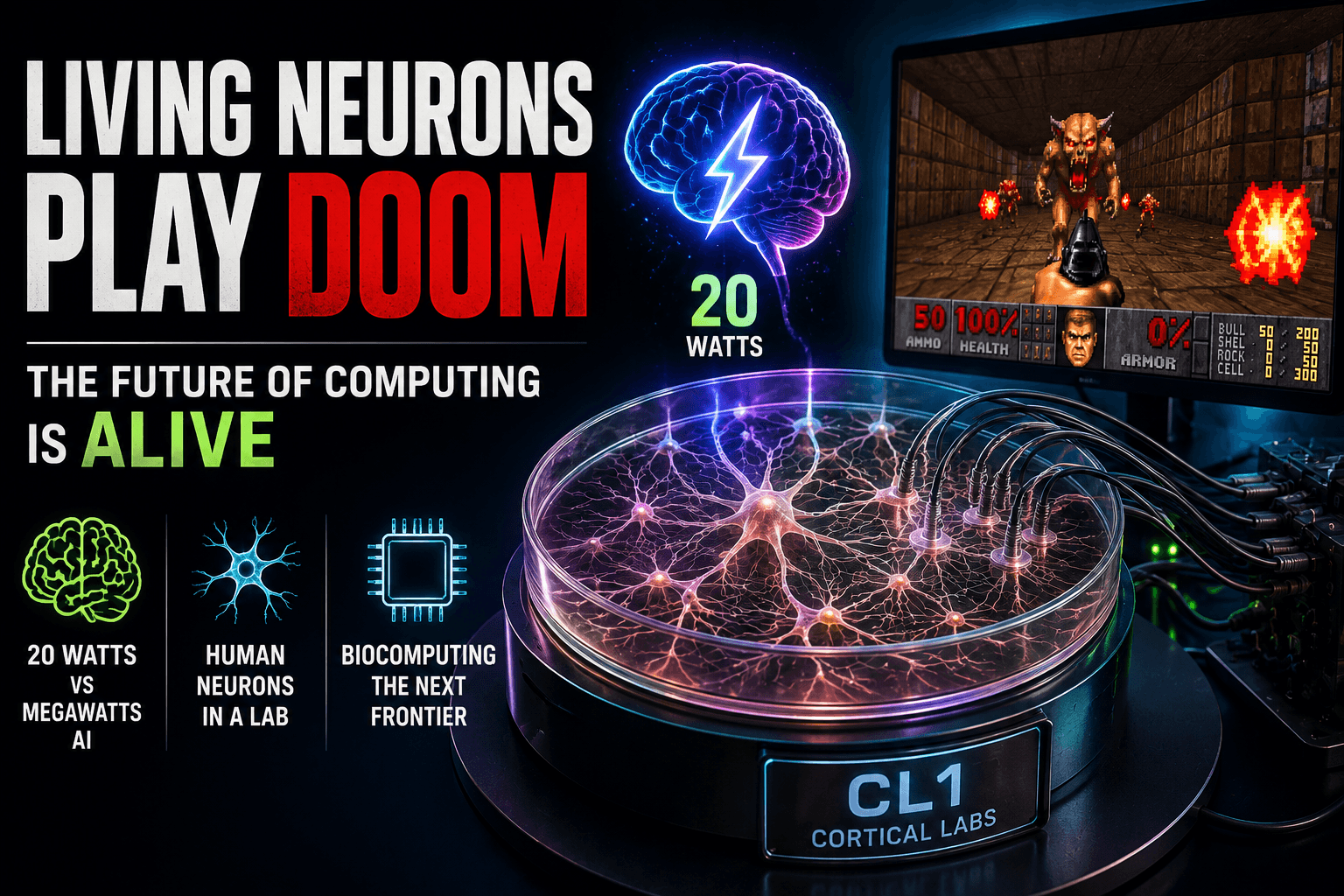
Researchers are experimenting with systems that connect living human neurons grown in laboratories to computer hardware. One of the most striking examples is associated with Cortical Labs and its CL1 project, where biological neurons are combined with conventional computing systems to perform computational tasks.
The idea is both fascinating and unsettling: living brain cells interacting with digital environments, including video games such as Pong and Doom.
Behind this unusual experiment lies a much bigger challenge—the exploding energy demands of artificial intelligence.
Why use living neurons instead of silicon?
Modern AI is becoming extraordinarily powerful, but it is also becoming increasingly energy-intensive.
Training and running advanced AI models can require vast computing infrastructure. Data centres packed with specialised chips consume enormous amounts of electricity.
The human brain presents a remarkable contrast.
It operates using roughly 20 watts of power while processing sensory information, learning continuously and performing complex tasks that computers still struggle to replicate.
That extraordinary efficiency is one reason scientists are asking whether biology could inspire—or even become part of—the future of computing.
Instead of trying to build ever-larger silicon systems that imitate the brain, biocomputing researchers are exploring another possibility:
Why not directly use biological neural networks?
From neuron-machine interfaces to “mini-brains”
The path towards biological computing has developed over decades.
Early experiments explored ways to connect neurons with electronic systems, allowing living cells to receive signals from and send signals back to computers.
The technology advanced further as scientists became increasingly capable of reprogramming cells.
A major breakthrough came from work involving Yamanaka factors, which showed how mature cells could be reprogrammed into stem-cell-like states and potentially transformed into different types of cells, including neurons.
This opened new possibilities for growing complex neural structures in laboratories.
Scientists could create clusters of brain cells and increasingly sophisticated organoids, sometimes described as simplified “mini-brains”. These are not human brains in the conventional sense, but laboratory-grown biological structures used to study development, disease and neural behaviour.
The same scientific progress has created a provocative possibility: connecting biological neural networks directly to machines.
How do you teach a brain cell to play a game?
This is where biocomputing becomes particularly strange.
Scientists can connect neurons to an electronic interface, allowing the cells to receive information about a digital environment and influence what happens inside it.
The biological system must then somehow learn.
One approach described in this field draws on the free energy principle, a framework associated with the idea that biological systems attempt to reduce unpredictability or surprise.
In simplified terms, researchers can create different feedback conditions.
When the system performs poorly, the cells may receive more unpredictable or disruptive signals—effectively creating a more chaotic environment.
When performance improves, the signals become more stable and predictable.
Over repeated interactions, the biological network can adapt its activity.
This approach helped generate one of biocomputing’s most famous demonstrations: living neurons learning to play Pong.
The concept is now being extended into more complex digital environments, including experiments described as involving Doom.
The remarkable point is not that a cluster of neurons understands a video game in the human sense.
Rather, the experiment explores whether biological neural networks can adapt their behaviour through feedback and learn to perform computational tasks.
The potential answer to AI’s energy problem
If biological systems can eventually perform useful computation at extremely low power, the implications could be enormous.
Today’s AI industry is investing heavily in more chips, larger data centres and greater electricity capacity.
Biological computing offers a radically different vision:
Silicon computing → More processing power → More electricity
Biological computing → Adaptive living networks → Potentially extreme energy efficiency
That does not mean biocomputers are ready to replace GPUs or data centres.
They remain experimental and face enormous challenges involving reliability, scalability, speed, maintenance and biological variability.
But if even a small part of future computing could exploit the energy efficiency of biological neural networks, the field could become strategically important.
Beyond computing: medicine and drug discovery
The technology could have applications far beyond AI.
Laboratory-grown neurons and organoids can help scientists study neurological diseases and observe how biological systems respond to drugs.
Instead of relying entirely on traditional cell cultures or animal models, researchers could potentially use more sophisticated human-derived neural systems to investigate conditions affecting the brain.
This could improve:
- disease modelling;
- drug testing;
- neuroscience research;
- understanding of neural development; and
- personalised medicine.
Yet the closer scientists move towards increasingly complex biological intelligence, the more difficult the ethical questions become.
The uncomfortable question: Can these systems feel?
This is where biocomputing becomes controversial.
Today’s biological computing systems are still far removed from a human brain. A small collection of cultured neurons connected to a computer is not equivalent to a conscious person playing a video game.
There is also no simple scientific test proving that such a system experiences the game, feels pain or possesses subjective awareness.
But the ethical dilemma becomes more serious as biological systems grow larger and more complex.
What happens if scientists eventually create neural structures sophisticated enough to have some form of experience?
Could an organoid experience distress?
Could a system designed to learn through negative feedback actually “suffer” in some meaningful sense?
And if a biological intelligence is repeatedly placed inside a digital environment to perform tasks, where should researchers draw the line?
These questions remain deeply uncertain. But uncertainty itself may be the problem.
By the time science can conclusively prove whether a sufficiently advanced artificial biological system is conscious, researchers may already have created one.
The future: computers that are partly alive?
For now, biocomputing remains a young and experimental field.
Silicon will continue to dominate mainstream computing, while AI companies race to build more powerful chips and larger data centres.
But projects involving living neurons point towards a radically different technological future.
The computer of tomorrow may not simply be a faster processor.
It could be a hybrid system:
Silicon + AI + Living Neurons
That possibility could eventually help address computing’s growing energy problem and transform medical research.
But it also forces humanity to confront one of the strangest questions technology has ever created:
If we build computers using living intelligence, how do we know when the machine has become something that deserves moral consideration?
The future of computing may therefore not be defined only by how intelligent machines become.
It may also depend on whether, somewhere along the way, our machines begin to feel.