
When people hear the word helium, they usually think of balloons floating in the sky. But in today’s technology-driven world, helium has become one of the most valuable strategic resources on Earth.
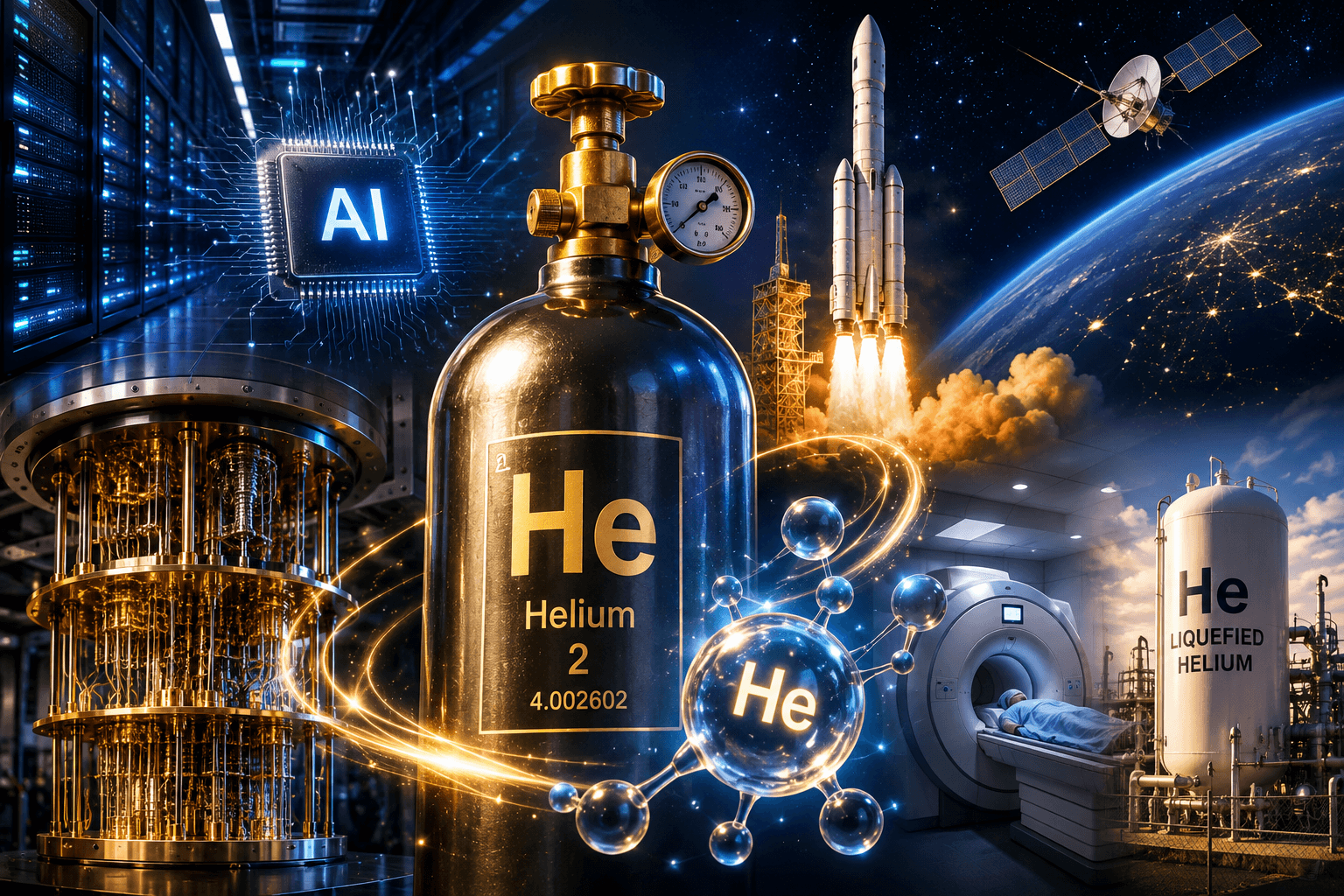
From MRI scanners and semiconductor chip manufacturing to quantum computers, AI infrastructure, and space exploration, helium plays an irreplaceable role. Unlike oil or many industrial metals, helium cannot be manufactured on demand and is extremely difficult to replace once lost.
As countries compete for leadership in artificial intelligence, advanced chips, and quantum technologies, helium is increasingly being called the “New Gold” or “Light Gold” of the 21st century.
What Is Helium?
Helium (He) is the second-lightest element in the universe and is chemically inert, meaning it rarely reacts with other elements.
Its most remarkable property is its extremely low boiling point of -268.9°C (4.2 Kelvin)—the lowest of any element. Because it remains liquid at temperatures close to absolute zero, helium is the world’s most effective coolant for superconducting technologies.
Unlike hydrogen, helium is non-flammable, making it safe for sensitive industrial and scientific applications.
Why Is Helium So Valuable?
Helium is a finite and non-renewable resource.
It forms naturally underground over millions of years through the radioactive decay of uranium and thorium. The gas accumulates in certain natural gas reservoirs, where it is extracted as a by-product during natural gas processing.
The concentration of helium in natural gas is usually only around 0.1%, making extraction expensive and geographically limited.
Even more importantly, once helium is released into the atmosphere, it is so light that Earth’s gravity cannot retain it. The gas gradually escapes into outer space and cannot be recovered.
Every litre of helium wasted is effectively gone forever.
Why Helium Is Indispensable
1. MRI Machines: Saving Millions of Lives
Perhaps the most familiar use of helium is in Magnetic Resonance Imaging (MRI).
MRI scanners contain superconducting magnets that must remain close to absolute zero to function correctly.
Liquid helium keeps these magnets at approximately −269°C.
If the cooling system fails, the helium rapidly evaporates in an event known as a quench. Besides shutting down the MRI machine, a quench can result in expensive repairs and interruptions to critical medical services.
Without helium, modern MRI scanners simply cannot operate.
2. Semiconductor Manufacturing
Every modern smartphone, AI accelerator, laptop, and data center depends on semiconductors—and helium plays a hidden but essential role in their production.
Helium is used during:
- Silicon wafer manufacturing
- Plasma etching
- Chip cooling
- Laser processing
- Extreme Ultraviolet (EUV) lithography
- Advanced semiconductor fabrication
As manufacturers race toward 2nm and sub-2nm chip technologies, ultra-high-purity helium has become even more important.
Companies such as TSMC, Samsung, Intel, Micron, SK Hynix, and chip suppliers supporting NVIDIA, AMD, Apple, Qualcomm, and OpenAI’s AI ecosystem all depend on helium somewhere within their manufacturing processes.
3. AI Infrastructure
The global AI boom is indirectly creating massive demand for helium.
Every AI model—from ChatGPT to Gemini, Claude, Grok, and advanced reasoning models—runs on data centers packed with high-performance chips.
Those chips must first be manufactured in semiconductor fabs that rely heavily on helium.
As governments announce hundreds of billions of dollars in AI infrastructure investments, helium has quietly become one of the invisible resources enabling the AI revolution.
4. Quantum Computing
Quantum computers require temperatures only fractions of a degree above absolute zero.
Liquid helium cools dilution refrigerators, allowing fragile quantum bits (qubits) to remain stable.
Leading companies and research organizations including IBM, Google, Microsoft, Quantinuum, PsiQuantum, and numerous national laboratories depend on helium-cooled systems.
Without helium, today’s superconducting quantum computers would not function.
5. Space Exploration
Helium is also indispensable in the space industry.
Space agencies including NASA, ISRO, ESA, JAXA, and private companies such as SpaceX use helium for:
- Cryogenic cooling
- Rocket engine testing
- Pressurizing fuel tanks
- Purging fuel systems
- Scientific instruments
- Satellite testing
India’s LVM3 (formerly GSLV Mk III) launch vehicle also relies on helium during cryogenic operations.
As lunar missions and commercial spaceflight expand, helium demand is expected to grow further.
6. Scientific Research
Helium supports some of humanity’s most advanced scientific experiments.
Applications include:
- Particle accelerators
- Nuclear fusion experiments
- Superconducting laboratories
- High-field research magnets
- Low-temperature physics
- Materials science
Many Nobel Prize-winning discoveries have relied on helium-cooled equipment.
Why Countries Are Worried About Helium
Unlike many industrial gases, helium production is concentrated in only a few regions.
According to global estimates:
- 🇺🇸 United States: ~42% of global supply
- 🇶🇦 Qatar: ~33%
- 🇩🇿 Algeria
- 🇷🇺 Russia
- 🇨🇦 Canada
Because only a handful of countries dominate production, any geopolitical disruption can quickly affect global availability and prices.
This concentration has transformed helium from an industrial gas into a strategic national resource.
Recently, China suspends helium exports, citing the need to secure supplies critical for chip manufacturing.
🧪 Helium – Strategic Supply Risk 🚨
— Insights | Integration🖊️ (@conect_insights) April 3, 2026
🇶🇦 Qatar supplies ~1/3 of global helium.
Derived as byproduct of natural gas processing. pic.twitter.com/4Behv5YWiZ
India’s Helium Challenge
India currently depends almost entirely on helium imports.
As the country rapidly expands:
- semiconductor manufacturing,
- AI data centers,
- quantum computing research,
- advanced healthcare,
- and ambitious space missions,
its dependence on imported helium is becoming an important strategic concern.
Researchers have identified naturally occurring helium emissions at Bakreshwar in West Bengal, one of India’s most discussed potential helium-bearing regions. While commercial-scale production remains under development, the discovery highlights India’s efforts to reduce long-term import dependence.
Helium Is Becoming a National Security Asset
Recent geopolitical tensions have exposed the vulnerability of global technology supply chains.
Export restrictions on critical minerals and industrial materials have prompted governments to rethink resource security.
Like rare earth elements, gallium, germanium, graphite, cobalt, and lithium, helium is increasingly viewed as a strategic resource essential for future technologies.
Many countries are now:
- building strategic helium reserves,
- investing in helium exploration,
- signing long-term supply agreements,
- and promoting recycling technologies.
Securing helium is no longer just an industrial issue—it is becoming a matter of economic resilience and national security.
Can Helium Be Recycled?
Yes.
Although helium cannot be recreated naturally within a human timescale, it can be recovered and reused.
Hospitals, semiconductor plants, and research laboratories increasingly install helium recovery systems that:
- capture escaped gas,
- purify it,
- liquefy it,
- and return it to storage.
Recycling reduces operating costs while conserving one of the planet’s rarest industrial resources.
As global demand rises, helium recycling is expected to become standard practice across high-tech industries.
Could the Moon Become a Future Helium Source?
Scientists are also studying Helium-3, a rare isotope believed to exist in significant quantities within the Moon’s surface.
Helium-3 has attracted global attention because of its potential use in future nuclear fusion reactors, a technology that could provide abundant clean energy.
Countries including India, China, and the United States have all expressed long-term interest in lunar resource exploration through programs such as Artemis, Chang’e, and future lunar missions.
Although Helium-3 is different from the helium used in MRI scanners and chip manufacturing, its strategic importance further highlights why helium has become central to discussions about the future of energy and space exploration.
Key Facts About Helium
| Feature | Details |
|---|---|
| Atomic Number | 2 |
| Boiling Point | −268.9°C (4.2 Kelvin) |
| Renewable? | ❌ No |
| Main Source | Natural gas reservoirs |
| Average Helium in Natural Gas | ~0.1% |
| Largest Uses | MRI, semiconductors, quantum computing, aerospace |
| Biggest Producers | United States, Qatar, Algeria, Russia, Canada |
| India’s Status | Nearly 100% import dependent |
| Future Importance | AI, quantum technology, advanced chips, fusion research |
Why Helium Matters More Than Ever
Several global trends are driving helium demand simultaneously:
- The explosive growth of Artificial Intelligence and AI data centers.
- Expansion of semiconductor fabrication plants worldwide.
- Investment in quantum computing.
- Growth of commercial space exploration.
- Rising healthcare demand for MRI imaging.
- National efforts to build resilient supply chains for critical resources.
Industry experts expect helium demand to continue increasing over the next decade, while discovering new economically viable reserves remains difficult.
Conclusion
Helium has evolved far beyond its image as a balloon gas. Today, it is one of the invisible pillars supporting the global technology ecosystem. It cools MRI machines that save lives, enables the production of cutting-edge AI chips, powers quantum computing research, and supports rocket launches that explore space.
Because helium is finite, non-renewable, and difficult to replace, governments are increasingly treating it as a strategic asset alongside critical minerals. For countries like India, securing long-term helium supplies, expanding recycling infrastructure, and exploring domestic sources such as Bakreshwar could become crucial for achieving ambitions in semiconductors, artificial intelligence, quantum technologies, and space exploration.
In the coming decades, the race for technological leadership may depend not only on advanced software and powerful chips—but also on securing enough of this invisible gas that quietly powers the future.