
For decades, long-range cruise missiles were symbols of military superpowers. Systems such as the Tomahawk, Storm Shadow, and Kalibr required billions of dollars in research, sophisticated supply chains, and highly classified electronics.
That assumption is now being challenged.
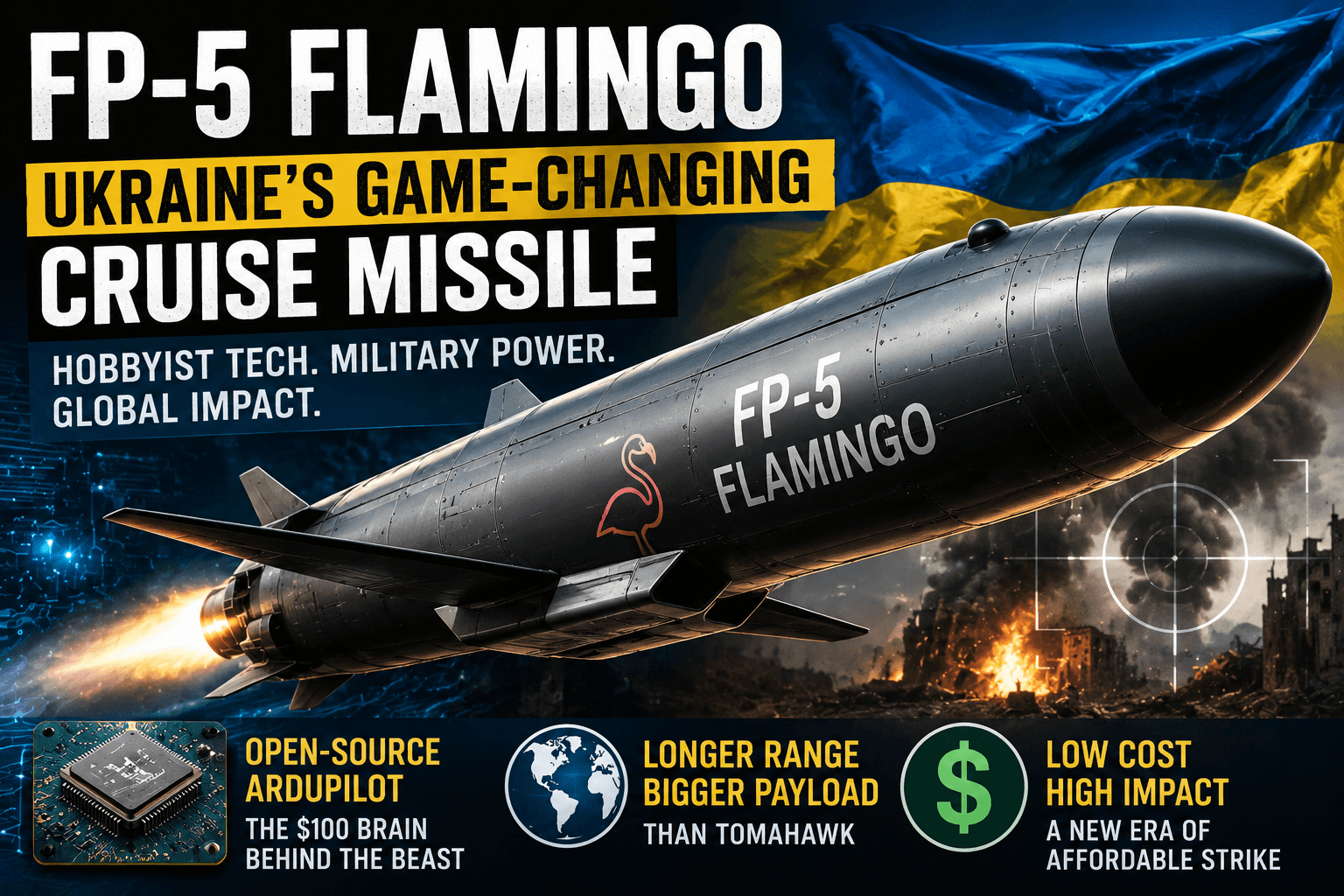
At the Eurosatory 2026 defence exhibition in Paris, Ukrainian defence company Fire Point unveiled the FP-5 Flamingo—a next-generation cruise missile that combines long-range strike capability with an unconventional design philosophy. Instead of relying entirely on expensive military-grade components, the Flamingo incorporates commercial hardware, open-source software, and rapid manufacturing techniques, making it dramatically cheaper than many traditional cruise missiles.
The missile has quickly become one of the most talked-about innovations in modern warfare, not only because of its specifications but because it signals a major shift in how advanced weapons may be built in the future.
What is the FP-5 Flamingo?
The FP-5 Flamingo is a Ukrainian-developed long-range cruise missile designed for precision strikes against strategic targets.
Unlike many legacy cruise missiles that depend on proprietary navigation systems and specialized electronics, the Flamingo adopts a modular architecture that leverages commercially available technologies wherever practical.
According to information presented by Fire Point, the missile is designed to carry a significantly larger payload than many existing Western cruise missiles while maintaining long-range strike capability. Perhaps even more remarkable is its reported production cost, which is only a fraction of comparable systems.
The philosophy is straightforward: deliver effective combat capability without the enormous costs associated with traditional defence procurement.
The Secret Behind Its Low Cost
One of the most revolutionary aspects of the FP-5 Flamingo is its flight control system.
Instead of building an entirely proprietary guidance computer from scratch, Fire Point reportedly adapted ArduPilot, one of the world’s best-known open-source autonomous vehicle software platforms.
Originally created in 2009 for hobby drones, model aircraft, autonomous boats, and robotics, ArduPilot has evolved through contributions from thousands of developers worldwide.
Today it supports advanced capabilities including:
- Autonomous navigation
- GPS waypoint guidance
- Terrain following
- Flight stabilization
- Mission planning
- Redundant safety systems
By adapting a mature open-source ecosystem instead of developing a bespoke military flight computer, developers dramatically reduced both cost and development time.
This reflects a broader transformation often described as the consumerization of military technology, where innovations from civilian electronics increasingly find defence applications.
Open-Source Software as a Strategic Advantage
For Fire Point, choosing open-source technology was not simply about saving money.
It also provides technological independence.
Military programmes frequently depend on specialized suppliers whose components may become unavailable due to sanctions, export controls, or geopolitical disruptions.
Open-source platforms reduce that dependence by allowing developers to maintain, modify, and improve software without relying on a single vendor.
The global ArduPilot community continuously identifies bugs, improves stability, and introduces new features—creating an innovation cycle that can move much faster than traditional defence procurement.
A New Era of Affordable Precision Weapons
The FP-5 Flamingo represents a larger trend that has emerged from the war in Ukraine.
Over the past several years, Ukraine has demonstrated how commercial drones, consumer electronics, AI-assisted navigation, satellite communications, and rapid software development can be integrated into highly effective battlefield systems.
The Flamingo extends this philosophy from small FPV drones to long-range cruise missiles, showing that advanced strike weapons no longer require decades of development or billion-dollar budgets.
Military analysts increasingly describe this shift as the transition from “exquisite” weapons to “attritable” or mass-producible precision weapons—systems that may not be perfect individually but can be manufactured quickly and deployed at scale.
Why Defence Experts Are Paying Attention
The missile’s greatest impact may not be its specifications alone but what it represents.
Historically, only major military powers possessed sophisticated long-range strike capabilities. Falling development costs and commercially available technologies could allow many more countries to develop similar systems in the coming years.
This trend raises both opportunities and concerns.
Affordable precision weapons strengthen smaller nations’ deterrence capabilities, but they also increase the risk that advanced missile technologies could spread more widely, forcing governments to rethink export controls, defence strategies, and air defence systems.
The Bigger Picture
The FP-5 Flamingo is more than another cruise missile—it reflects a fundamental transformation in modern warfare.
Artificial intelligence, open-source software, commercial electronics, additive manufacturing, and modular engineering are rapidly reshaping how advanced weapons are designed and produced.
Rather than relying solely on expensive, highly customized military hardware, future weapons may increasingly resemble technology products: software-driven, rapidly upgradeable, and built using globally available components.
As conflicts become increasingly technology-centric, the FP-5 Flamingo offers a glimpse into the future of defence innovation—where agility, affordability, and open-source development could become just as important as raw firepower.