As extreme weather intensifies, AI models are moving from laboratories into real-time forecasting.
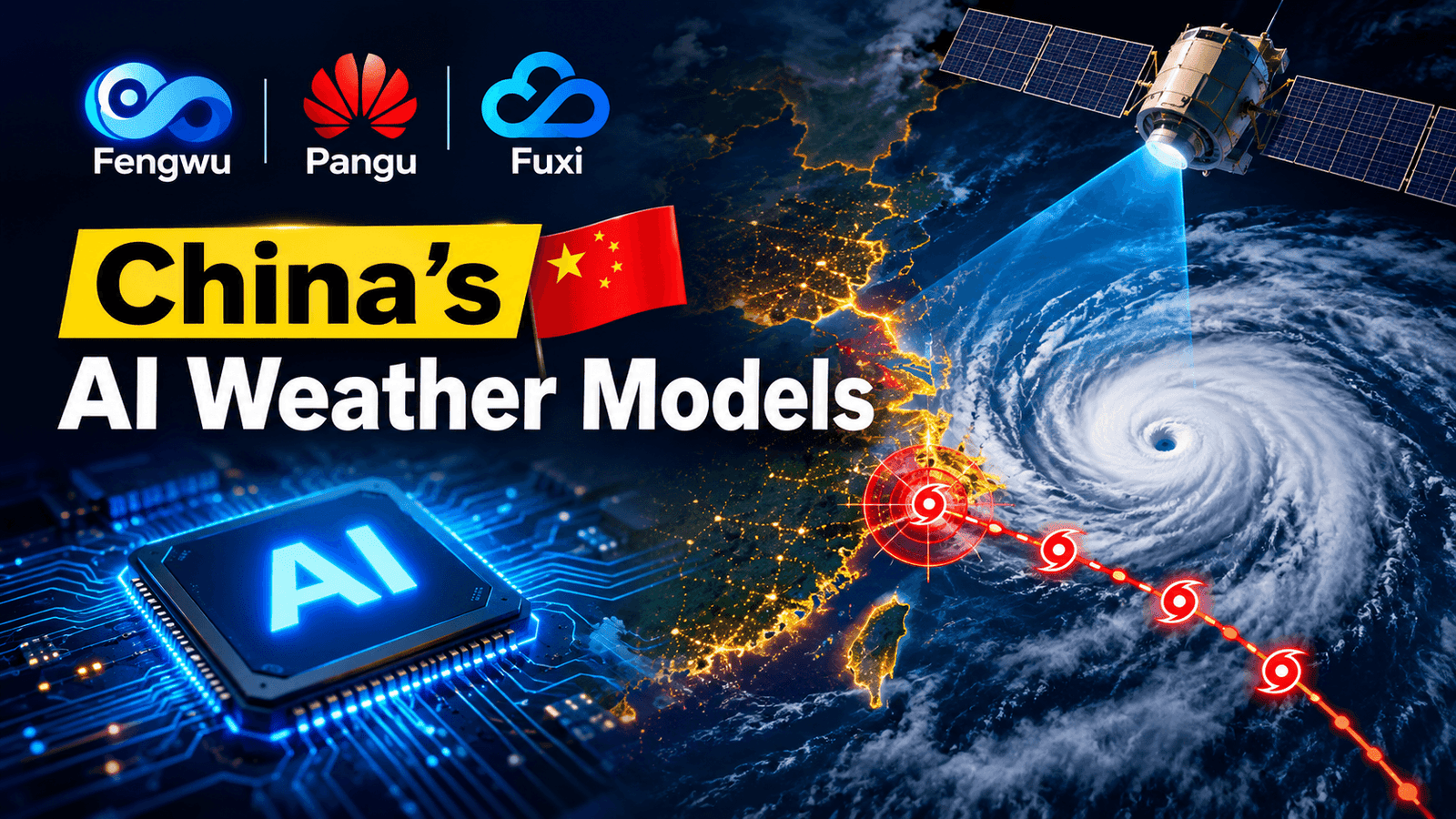
China is increasingly deploying AI-based weather forecasting alongside conventional meteorological systems, highlighted by recent tracking of Typhoon Dolphin.
Chinese AI models include:
- Fengwu — Shanghai AI Laboratory
- Pangu — Huawei
- Fuxi — Fudan University
These systems can generate forecasts far faster than conventional numerical models and, on some measures, match or outperform them.
From Physics Simulations to AI Prediction
Traditional numerical weather prediction works by solving equations describing the atmosphere. Supercomputers process observations and simulate atmospheric physics to estimate how weather systems will evolve.
AI weather models take a fundamentally different approach.
Instead of explicitly calculating every atmospheric process, they are trained on vast historical datasets and learn statistical patterns associated with how weather evolves.
In simplified terms:
Traditional forecasting:
Observations → Physics equations → Supercomputer simulation → Forecast
AI forecasting:
Historical weather data → Pattern learning → AI inference → Forecast
The major attraction is speed and computational efficiency. AI models can generate forecasts in a fraction of the time required by conventional systems.
That matters enormously during rapidly developing disasters, when even a small improvement in forecast speed or accuracy can give authorities additional time to evacuate populations, prepare flood defences, manage transport and warn farmers and fishermen.
Fengwu and the Global AI Forecasting Race
Fengwu has attracted particular attention.
In a 2023 benchmark, Fengwu outperformed Google’s GraphCast on about 80% of 880 evaluated atmospheric variables.
This puts Fengwu into a global field that includes:
- Google: GraphCast and GenCast
- NVIDIA-backed: FourCastNet
- European Centre for Medium-Range Weather Forecasts: AIFS
- China: Fengwu, Pangu and Fuxi
The competition is therefore no longer simply about building better weather satellites or faster supercomputers. It is increasingly about developing better AI architectures, training datasets, data-assimilation systems and forecasting workflows.
Typhoons: Where AI Could Make a Real Difference
Tropical cyclones provide an especially important testing ground.
For governments and emergency agencies, knowing exactly where a storm will travel can determine:
- Where evacuations should occur
- Which roads and airports may need to close
- Where flood-control resources should be positioned
- Which coastal communities face the greatest risk
- How farmers and fishermen should respond
Techwind, the company involved in Fengwu’s industrial applications, told Reuters that the model predicted Typhoon Dolphin’s mainland landfall five days in advance to within about 30 minutes in timing and 30 km in location.
During Typhoon Dolphin, Reuters reported that Fengwu was being used alongside conventional forecasting systems as the storm approached China.
The significance is not that AI has suddenly made traditional meteorology obsolete. It is that forecasters now have another powerful source of predictive information.
But There Is a Major Weakness
Here is where the hype needs to be controlled.
AI weather forecasting is not yet superior across the board.
One of its most important weaknesses is tropical cyclone intensity.
The Typhoon Committee has reported that AI models can perform strongly on cyclone-track prediction but have tended to underestimate storm intensity and remain less competitive with conventional numerical weather prediction for this parameter.
That distinction matters.
Knowing that a typhoon will hit a particular location is useful.
Knowing whether it will arrive as a moderate storm or an exceptionally powerful cyclone can be the difference between routine precautions and a catastrophic disaster.
So the present AI advantage is clearer in where a storm goes than in exactly how powerful it becomes.
The Bigger Challenge: Long-Term Climate Prediction
Another frontier is much more difficult: predicting major climate events months or years ahead.
Questions such as:
- Will an El Niño event occur?
- How will sea-surface temperatures change?
- How will these changes affect marine ecosystems?
- Will altered ocean conditions affect fish breeding cycles?
cannot simply be treated as extended versions of short-term weather forecasting.
AI models need extensive scientific validation before society can confidently use them for such long-range predictions.
This is particularly important because weather forecasting is ultimately a trust problem as much as a technology problem.
A model can produce a prediction in seconds. The difficult question is whether decision-makers can trust that prediction enough to evacuate a city, shut down transport infrastructure or move millions of people.
Why Speed Matters
The biggest potential advantage of AI is not necessarily that it will make every forecast dramatically more accurate.
It is that AI can potentially produce useful forecasts much faster and more cheaply.
That creates possibilities for:
More frequent forecasts → faster warnings → more scenario modelling → better disaster preparation
This could become particularly valuable as extreme weather places increasing pressure on emergency-management systems.
China’s Typhoon Dolphin response illustrates the scale of the challenge. The storm caused severe flooding as it moved inland, while authorities issued warnings and relocated people from vulnerable areas.
In such circumstances, every improvement in forecast speed, track accuracy and warning lead time can have practical consequences.
The Future Is Probably Hybrid
The most realistic future is not:
AI replaces meteorologists.
It is:
AI + Physics + Observations + Human Expertise
Traditional numerical models remain extremely valuable because they are grounded in physical equations and can represent atmospheric processes in ways that purely data-driven models may struggle to capture.
AI, meanwhile, offers speed, efficiency and powerful pattern recognition.
The two approaches can therefore reinforce each other.
Research is already exploring hybrid systems that combine AI forecasts with physics-based models, with studies showing potential improvements in tropical-cyclone track and intensity prediction.
This is likely to become one of the most important directions in next-generation weather forecasting.
China’s Strategic Advantage
China’s investment in Fengwu, Pangu and Fuxi gives it more than a collection of experimental AI models.
It is building an ecosystem involving:
AI models + meteorological agencies + real-time verification + satellite observations + conventional numerical forecasting
China’s National Meteorological Centre has already integrated multiple AI forecasting systems into operational evaluation and forecasting workflows.
That operational integration may ultimately matter more than any single benchmark.
The real test is not whether an AI model wins a research-paper comparison.
The real test is whether it consistently helps a meteorologist make a better decision when a dangerous storm is approaching.
The Bottom Line
Artificial intelligence is changing weather forecasting—but the transformation is still underway.
China’s Fengwu, Pangu and Fuxi demonstrate how AI can deliver extremely fast forecasts and strong performance, particularly for medium-range weather prediction and tropical-cyclone tracks. Global competitors such as GraphCast, GenCast, FourCastNet and AIFS show that this is becoming an international technology race.
But AI still has weaknesses, particularly in predicting tropical-cyclone intensity, while its reliability for major long-term climate developments requires much more validation.
The most important development, therefore, is not the replacement of traditional meteorology.
It is the emergence of a hybrid forecasting era, where artificial intelligence works alongside physics-based models, satellites, observations and human forecasters.
The ultimate objective is simple:
Predict earlier. Predict better. Act faster.
And as extreme weather becomes increasingly consequential, that capability could become one of the most valuable applications of artificial intelligence on Earth.