
Obesity treatment is undergoing its biggest transformation since bariatric surgery. What began with drugs like Ozempic and Wegovy has evolved into a new generation of medicines that target multiple metabolic pathways simultaneously. Researchers now believe obesity is not merely a lifestyle issue but a complex biological disease that can be treated through hormones regulating appetite, metabolism, satiety, and energy expenditure.
The Breakthrough: Beyond Traditional GLP-1 Drugs
The first wave of obesity drugs focused on GLP-1 (Glucagon-Like Peptide-1), a hormone that reduces appetite and slows stomach emptying.
However, the next frontier involves multi-hormone therapies that combine GLP-1 with GIP, glucagon, or amylin pathways to achieve weight-loss levels approaching those seen after bariatric surgery. Several late-stage candidates have demonstrated weight reductions exceeding 20%, a threshold once considered achievable only through surgery.
Approved GLP-1 and Related Obesity Drugs (2026)
Semaglutide Family
- Wegovy (Semaglutide) – Weekly injection for obesity.
- Oral Wegovy (Oral Semaglutide) – Pill version expanding patient access.
Tirzepatide Family
- Zepbound (Tirzepatide) – Dual GLP-1/GIP agonist producing greater weight loss than earlier GLP-1 therapies.
New Oral GLP-1
- Foundayo (Orforglipron) – Eli Lilly’s once-daily oral GLP-1 pill approved in 2026, marking a major breakthrough because it does not require injections and offers simpler administration. Clinical trials showed double-digit weight reduction.
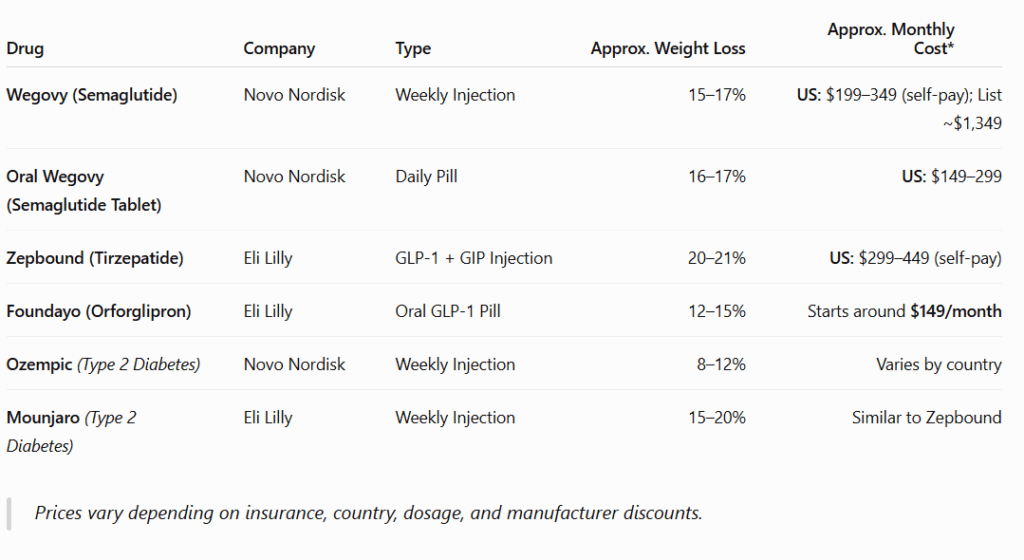
Cost of GLP-1 Drugs Available in the Market (2026)
GLP-1 Drugs Available in the Market (2026)
- Wegovy (Semaglutide)
- Company: Novo Nordisk
- Type: Weekly Injection
- Approx. Weight Loss: 15–17%
- Approx. Monthly Cost: US: $199–349 (self-pay); List Price: ~$1,349
- Oral Wegovy (Semaglutide Tablet)
- Company: Novo Nordisk
- Type: Daily Pill
- Approx. Weight Loss: 16–17%
- Approx. Monthly Cost: US: $149–299
- Zepbound (Tirzepatide)
- Company: Eli Lilly
- Type: GLP-1 + GIP Weekly Injection
- Approx. Weight Loss: 20–21%
- Approx. Monthly Cost: US: $299–449 (self-pay)
- Foundayo (Orforglipron)
- Company: Eli Lilly
- Type: Oral GLP-1 Pill
- Approx. Weight Loss: 12–15%
- Approx. Monthly Cost: Starts at $149/month
- Ozempic(Approved for Type 2 Diabetes; commonly used off-label for weight loss)
- Company: Novo Nordisk
- Type: Weekly Injection
- Approx. Weight Loss: 8–12%
- Approx. Monthly Cost: Varies by country and insurance coverage
- Mounjaro(Approved for Type 2 Diabetes; Tirzepatide)
- Company: Eli Lilly
- Type: Weekly Injection
- Approx. Weight Loss: 15–20%
- Approx. Monthly Cost: Similar to Zepbound (market and insurance dependent)
Next-Generation Obesity Drugs in Development (2026)
1. Retatrutide (“Triple Agonist”)
Often considered the most anticipated obesity drug in development.
Targets:
- GLP-1
- GIP
- Glucagon
Early and late-stage trials have shown weight-loss results exceeding many existing therapies, leading some experts to describe it as a potential game-changer in obesity medicine.
2. CagriSema
Combination of:
- Semaglutide
- Cagrilintide (Amylin analogue)
This dual-action approach aims to improve satiety and appetite control beyond conventional GLP-1 treatment. Regulatory filings and late-stage studies have kept it among the most closely watched obesity medicines.
3. MariTide
Developed by Amgen, MariTide is attracting attention because of its long-acting profile and substantial weight-loss results in trials. Some analysts view it as one of the strongest challengers to existing market leaders.
4. Survodutide
A dual GLP-1 and glucagon receptor agonist.
Recent Phase III results demonstrated significant weight loss and potential benefits for reducing visceral fat and fatty liver disease (MASH), making it attractive beyond obesity treatment alone.
5. Amycretin and UBT251
These experimental therapies represent the next wave of multi-target obesity medicines. Early studies suggest they may deliver even greater metabolic benefits through simultaneous activation of multiple hormone pathways.
Emerging Trend: From Injections to Pills
One of the most important developments in 2026 is the shift toward oral obesity medicines.
Until recently, highly effective weight-loss treatments required weekly injections. Drugs like Orforglipron and oral semaglutide are changing that equation, potentially making obesity treatment cheaper, more accessible, and easier to scale globally.
Why This Matters
The obesity drug market is rapidly becoming one of the largest pharmaceutical sectors in history. Analysts project a market worth well over $100 billion annually within the next decade. The competition is no longer just between Wegovy and Zepbound; it now includes triple agonists, amylin combinations, oral GLP-1s, and precision metabolic therapies.
Key Takeaway
The biggest obesity breakthrough of 2026 is not a single drug but the emergence of multi-hormone metabolic therapies. From Retatrutide and CagriSema to MariTide, Survodutide, and Orforglipron, medicine is moving toward treatments that deliver surgery-like weight loss through targeted biological pathways—potentially transforming the fight against one of the world’s fastest-growing health challenges.
Reference: Reuters, Novo Nordisk, Eli Lily
Disclaimer: This article is for informational and educational purposes only. Drug prices, availability, approvals, and clinical data may vary by country, dosage, insurance coverage, and regulatory updates. Always consult a qualified healthcare professional before starting, stopping, or changing any obesity or diabetes medication. This article does not constitute medical advice.