Gold has always represented scarcity, trust and stored value. But the next generation of strategic wealth may not come from traditional precious metals.
As AI accelerates, energy demand rises, populations grow and geopolitical competition intensifies, the world’s most valuable assets could be the resources that power, feed, connect and sustain civilisation.
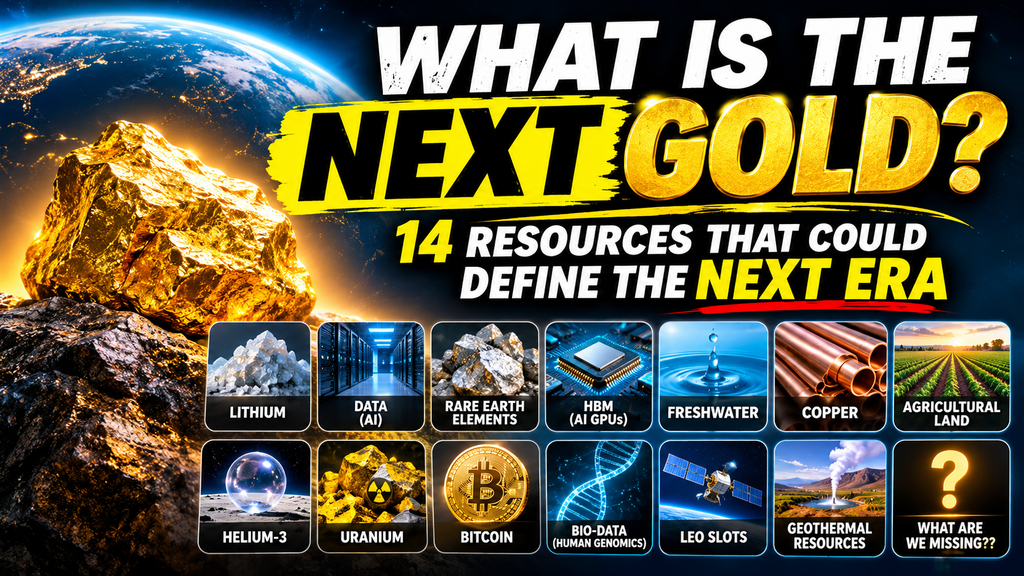
Here are 14 contenders for the next gold — and why they matter.
1. Lithium — The Metal Behind Electrification
Lithium is essential to batteries used in electric vehicles, grid-scale energy storage and portable electronics. As economies move towards electrification, demand for reliable battery supply chains makes lithium strategically important.
2. Data — The New Oil of Artificial Intelligence
AI models are only as valuable as the data used to train and improve them. High-quality, proprietary, accurately labelled and legally usable datasets can become powerful competitive advantages. In the AI economy, data is not just information; it is an input to intelligence.
3. Rare Earth Elements — The Backbone of Modern Technology
Rare earth elements are critical for high-performance magnets, electric motors, wind turbines, defence systems and advanced electronics. Their importance is amplified by concentrated global supply chains and the difficulty of developing alternative sources.
4. High-Bandwidth Memory (HBM) — The Fuel for AI Computing
AI GPUs need enormous amounts of fast memory to process increasingly complex models. HBM enables high-speed data movement between processors and memory. As AI infrastructure expands, advanced memory could become as strategically important as the chips themselves.
5. Freshwater — The Ultimate Resource Constraint
Water is essential for agriculture, industry, human survival and energy production. Climate change, groundwater depletion and population growth are increasing pressure on freshwater supplies. Unlike many commodities, water has no practical substitute.
6. Copper — The Metal of Electrification
Electric vehicles, power grids, renewable energy systems, data centres and industrial infrastructure all require copper. Electrification means more demand for electrical conductivity, while new mines take years to develop. Supply constraints could become increasingly important.
7. Agricultural Land — The Foundation of Food Security
Arable land is finite, geographically concentrated and difficult to replace. Population growth, climate volatility and food security concerns make productive agricultural land a strategic asset, not merely a real estate investment.
8. Helium-3 — A Potential Future Energy Resource
Helium-3 is being explored for its potential role in advanced fusion research and has applications in specialised scientific and cryogenic technologies. Its potential association with lunar resources has attracted attention. However, commercial fusion using helium-3 remains highly speculative.
9. Uranium — The Strategic Fuel for Nuclear Energy
As countries seek reliable, low-carbon baseload electricity, nuclear power is receiving renewed attention. Uranium is the primary fuel for most commercial nuclear reactors. Energy security and expanding nuclear capacity could strengthen its strategic importance.
10. Bitcoin — Digital Scarcity in a Connected World
Bitcoin has a mathematically limited supply of 21 million coins and operates without a central issuing authority. Its supporters view it as a decentralised store of value and an alternative monetary asset. Its volatility, regulatory uncertainty and adoption risks remain significant.
11. Bio-Data — The Next Frontier of Personalised Medicine
Human genomic and biological data could transform drug discovery, disease prediction, diagnostics and personalised healthcare. As biotechnology advances, large, diverse and ethically collected biological datasets may become increasingly valuable. Privacy, consent and ownership will be critical.
12. Low Earth Orbit (LEO) Capacity — The New Strategic Real Estate
Low Earth Orbit is becoming increasingly important for satellite internet, Earth observation, communications and defence. Orbital congestion, spectrum rights, coordination requirements and physical orbital capacity could make access to valuable orbital positions and operating infrastructure strategically important.
13. Geothermal Resources — Energy Beneath Our Feet
Geothermal energy offers reliable, round-the-clock electricity with relatively low emissions. Advances in enhanced geothermal systems could unlock resources beyond traditional volcanic regions. This could make underground heat an important component of future energy security.
14. What Are We Missing?
Other contenders deserve attention:
- Semiconductor manufacturing capacity: The foundation of the digital economy.
- Grid infrastructure and transformers: Electricity generation means little without transmission and distribution.
- Energy storage: Essential for balancing intermittent renewable power.
- Compute capacity: Access to advanced processors and data-centre infrastructure.
- Carbon removal capacity: Potentially valuable as climate regulation and decarbonisation pressures increase.
- Phosphate and potash: Critical inputs for global food production.
- Antimony and gallium: Important materials for defence, electronics and advanced manufacturing.
- Spectrum rights: Increasingly valuable for communications and connectivity.
The Bigger Picture
The next gold will not necessarily be the rarest resource. It will be the resource that combines three characteristics:
- Scarcity: Supply is limited, concentrated or difficult to expand.
- Strategic necessity: The global economy cannot easily function without it.
- High barriers to substitution: Replacing it is expensive, difficult or technologically challenging.
Gold was valuable because people trusted it and its supply was constrained.
Tomorrow’s strategic assets may derive their value from something different: their ability to keep the modern world running.
The real question is no longer just what is scarce. It is what the world cannot afford to run out of.