
For more than 14 years, NASA’s Curiosity rover has rewritten what we know about Mars. It has uncovered ancient lakebeds, sulfur crystals, organic molecules, and evidence that the Red Planet once had conditions suitable for microbial life. Now, the rover has stumbled upon another geological mystery—a vast honeycomb-like landscape unlike anything previously observed on Mars.
The remarkable discovery, announced by NASA’s Jet Propulsion Laboratory, could provide fresh clues about the planet’s ancient climate and geological evolution.
A Sea of Honeycomb Patterns
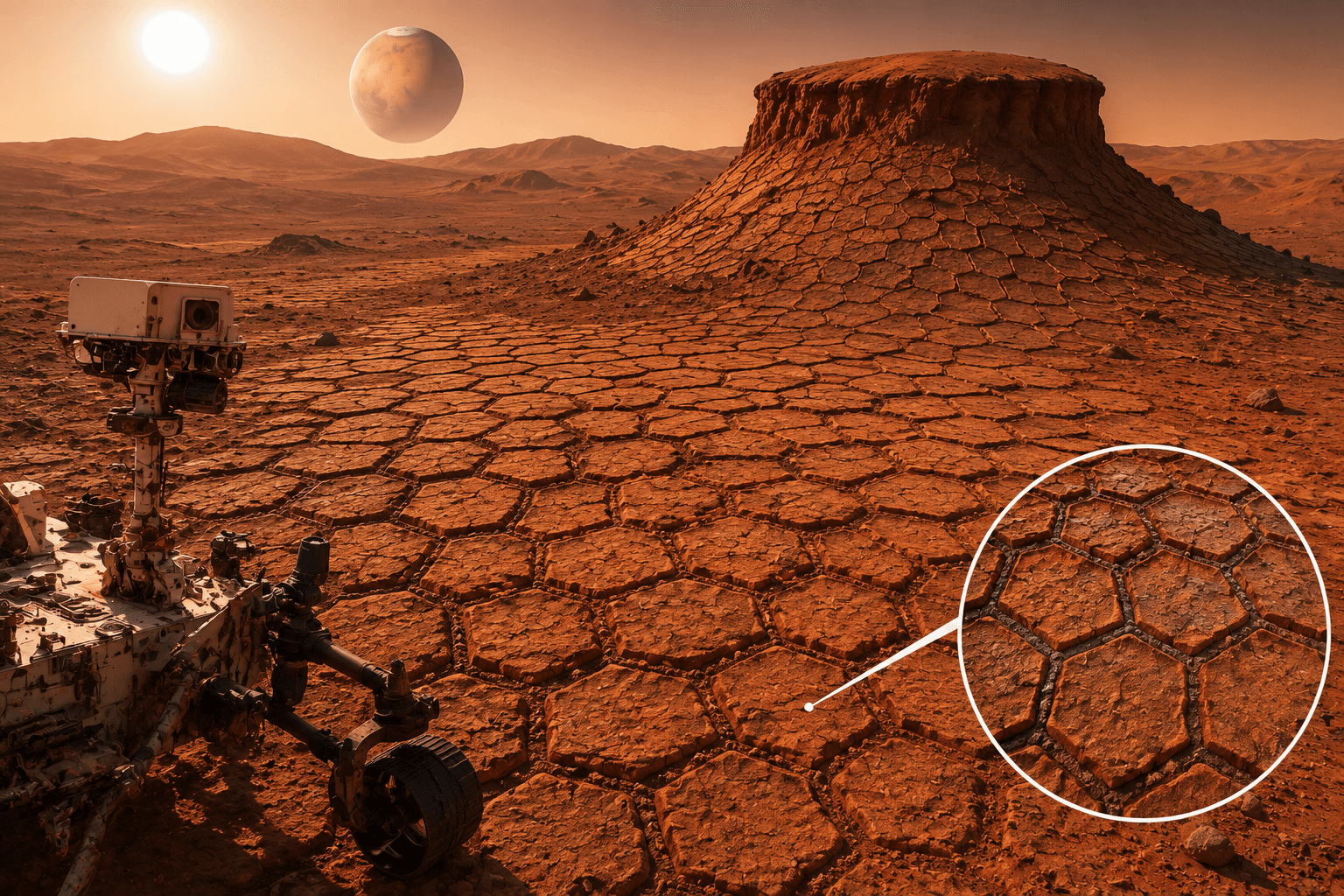
While exploring a Martian valley known as Valle Grande, Curiosity encountered an enormous field of polygon-shaped fractures covering the ground.
Unlike earlier discoveries, where only small clusters of these geometric patterns were seen, the new formations stretch across the landscape as far as the rover’s cameras can see.
Each polygon measures only 4–8 centimeters (1.5–3 inches) across, creating an intricate honeycomb appearance that blankets the valley floor.
Even more intriguing, the same patterns continue up the sides of a nearby 6-meter (20-foot) butte nicknamed Miraflores, suggesting the process that created them affected an extensive area.
NASA scientists described the landscape as one of the mission’s most breathtaking discoveries.
What Created These Strange Patterns?
Although the formations resemble dried mud cracks on Earth, scientists believe several geological processes could be responsible.
Some leading possibilities include:
- Ancient mud repeatedly drying and cracking after water evaporated.
- Cycles of heating and cooling that fractured the surface over millions of years.
- Compression of buried sediments that forced water out, creating polygonal cracks.
- A combination of multiple geological processes acting over long periods.
Curiosity is now analyzing both the shape and chemical composition of the rocks to determine which explanation best fits the evidence.
Another Piece of Mars’ Ancient Water Story
The discovery is especially important because Curiosity has spent years climbing Mount Sharp, exploring rock layers that preserve Mars’ environmental history.
Billions of years ago, this region contained:
- Rivers
- Lakes
- Groundwater systems
- Sediments capable of preserving chemical signatures
Previous discoveries by Curiosity include:
- Organic carbon molecules
- Clay minerals formed in water
- Sulfur-rich rocks
- Evidence of long-lasting freshwater environments
Together, these findings strongly suggest Mars once had conditions capable of supporting microbial life, even though scientists have not found direct evidence that life actually existed.
Why This Discovery Matters
Polygonal fracture networks are valuable geological records.
On Earth, similar formations help scientists reconstruct:
- Ancient climate conditions
- Wet and dry environmental cycles
- Sediment formation
- Water activity over geological time
Finding such an extensive polygon field on Mars could reveal how water behaved billions of years ago and improve our understanding of how the planet gradually transformed into the cold, dry world seen today.
The fact that the patterns extend over both flat terrain and elevated rock formations suggests they were created before later erosion reshaped the landscape.
Curiosity Still Keeps Surprising Scientists
Curiosity landed inside Gale Crater on August 5, 2012, with a mission to determine whether Mars was ever habitable.
Fourteen years later, the rover continues to exceed expectations.
Its latest honeycomb landscape demonstrates that Mars still holds geological secrets waiting to be uncovered. Every new discovery helps researchers reconstruct the planet’s ancient history and guides future missions searching for evidence of past life.
As Curiosity continues exploring the slopes of Mount Sharp, this mysterious “sea of polygons” may become another key piece in solving one of science’s biggest questions: What was ancient Mars really like—and could life once have existed there?