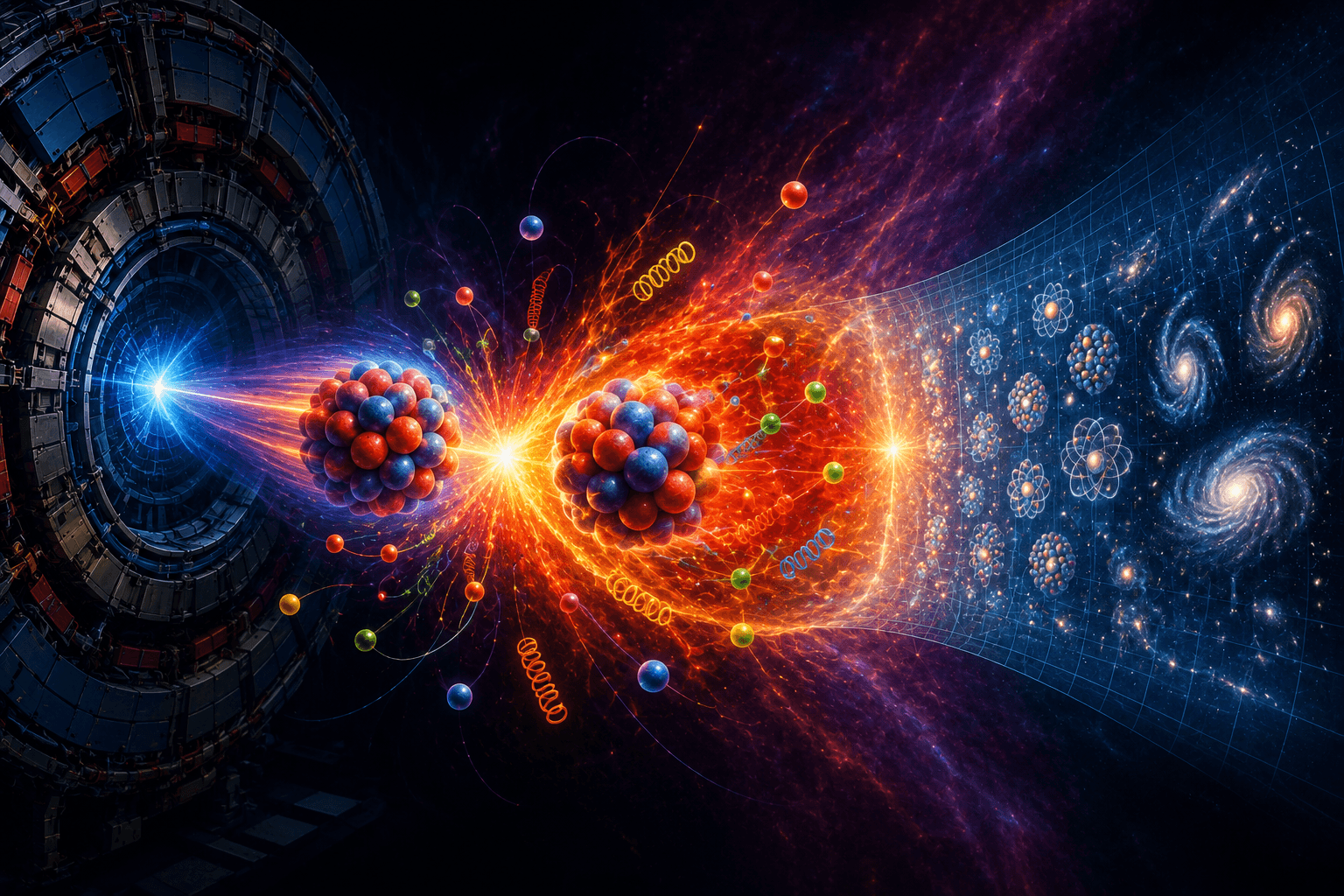
Just microseconds after the Big Bang, the Universe looked nothing like it does today. Instead of atoms, stars, or galaxies, it was filled with an ultra-hot, dense soup of free quarks and gluons—a state known as the Quark–Gluon Plasma (QGP).
Now, scientists at CERN have found fresh evidence that this primordial matter can form in far smaller particle collisions than previously believed, opening a new chapter in our understanding of the early Universe.
What Is Quark–Gluon Plasma (QGP)?
Quark–Gluon Plasma (QGP) is an extreme state of matter where quarks and gluons—the fundamental building blocks of protons and neutrons—are no longer bound together.
To create QGP, temperatures must exceed 100,000 times the temperature at the Sun’s core, recreating conditions that existed during the Universe’s first few millionths of a second.
Physicists generate these conditions using the Large Hadron Collider (LHC), the world’s most powerful particle accelerator.
CERN’s New Discovery
All four major LHC experiments—ALICE, ATLAS, CMS, and LHCb—have now reported signs that oxygen-oxygen and neon-neon collisions may briefly produce Quark–Gluon Plasma.
This is significant because scientists previously believed that only very heavy ions, such as lead nuclei, could generate enough energy and pressure to create QGP.
The latest findings suggest that lighter atomic nuclei may also be capable of producing this primordial state of matter, challenging long-held assumptions in particle physics.
How Did Scientists Detect It?
Researchers looked for several characteristic signatures of QGP:
- Parton Energy Loss: Fast-moving quarks and gluons lose energy while passing through the dense plasma, creating an imbalance in high-energy particle jets.
- Particle Suppression: Fewer energetic particles emerge from collisions than expected because they are slowed inside the plasma.
- Heavy Quark Suppression: Particles containing bottom or charm quarks disappear more readily in denser collision environments.
- Anisotropic Flow: The plasma behaves like an almost perfect liquid, transferring its collective motion to newly formed particles.
Finding multiple independent signatures across different experiments greatly strengthens the evidence for QGP formation.
Why It Matters
Understanding Quark–Gluon Plasma helps scientists answer one of physics’ biggest questions:
How did ordinary matter form after the Big Bang?
By recreating QGP inside the LHC, researchers can study how the earliest matter cooled and combined into protons, neutrons, atoms, stars, planets, and eventually life itself.
The discovery also provides new insights into Quantum Chromodynamics (QCD)—the fundamental theory describing the strong nuclear force that binds atomic nuclei together.
What Comes Next?
CERN is upgrading the accelerator into the High-Luminosity Large Hadron Collider (HL-LHC), which will produce vastly more collisions and higher-quality data.
With these upgrades, physicists hope to map the properties of Quark–Gluon Plasma in unprecedented detail and determine exactly how the Universe transitioned from its primordial plasma into the matter-filled cosmos we observe today.
As evidence continues to grow, QGP is no longer seen as a phenomenon exclusive to massive lead-ion collisions. Even lighter atomic nuclei are proving capable of recreating one of the oldest forms of matter in cosmic history, bringing scientists another step closer to understanding the Universe’s very first moments.