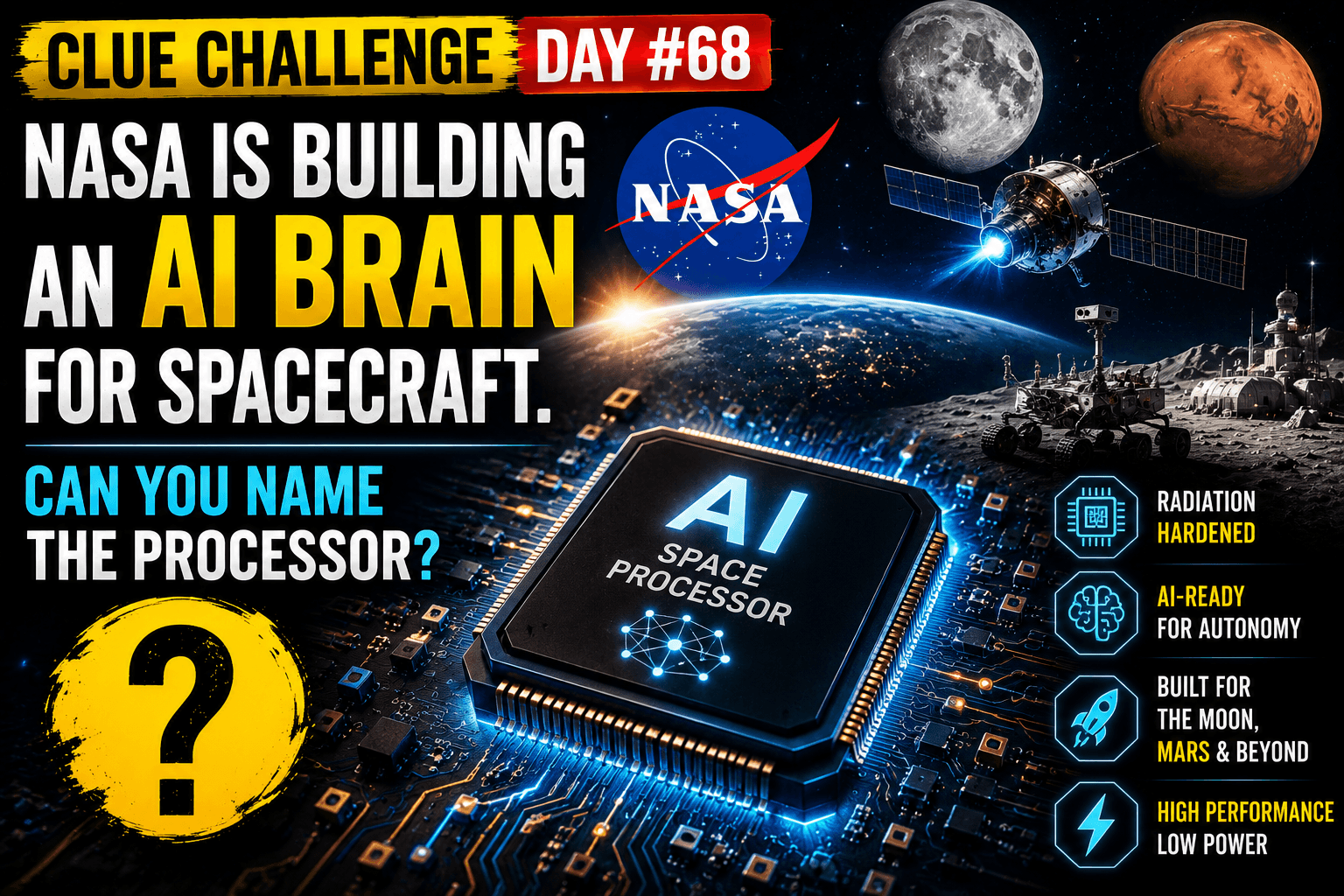
One processor. Five clues. Built for the Moon, Mars and beyond. Radiation-proof. AI-ready. All real. All 2026.
Modern AI chips dominate data centres on Earth—but they cannot survive the brutal conditions of deep space. Now, NASA and its partners have built a next-generation processor designed to think, adapt and make decisions millions of kilometres from Earth. It is expected to power future lunar bases, Mars missions and autonomous spacecraft. Can you name the processor before the final clue?
Clue #1 — Earth’s fastest AI chips would quickly fail in space
Space is unforgiving.
Cosmic radiation, extreme temperature swings and constant exposure to energetic particles can permanently damage conventional computer chips. A processor inside a spacecraft cannot simply be rebooted or replaced.
That’s why NASA has spent years developing a completely new computing platform—one capable of surviving where ordinary processors cannot.
Its goal is simple: give future spacecraft enough computing power to make intelligent decisions without constantly waiting for instructions from Earth.
Clue #2 — It delivers around 100 times more computing power than today’s space computers
For decades, many NASA missions relied on radiation-hardened processors that prioritised reliability over speed.
The new processor changes that equation.
It is expected to provide roughly 100 times the computing capability of many currently deployed spaceflight processors while consuming relatively little power—opening the door to real-time AI, advanced robotics, autonomous navigation and scientific data analysis directly onboard the spacecraft.
Instead of sending enormous volumes of raw data back to Earth, future missions can analyse information instantly and transmit only the most valuable discoveries.
Clue #3 — It was built for Artemis, Mars and deep-space exploration
The processor is designed to become the digital brain of NASA’s next generation of missions.
Potential applications include:
- Autonomous lunar rovers
- Deep-space probes
- Planetary landers
- Space stations
- Future Mars missions
- Intelligent satellites
As communication delays increase with distance—up to 20 minutes one way between Earth and Mars—spacecraft must increasingly think for themselves.
Artificial intelligence makes that possible.
Clue #4 — It wasn’t built by NASA alone
NASA partnered with leading American semiconductor and aerospace companies to develop the processor.
The project combines radiation-hardened engineering with modern multi-core computing architecture, allowing software developers to run far more complex applications than ever before.
The processor also supports open software development, making it easier for researchers, universities and commercial space companies to build next-generation space applications.
Its success could establish a common computing platform for missions across the coming decade.
Clue #5 — Its name tells you exactly what it does
Here’s your strongest clue.
The answer is not a spacecraft.
It is not an AI model.
It is not a satellite.
Its four-letter acronym begins with the word High.
The second word describes computing performance.
The third refers to spaceflight.
The final word is simply processor.
Put those four words together and you have the official name of NASA’s newest AI-ready space computer.
So… what is this processor?
- Designed for future Moon and Mars missions
- Around 100× more powerful than many existing spaceflight processors
- Built to survive cosmic radiation
- Supports onboard AI and autonomous decision-making
- Developed through NASA’s Space Technology Mission Directorate with industry partners
- Expected to become the computing backbone of future deep-space exploration
Can you guess its official name before checking the answer?
Bonus Challenge
Can you also answer these?
- Which NASA programme aims to return astronauts to the Moon using technologies like this?
- Why must space processors be radiation-hardened?
- Approximately how long can a one-way communication delay between Earth and Mars become?
- Which NASA directorate is leading development of next-generation space computing technologies?
Drop your answer below. The next giant leap in space exploration may not be another rocket—it may be a smarter computer. Day #69 arrives tomorrow.
Missed Yesterday Challenge?

Answer to Yesterday’s Challenge: DAY #67
(Click above to reveal)