
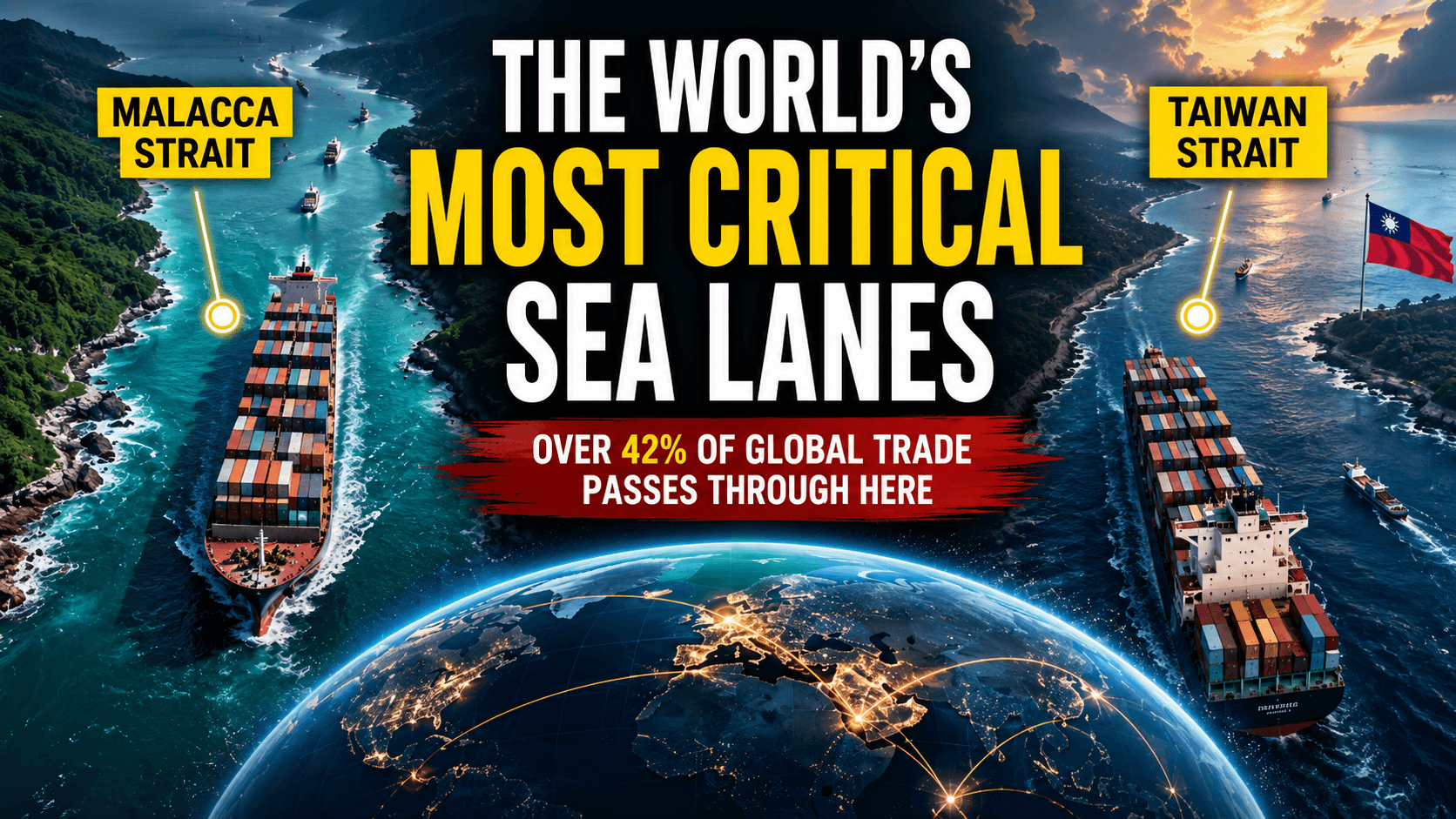
Global trade depends not only on ports and ships but also on a handful of strategic maritime chokepoints. Among them, the Malacca Strait and the Taiwan Strait have emerged as the world’s two most important sea lanes, each carrying over one-fifth of global maritime trade. Recent geopolitical tensions in the Indo-Pacific have once again highlighted how disruptions in these narrow waterways could ripple across the global economy.
Why Are Maritime Chokepoints Important?
Maritime chokepoints are narrow sea passages through which a large share of global shipping must pass. Because alternative routes are often longer and costlier, any blockage or conflict can delay trade, raise freight costs, and disrupt global supply chains.
The World’s Most Important Trade Straits
Based on the latest global trade data:
| Strait | Trade Value | Share of Global Maritime Trade |
|---|---|---|
| Malacca Strait | $2.46 Trillion | 21.11% |
| Taiwan Strait | $2.45 Trillion | 21.02% |
| Sunda Strait | $396 Billion | 3.40% |
| Luzon Strait | $290 Billion | 2.49% |
| Mindoro Strait | $283 Billion | 2.43% |
| Makassar Strait | $182 Billion | 1.56% |
| Balabac Strait | $174 Billion | 1.49% |
| Lombok Strait | $133 Billion | 1.14% |
Together, the Malacca and Taiwan Straits account for more than 42% of global maritime trade, making them indispensable to the world economy.
Why the Malacca Strait Is Crucial
Located between Indonesia, Malaysia, and Singapore, the Malacca Strait connects the Indian Ocean with the South China Sea. It is the shortest maritime route between Asia, Europe, and the Middle East.
The strait carries:
- Energy supplies from the Persian Gulf to East Asia.
- Container shipments linking Asian factories with global markets.
- A significant share of India’s seaborne trade.
Any disruption would force ships to take longer routes through the Lombok or Sunda Straits, increasing shipping time and transportation costs.
Why the Taiwan Strait Matters
The Taiwan Strait has become one of the world’s most strategically sensitive waterways. It is a major corridor for:
- Semiconductor exports from Taiwan.
- Electronics supply chains.
- Trade between Northeast Asia and Southeast Asia.
With Taiwan playing a central role in advanced chip manufacturing, instability in the region could affect industries ranging from smartphones to automobiles and artificial intelligence.
Why India Should Care
India’s economy depends heavily on secure sea lanes through the Indo-Pacific.
Any disruption in these chokepoints could lead to:
- Higher import costs.
- Increased oil prices.
- Delays in exports.
- Supply chain disruptions.
- Rising inflation.
This explains India’s growing focus on SAGAR (Security and Growth for All in the Region), the Indo-Pacific Oceans Initiative (IPOI), maritime partnerships through the Quad, and strengthening its naval presence in the Indian Ocean Region.
The Bigger Picture
Recent geopolitical developments—including tensions in the Taiwan Strait, disputes in the South China Sea, and concerns over global supply-chain resilience—have reinforced one reality: control of strategic sea lanes is increasingly linked to economic security.
Countries are now investing in alternative shipping routes, resilient logistics networks, and stronger maritime cooperation to reduce dependence on a few vulnerable chokepoints.
Key Takeaway
The Malacca Strait and Taiwan Strait are the twin arteries of global commerce, each handling over $2.4 trillion in annual trade. As geopolitical competition intensifies in the Indo-Pacific, safeguarding these maritime chokepoints has become essential not only for regional stability but also for the uninterrupted flow of global trade, energy, and critical technologies.