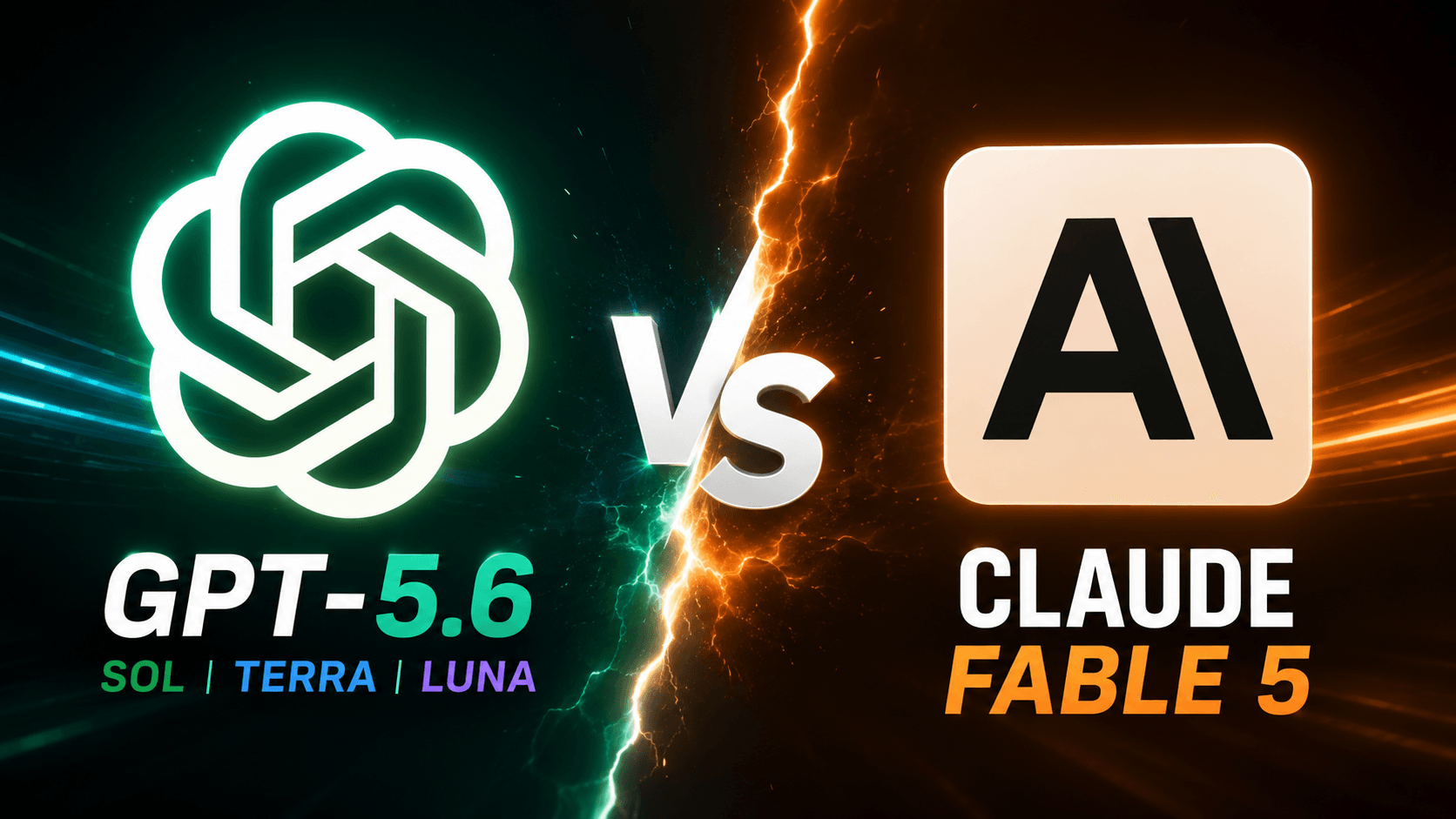
The battle for AI supremacy has entered a new phase.
Just days after Anthropic restored access to its Claude Fable 5 models following a brief suspension caused by U.S. export-control issues, OpenAI responded with its biggest release of the year—the GPT-5.6 family, introducing GPT-5.6 Sol, Terra, and Luna. Rather than launching a single flagship model, OpenAI unveiled three capability tiers aimed at different users, from enterprise developers to cost-conscious startups.
The launch has reignited one of the biggest questions in artificial intelligence:
Has GPT-5.6 finally surpassed Anthropic’s Claude Fable 5?
The answer is yes in some areas—but not all.
Meet the GPT-5.6 Family
OpenAI’s new lineup introduces a tiered approach to frontier AI.
- GPT-5.6 Sol – the flagship model for advanced reasoning, coding, scientific research, cybersecurity, and AI agents.
- GPT-5.6 Terra – a balanced model designed for everyday professional work.
- GPT-5.6 Luna – the fastest and most affordable option for high-volume tasks.
OpenAI says this structure allows each model tier to evolve independently while giving developers more flexibility over performance, speed, and cost.
Where GPT-5.6 Sol Takes the Lead
OpenAI’s strongest claim is efficiency.
According to the company, GPT-5.6 Sol now leads the Artificial Analysis Coding Agent Index, scoring 80, about 2.8 points ahead of Claude Fable 5. More importantly, it achieves that score while using less than half the output tokens, completing tasks in less than half the time, and at roughly one-third lower estimated cost.
OpenAI also reports that GPT-5.6 Sol sets new records on several demanding evaluations, including:
- Agents’ Last Exam, which measures long-running professional workflows across dozens of domains.
- BrowseComp, evaluating complex web research.
- OSWorld 2.0, which tests AI performance in real computer-use tasks.
- Terminal-Bench 2.1 and DeepSWE, focused on software engineering and command-line workflows.
These results suggest GPT-5.6 excels at operating as an autonomous AI agent capable of completing complex, multi-step work.
Where Claude Fable 5 Still Dominates
Despite OpenAI’s progress, Anthropic retains a significant advantage in one benchmark that many software engineers consider especially important.
On SWE-Bench Pro, which measures an AI model’s ability to understand large codebases and fix real software bugs, Claude Fable 5 scores 80.3%, while GPT-5.6 Sol scores 64.6%.
That gap indicates Claude remains exceptionally strong at precise debugging and making targeted changes within unfamiliar production code. Independent analysts note that this benchmark reflects a different skill from broader workflow automation, so leadership depends on the type of task being measured.
Why Both Companies Can Claim Victory
At first glance, the competing benchmark results appear contradictory.
In reality, they measure different capabilities.
Think of it this way:
- Claude Fable 5 performs like an expert software engineer brought in to diagnose and repair a critical bug inside a massive, unfamiliar codebase.
- GPT-5.6 Sol behaves more like a technical project manager who can install software, configure systems, coordinate multiple tools, troubleshoot problems, and complete long sequences of tasks.
Neither approach is universally better.
They simply optimize for different kinds of work.
OpenAI’s Bigger Bet: AI Agents
The GPT-5.6 launch is about more than benchmark scores.
OpenAI simultaneously introduced ChatGPT Work, an agentic workspace built around GPT-5.6 that can read emails, summarize documents, generate presentations, organize dashboards, write code, and complete recurring workflows using connected business tools.
This places OpenAI in direct competition with Anthropic’s enterprise agent platform, reflecting a broader industry shift from conversational chatbots to AI systems capable of independently completing real-world tasks.
Safety Remains Central
The GPT-5.6 rollout also reflects growing attention to AI governance.
OpenAI says GPT-5.6 includes its most robust safety stack to date, combining human red-teaming, automated evaluations, real-time monitoring, and stronger protections against misuse in cybersecurity and other sensitive domains.
The cautious rollout follows months of increased scrutiny over frontier AI models and the need to balance powerful capabilities with responsible deployment.
So, Has GPT-5.6 Beaten Claude?
The evidence suggests there is no single winner.
If your priority is coding efficiency, autonomous agents, lower operating costs, and long-horizon professional workflows, GPT-5.6 Sol currently has a compelling advantage.
If your work depends on deep software engineering, careful code review, and precise bug fixing, Claude Fable 5 continues to lead on one of the industry’s most respected coding benchmarks.
The AI race is no longer about one model dominating every category.
Instead, it has become a contest of specialized strengths—where efficiency, cost, safety, and task-specific performance matter just as much as raw intelligence.
For developers and businesses, that is perhaps the biggest takeaway from OpenAI’s GPT-5.6 launch: choosing the best AI increasingly depends on what you need it to do, not simply which model sits at the top of a leaderboard.