
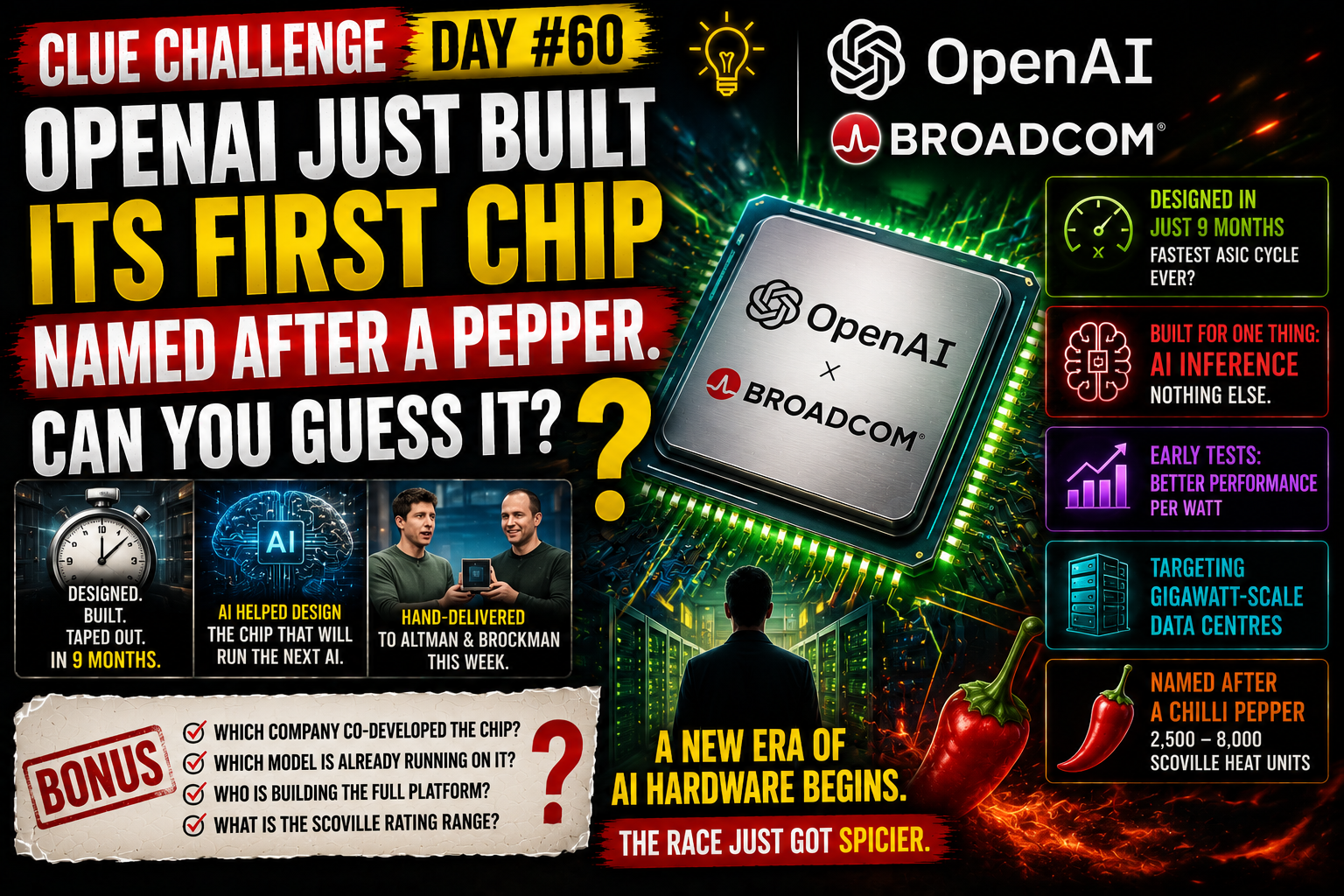
One chip. Five clues. Designed in nine months. Better than Nvidia. Named after something in your kitchen. All real. All June 2026.
For years, the world’s most powerful AI company ran entirely on chips it didn’t design. That changed this week.OpenAI just unveiled its first ever custom silicon — an inference accelerator built from scratch around one obsessive question: What does a chip look like if you design it purely for AI, not for anything else?
Can you name it before the final clue?
Clue #1 — It was built from scratch for one purpose — and one purpose only
Every major AI chip before this one began life as a general-purpose accelerator — then was adapted for AI workloads. This chip was different from day one.
Its designers started with a blank slate. No legacy architecture. No compromises from previous generations. Every design decision — memory movement, compute balance, networking, scheduling — was optimised around a single goal: making large language model inference faster, cheaper, and more reliable than anything currently available.
Early testing shows it will deliver performance per watt substantially better than the current state of the art.
“We optimised the architecture around the kernels, memory movement, networking, and serving patterns that matter most for frontier AI models,” said the head of the hardware program.
Clue #2 — It was designed, built, and taped out in just nine months — the fastest ASIC cycle in history
Most advanced custom chips take three to five years from initial design to manufacturing tape-out. This one took nine months.
The speed was made possible by three factors: deep software-hardware co-development between two major technology companies, advanced silicon implementation expertise, and — in a striking twist — the use of the very AI models this chip is designed to run, to help accelerate parts of the chip’s own design and optimisation process.
The same models served to users every day helped design the infrastructure that will run the next generation of those models. AI helping build a faster AI chip — so that chip can train a better AI — which then helps design the next chip.
Clue #3 — It was physically handed to Sam Altman and Greg Brockman this week — by Broadcom’s CEO
The chip was delivered in person to OpenAI’s CEO and President by the President and CEO of Broadcom — one of the world’s largest semiconductor companies — marking the first physical handoff of OpenAI’s first ever piece of custom silicon.
Broadcom is the semiconductor partner. Celestica is the board and rack integration partner. Together they are building a multi-generation compute platform targeting initial deployment at gigawatt-scale data centres by the end of 2026 — with Microsoft named as the first major partner.
The chip is already running production-target ML workloads in the lab — including one of OpenAI’s most advanced coding models.
Clue #4 — It is named after something found in most home kitchens — and carries a specific heat level in its name
This is your most direct clue.
The chip is named after a food ingredient universally recognised across Latin America, Asia, and the world. It is a variety of chilli pepper — mildly to moderately hot, ranging from 2,500 to 8,000 on the Scoville scale. Widely used in Mexican cuisine. Green when unripe, red when mature.
Its name has three syllables. It starts with J. It ends in a vowel sound. It is the name of a pepper — and now, as of this week, the name of OpenAI’s first Intelligence Processor.
Clue #5 — It is designed to run every LLM in the industry — not just OpenAI’s own
This chip was not designed solely for ChatGPT or Codex. It was architected with flexibility to work across all large language models — guided by OpenAI’s deep understanding of inference patterns across the industry.
The long-term vision: by designing more of the technology stack themselves — from chip architecture to kernels to memory systems to networking to scheduling to the products people use — OpenAI can make intelligence faster, more reliable, and less expensive for students, developers, small businesses, and researchers worldwide.
“The world is moving to a compute-powered economy,” said OpenAI’s President. “By designing more of the stack ourselves, we can serve more intelligence with greater efficiency.”
A chip named after a pepper. Designed by an AI company. Partly designed using AI. To run AI faster than ever before. And its name — three syllables, starting with J — is growing hotter by the day.
So — what is this chip called?
OpenAI’s first custom silicon. Co-developed with Broadcom. Designed in nine months — the fastest ASIC development cycle in the history of high-performance semiconductors. Optimised entirely for LLM inference. Already running production workloads in the lab. Targeting gigawatt-scale data centre deployment by end of 2026. Named after a chilli pepper with a Scoville rating between 2,500 and 8,000.
Bonus — can you name:
- The semiconductor company that co-developed it with OpenAI
- The OpenAI model already running on it in the lab
- The board and rack integration partner completing the platform
- The Scoville heat rating range of the pepper it is named after
Drop your answer below. Unlike Wordle, this one is already running the models that beat Wordle. Day #61 arrives tomorrow.
Missed yesterday’s challenge?

Answer to Yesterday’s Challenge: DAY #59
(Click above to reveal)