When Elon Musk posted this week that humanity will one day spend “a trillion times a trillion dollars” making antimatter to travel to other star systems — and then clarified in a follow-up that by that point, “things won’t be measured in dollars… just mass and energy” — he wasn’t being poetic. He was, perhaps accidentally, summarizing the exact physics that makes antimatter propulsion both the most promising and most humbling concept in deep space travel.
Because antimatter isn’t just expensive. It’s the most expensive substance in the universe. And it might also be our only realistic ticket to the stars.
What Is Antimatter, and Why Does It Matter?
Every particle of ordinary matter has a corresponding antiparticle with the opposite charge. The antiparticle of a proton is an antiproton. The antiparticle of an electron is a positron. When matter meets antimatter, both annihilate completely, converting 100% of their combined mass into pure energy via Einstein’s E=mc².
This is what makes antimatter so extraordinary as a fuel source. Chemical rockets convert less than 0.001% of their fuel mass into energy. Nuclear fission converts roughly 0.1%. Nuclear fusion gets to about 0.7%. Antimatter annihilation? A perfect, theoretical 100%. Nothing in physics can beat it. It is the absolute ceiling of energy density the universe permits.
For interstellar travel, this matters enormously. The nearest star system, Alpha Centauri, is 4.37 light-years away. With current chemical propulsion, a spacecraft would take roughly 70,000 years to get there. A well-designed antimatter rocket could, in theory, make the trip in decades — perhaps as few as 40 years at a significant fraction of the speed of light.
How Would It Actually Work?
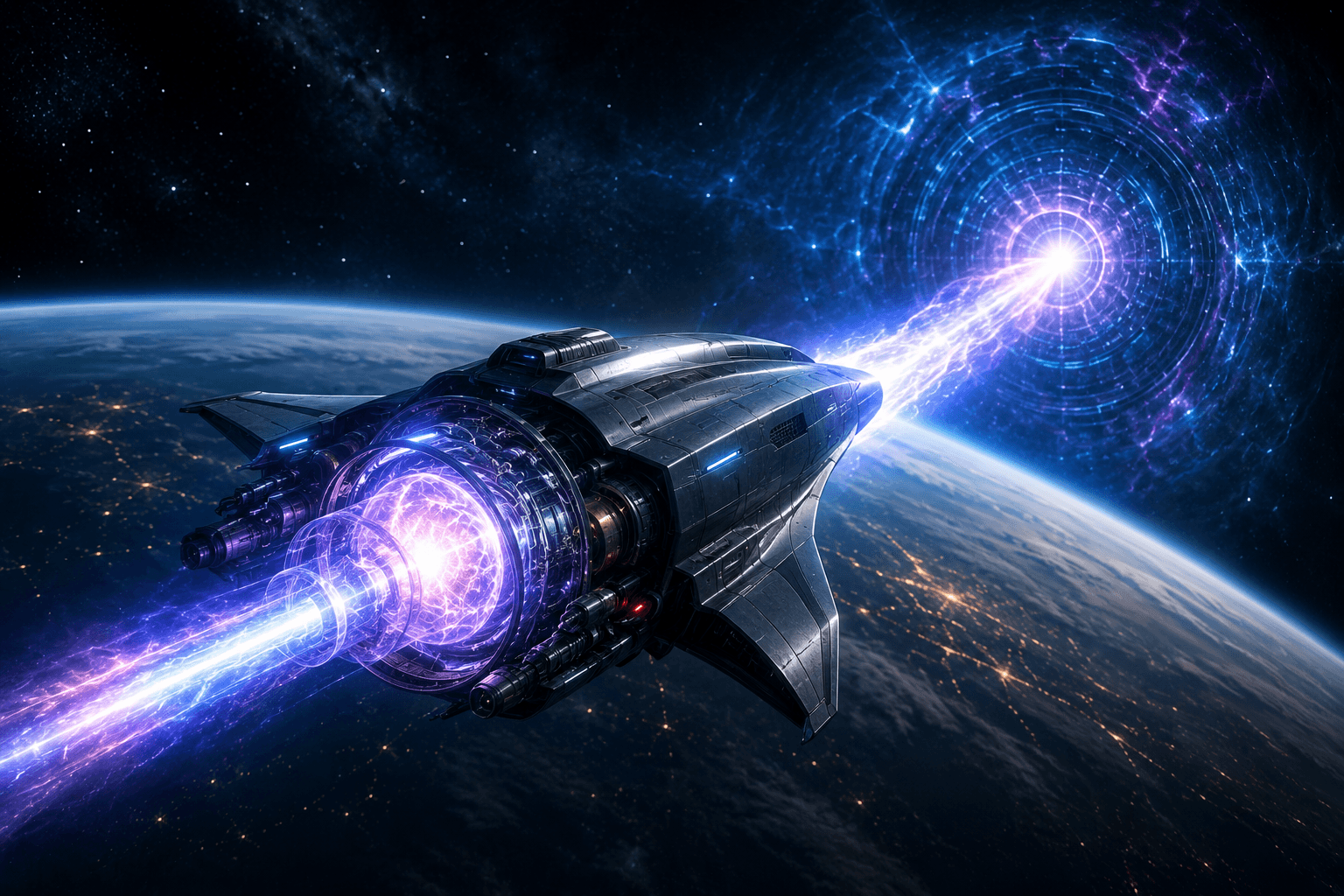
The most studied design is the antimatter-catalyzed fusion rocket and the pion rocket. In the latter, antiprotons annihilate with protons, producing charged pions — subatomic particles that travel at roughly 94% the speed of light. A magnetic nozzle can direct these pions as exhaust, generating thrust. No combustion, no chemical reaction, just pure physics channeling the violence of matter-antimatter annihilation into forward momentum.
Another approach is the “beam-core” engine, where equal quantities of hydrogen and antihydrogen are fed into a magnetic confinement chamber, annihilated, and the resulting energy directed for thrust. The specific impulse — a measure of fuel efficiency — would be millions of seconds. A Space Shuttle main engine achieves about 450 seconds. The difference is almost incomprehensible.
There are also hybrid designs: antimatter-catalyzed nuclear pulse propulsion, where tiny amounts of antimatter ignite pellets of fusion fuel, dramatically reducing the quantity of antimatter needed. This is seen as the more near-term viable approach, since producing even micrograms of antimatter is currently beyond our industrial capacity.
The Production Problem
Here is where Musk’s intuition about scale becomes relevant. Today, CERN produces antiprotons in quantities measured in nanograms per year, at a cost that makes gold look cheap — estimates range from $10 billion to $100 billion per gram. To fuel even a modest interstellar probe using pure antimatter annihilation would require kilograms of the stuff.
The gap between where we are and where we need to be is not a gap in decades. It’s a gap in civilization scale.
Producing antimatter requires massive particle accelerators. Storing it requires magnetic traps that must never fail — because if antimatter touches its container, it annihilates instantly. Scaling this from nanograms to kilograms would require energy inputs that dwarf the current global power grid. Which is exactly why Musk’s follow-up comment cuts to the core of the problem: the accounting unit for this endeavor is not dollars. It is joules. It is kilograms. It is the raw physical budget of an advanced civilization.
The Fermi Paradox Connection
Some physicists have noted that antimatter propulsion may serve as a kind of filter or marker in the search for intelligent life. A civilization capable of producing and storing antimatter at scale has, by necessity, mastered energy production at a planetary level. It is a Kardashev Type II technology — one that harnesses the output of an entire star.
The fact that we can describe antimatter drives theoretically, but cannot build them practically, says something precise about where we sit in the developmental arc of technological civilization. We understand the physics. We lack the infrastructure.
Where the Research Stands
NASA has funded preliminary antimatter propulsion studies, and groups at Penn State and CERN have explored antihydrogen synthesis and magnetic confinement. The Alpha Magnetic Spectrometer on the International Space Station has detected cosmic positrons, opening questions about natural antimatter sources. Some proposals suggest harvesting naturally occurring antiparticles trapped in Earth’s magnetosphere — though quantities remain far too small for propulsion purposes.
Progress is real but incremental. The physics is settled. The engineering is generational.
A Civilization-Scale Project
What Musk gestured at this week — perhaps more intuitively than he knew — is that interstellar travel is not an engineering problem in the ordinary sense. It is a civilizational project, measured not in dollars and timelines, but in the fundamental currencies of the cosmos: mass and energy.
Antimatter propulsion is humanity’s theoretical answer to the stars. The question isn’t whether it works. The question is whether we last long enough, and grow wise enough, to build it.