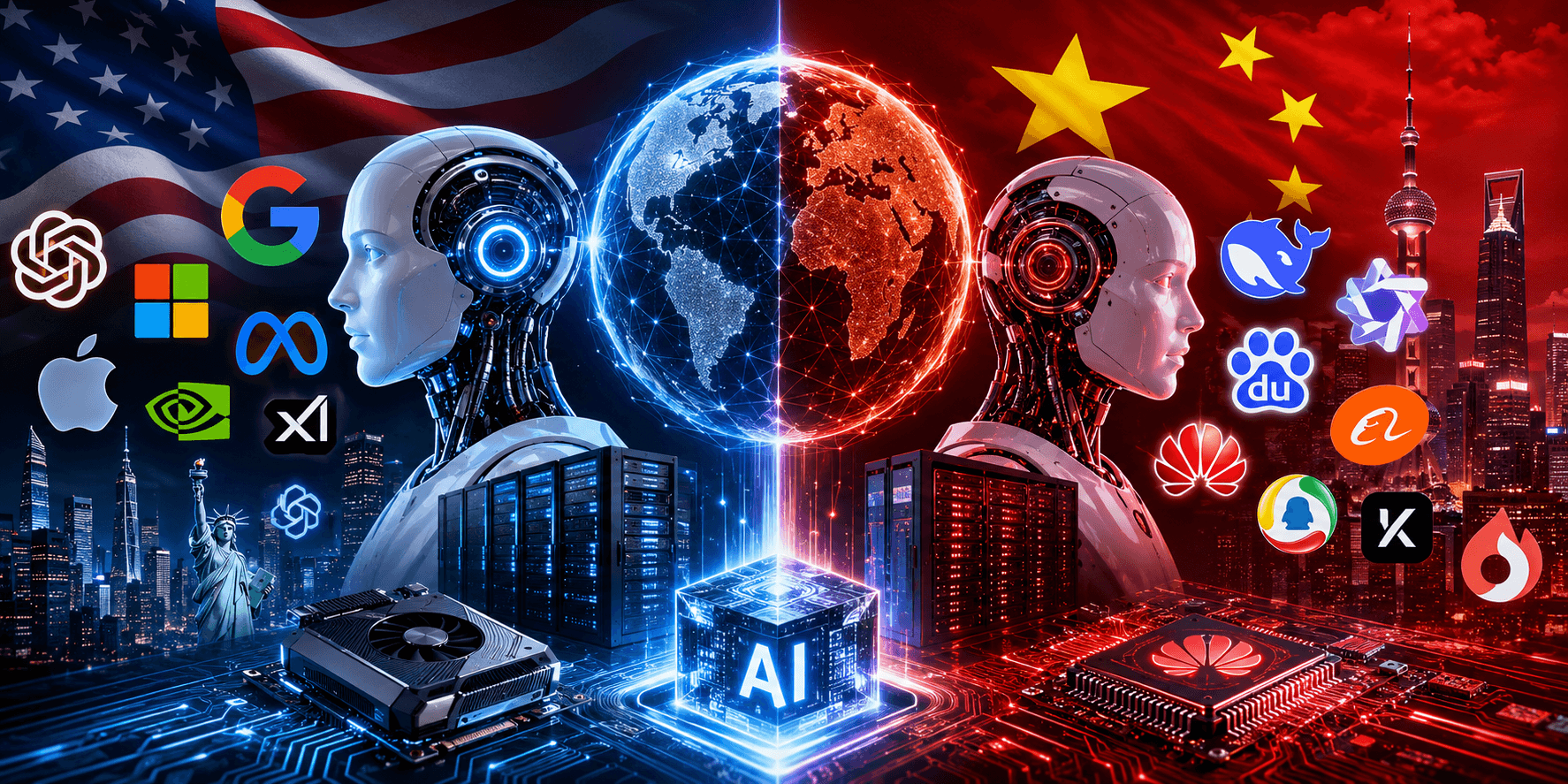
Artificial Intelligence is no longer just a technology trend. It has become a geopolitical competition between two superpowers: United States and China.
From advanced reasoning models and coding assistants to multimodal AI systems capable of video, voice, robotics, and scientific research, the AI race in 2026 is accelerating faster than ever before.
The United States still leads in frontier AI research and global infrastructure dominance. But China has rapidly closed the gap through open-source innovation, aggressive deployment, lower-cost models, and state-backed AI expansion.
The U.S. AI Ecosystem
The American AI ecosystem is dominated by major companies including:
- OpenAI
- Google DeepMind
- Anthropic
- Meta AI
- xAI
- Microsoft AI
- NVIDIA
- Mistral AI (Europe-based but closely aligned with Western AI infrastructure)
These firms dominate cloud AI infrastructure, frontier model research, and enterprise AI adoption globally.
Major American AI Models (Old + New)
OpenAI
GPT-3
The model that started the modern generative AI boom in 2020.
GPT-3.5
Powered the first mass adoption of ChatGPT.
GPT-4
Brought major improvements in reasoning and multimodal understanding.
GPT-4o
Focused on voice, image, and real-time interaction.
GPT-5
Introduced stronger reasoning and agentic workflows.
GPT-5.1
GPT-5.2
GPT-5.4
GPT-5.5
One of the most capable reasoning and production AI systems in 2026.
Google DeepMind
Gemini 1.0
Gemini 1.5
Known for extremely long context windows.
Gemini 2.5 Pro
A major leap in long-document reasoning and coding.
Gemini 3
Gemini 3.0 Pro
Gemini 3.1 Pro
Widely considered among the strongest frontier AI models in 2026.
Anthropic
Claude 2
Claude 3
Claude 3.5 Sonnet
Claude 3.7 Sonnet
Strong reasoning-focused release with major coding improvements.
Claude Opus 4.1
Claude Opus 4.6
Claude Opus 4.7
Known for agentic workflows, coding reliability, and high-quality writing.
Meta AI
Llama
Llama 2
Llama 3
Llama 4
Llama 4 Maverick
Famous for open-source deployment and massive context windows.
xAI
Grok
Grok 2
Grok 3
Grok 4
Grok 4.20
Known for coding benchmarks and real-time X integration.
Other Important Western Models
- Gemma
- Gemma 4
- Mistral Large
- Mistral Large 3
- Mixtral
- Command R+
The Chinese AI Ecosystem
China’s AI expansion is driven by:
- Massive government investment
- Huge domestic user base
- Open-source AI releases
- Huawei AI chips
- Low-cost deployment strategies
- Rapid commercialization
Major Chinese AI companies include:
- DeepSeek
- Alibaba Cloud AI
- Baidu AI
- Tencent AI
- Moonshot AI
- MiniMax
- Z.ai
- Huawei Cloud AI
Major Chinese AI Models (Old + New)
DeepSeek
DeepSeek V2
DeepSeek V3
DeepSeek R1
The model that shocked Silicon Valley with high performance at very low cost.
DeepSeek V3.1
DeepSeek V3.2
DeepSeek V4
DeepSeek V4 Pro
DeepSeek V4 Flash
Optimized for Huawei chips and praised for extremely low-cost performance.
Alibaba Qwen Series
Qwen
Qwen 2.5
Qwen 2.5 Max
Qwen 3
Qwen 3.5
Qwen 3.5 Max
Qwen 3.6
Qwen 3.6 Plus
Known for multilingual strength and million-token context windows.
Moonshot AI
Kimi
Kimi K2
Kimi K2.5
Kimi K2.6
One of China’s strongest open-weight reasoning models.
Z.ai GLM Series
GLM-4
GLM-4.5
GLM-5
GLM-5.1
Strong coding and agentic workflow performance.
Other Chinese Models
- ERNIE
- ERNIE 4.5
- MiniMax M2.5
- Step 3.5 Flash
- Yi
- HunYuan
- Doubao
USA vs China: Key Differences
| Area | USA | China |
|---|---|---|
| Frontier Research | Strong lead | Rapidly catching up |
| Open Source | Moderate | Extremely aggressive |
| AI Chips | NVIDIA dominance | Huawei alternatives rising |
| Global Reach | Strongest globally | Expanding rapidly |
| Cost Efficiency | Expensive frontier APIs | Much cheaper APIs |
| Enterprise Adoption | Mature | Exploding growth |
| Government Support | Strategic | Massive state-backed push |
| Multilingual Strength | Strong English focus | Strong Chinese + multilingual |
| Infrastructure | Advanced cloud dominance | Huge domestic deployment scale |
Open Source: China’s Biggest Weapon
One of the biggest shifts in 2026 is China’s dominance in open-source AI.
Models such as:
- DeepSeek V4
- Qwen 3.6
- GLM-5.1
- Kimi K2.6
are downloadable, customizable, and significantly cheaper than many closed American systems.
This has made Chinese AI models extremely popular among developers, startups, and independent researchers worldwide.
Is China Catching Up?
Yes — very quickly.
According to recent reports, the performance gap between American and Chinese AI models has narrowed dramatically.
Some benchmarks now show Chinese models competing directly with:
- GPT-5.5
- Gemini 3.1 Pro
- Claude Opus 4.7
especially in coding, multilingual reasoning, and cost efficiency.
The Biggest AI Battle Ahead
The future AI war may not be decided only by intelligence benchmarks.
The real battle is about:
- AI chips
- Cloud infrastructure
- Open-source ecosystems
- Robotics
- Autonomous agents
- Military AI
- Data access
- Energy supply
- Developer adoption
- National strategy
The United States still leads in frontier innovation and semiconductor power. But China is scaling faster, deploying cheaper models, and building a massive domestic AI ecosystem.
The AI race is no longer theoretical. It is already reshaping technology, economics, national security, and global power itself.
Continue the AI Challenge
Think you know the AI industry beyond ChatGPT, Gemini, and DeepSeek?
Try solving:
Clue Challenge Day #11: Guess the AI-Only Social Platform
A short AI trivia challenge designed for tech enthusiasts, students, and curious readers following the global AI race.
What It All Means
In 2026, the world is witnessing the rise of two parallel AI superpowers.
The U.S. dominates premium frontier intelligence through models like:
- GPT-5.5
- Gemini 3.1 Pro
- Claude Opus 4.7
- Grok 4
Meanwhile, China is leading the open-source AI revolution through:
- DeepSeek V4
- Qwen 3.6
- Kimi K2.6
- GLM-5.1
The next few years may determine which nation shapes the future of artificial intelligence — and possibly the future global order itself.