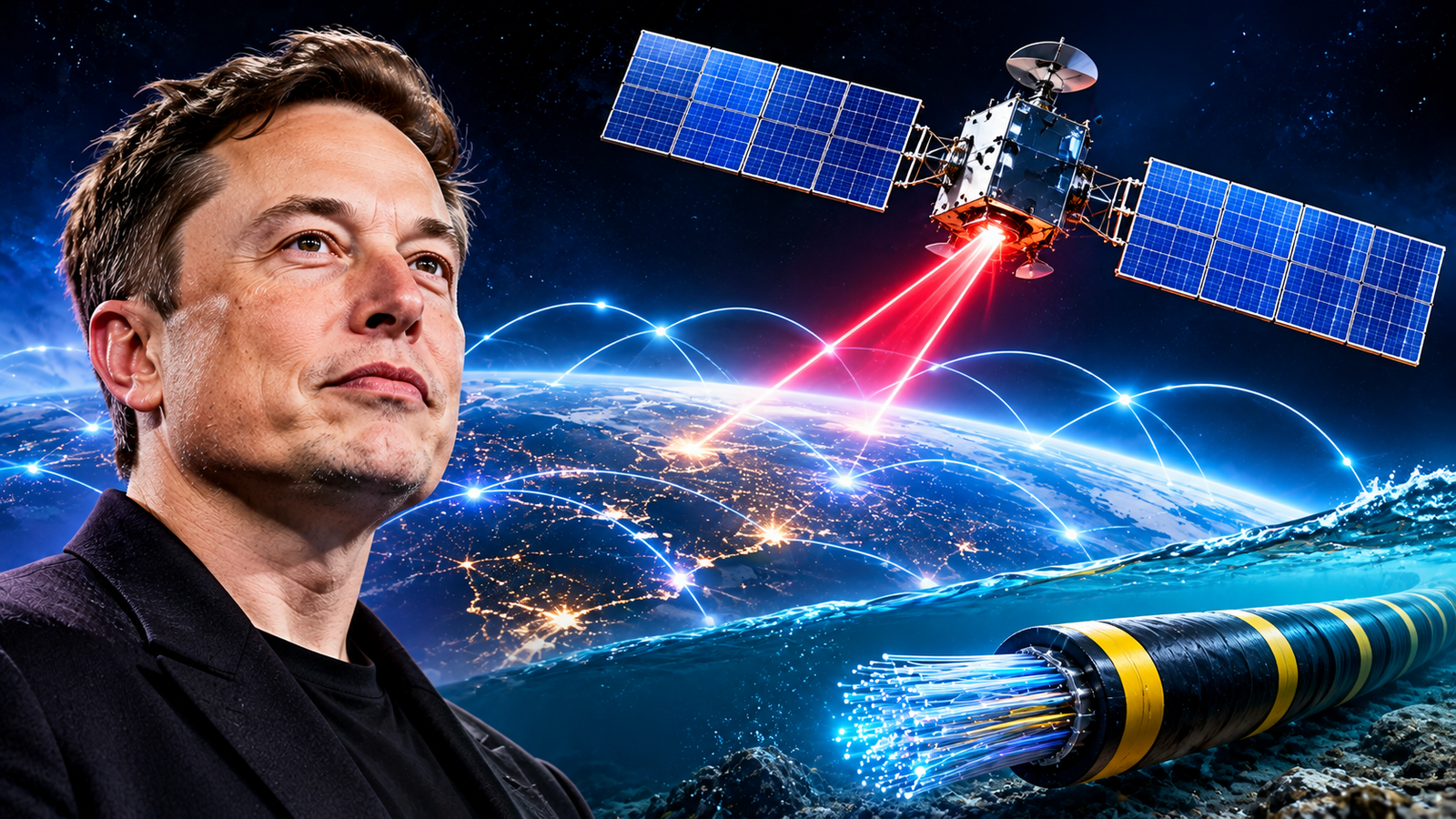
Musk outlined that satellites equipped with ~100 lasers each, operating above 10 Tb/s, and a constellation exceeding 100,000 units could outperform undersea fiber cables—leveraging light’s faster speed in the space vacuum and more direct routing. Example: a London-to-Singapore laser link would arrive in ~41 ms versus ~75 ms via fiber, underscoring the latency advantage. SpaceX is also preparing for orbital AI with the Starmind computer, co-designed with NVIDIA; further details are promised next year, with launches targeted for 2027–2029.
Elon Musk believes next-generation Starlink satellites could eventually challenge the undersea fibre-optic cables that carry much of the world’s international internet traffic. His vision relies on high-speed laser communications, a massive satellite constellation and the shorter routes that data can take through space.
The proposal could reshape global connectivity if SpaceX can turn the ambitious technical targets into a reliable, commercially competitive network.
How Could Starlink Lasers Beat Undersea Cables?
On November 7, 2026, Musk said satellites equipped with approximately 100 laser links, each operating above 10 terabits per second (Tbps), could outperform undersea cables if deployed across a constellation exceeding 100,000 satellites.
His argument centres on two advantages: speed of light and shorter transmission routes.
Light travels roughly 40% faster through a vacuum than through optical fibre. Meanwhile, undersea cables must follow practical routes across ocean floors, whereas satellite networks can route data more directly between distant locations.
A London-to-Singapore comparison cited in the original claim estimates approximately 41 milliseconds for a space-based laser route versus 75 milliseconds through fibre. These figures should be treated as illustrative estimates, not verified performance measurements of a deployed Starlink network.
Actual latency depends on routing, ground connections, network congestion and other technical factors.
What Is Starlink’s Next-Generation Laser Technology?
Starlink already uses optical inter-satellite links to transfer data between satellites without relying on a ground station at every stage.
Its published technology currently describes three optical space lasers per satellite, operating at speeds of up to 200 gigabits per second. Musk has now outlined a much more ambitious next-generation target of 10 Tbps per laser link.
That would represent a major increase in potential transmission capacity, although the proposed specifications and constellation scale are not yet equivalent to a proven operational network.
How Does SpaceX’s Starmind AI Project Fit In?
SpaceX is also developing Starmind, an orbital computing initiative intended to use solar-powered satellites for artificial intelligence workloads. The concept combines onboard computing with high-bandwidth laser links to transmit results through the Starlink network.
Musk has indicated that further details about the Starmind computer will be revealed next year. SpaceX’s plans point towards satellite deployment beginning as early as late 2027, subject to development and launch progress.
Can Space-Based Internet Replace Undersea Cables?
Not yet. SpaceX must demonstrate that its proposed laser speeds, routing performance and large-scale satellite network can work reliably and economically.
The bigger shift may be the convergence of satellite internet, laser communications and orbital AI computing. If these technologies scale successfully, space could become a much more important part of the world’s digital infrastructure.