AI models are becoming faster, smarter and capable of handling enormous amounts of information. Yet one of their biggest weaknesses is surprisingly simple: they can lose their grip on context.
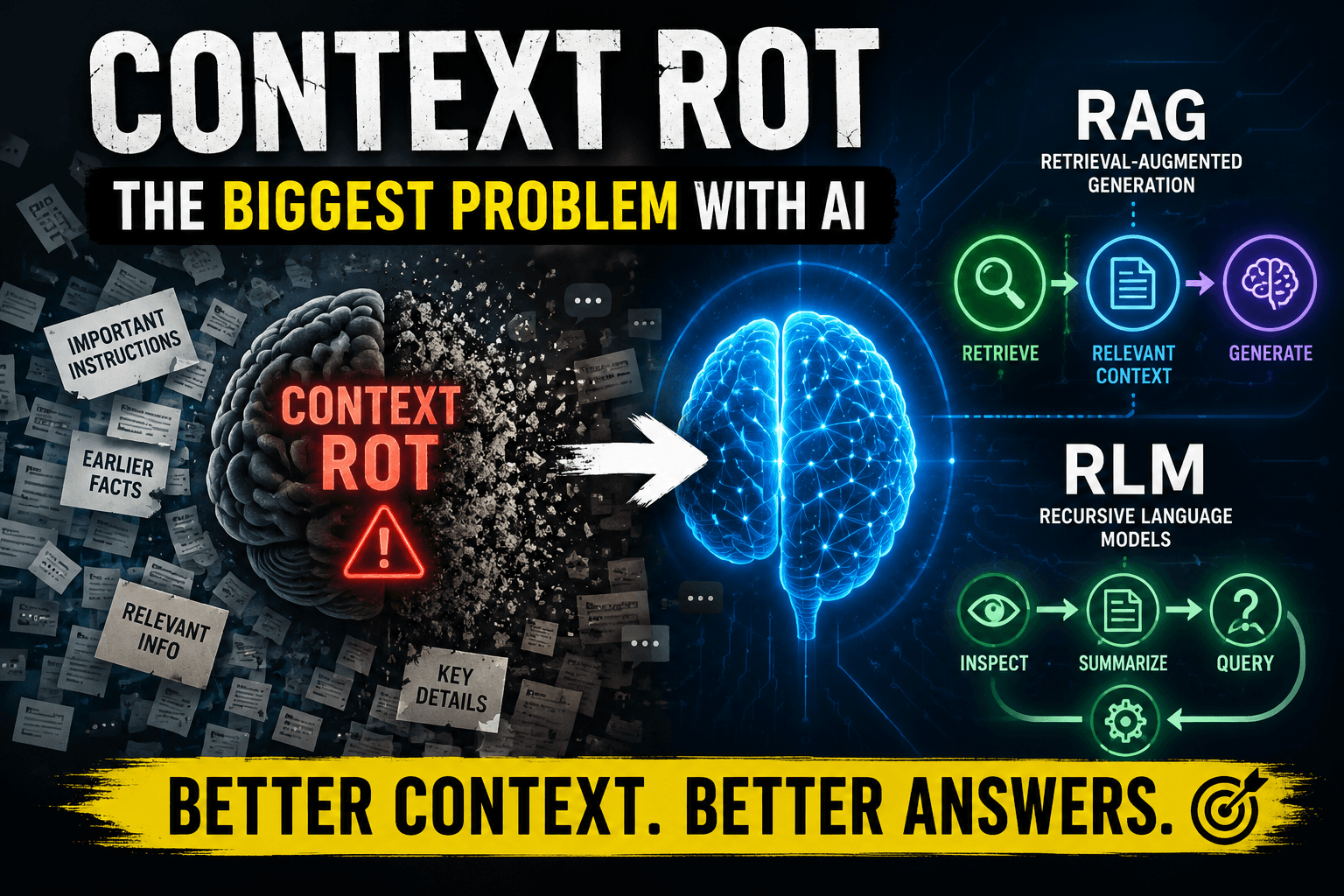
This problem is increasingly described as “context rot” — the gradual decline in an AI model’s ability to reliably use information as the amount of context grows.
What Is Context Rot?
A large language model does not “remember” a conversation in the same way a human does. It processes tokens supplied to it and uses patterns learned during training to generate an answer.
As more documents, messages, instructions and data are placed into the context window, important information can become harder for the model to retrieve and use correctly.
The result can be subtle:
- Important instructions get overlooked.
- Earlier facts are contradicted.
- Relevant information buried in long documents is missed.
- The model becomes less precise.
- Repeated or irrelevant information dilutes useful context.
This creates a paradox: a larger context window does not automatically mean better reasoning.
Why Bigger Context Is Not the Complete Solution
AI companies have dramatically expanded context windows, allowing models to process books, software repositories and large collections of documents.
But simply putting everything into a prompt is often inefficient.
Imagine asking an AI system to analyze 500 documents when only 20 contain information relevant to the question. The model must navigate a huge information space before producing an answer.
That is where new approaches such as RAG and RLM become important.
RAG: Give AI the Right Information
Retrieval-Augmented Generation (RAG) separates information retrieval from answer generation.
Instead of sending an entire database to the AI, a retrieval system searches for relevant passages and supplies only the most useful material to the model.
A typical RAG pipeline looks like:
Database → Search/Retrieval → Relevant Context → AI Model → Answer
This can reduce unnecessary context and make answers more grounded in external information.
RAG is already widely used for enterprise knowledge bases, customer support, research systems and document-based AI assistants.
RLM: AI That Works With Its Own Context
Recursive Language Models (RLMs) take a different approach. Rather than forcing a model to process an enormous context in one pass, the system can treat large context as an external environment and progressively inspect, summarize, query or decompose it.
The idea is important because the future of AI may not simply involve bigger context windows.
Instead, intelligent systems may need better ways to manage context.
The Bigger AI Problem
Recent developments in AI agents make this issue more important. Modern models increasingly operate across long-running tasks, coding projects, research workflows and cybersecurity evaluations.
Recent incidents involving AI systems accessing unintended external resources have also highlighted another challenge: the longer and more autonomous an AI workflow becomes, the harder it can be to predict exactly what information and tools the model will rely on.
Context management therefore becomes an engineering and safety problem, not merely a prompting problem.
The Future: Less Context, Better Context
The next generation of AI may not win simply by having the largest context window.
It may win by knowing what to remember, what to retrieve, what to ignore and when to revisit information.
RAG provides targeted retrieval. RLM-style approaches provide structured interaction with massive context. Together with better memory, summarization and verification, they point toward a different AI architecture.
The central lesson is simple:
AI doesn’t necessarily need more context. It needs better context management.
That may become one of the defining challenges of the agentic-AI era.