A daily puzzle for curious minds. Read the clues. Crack the challenge. Drop your answer below.
The Clue Challenge
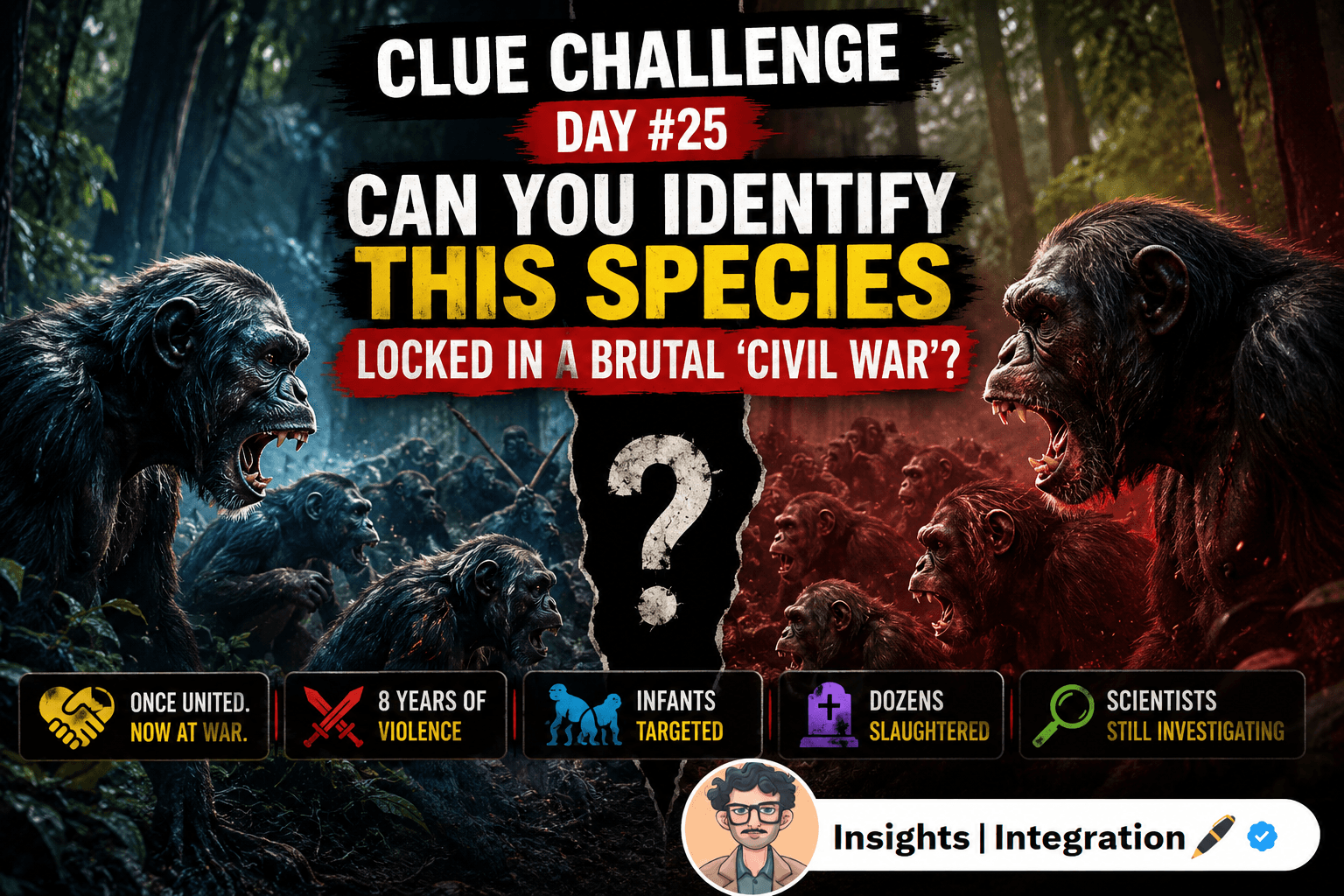
For decades, scientists believed this highly intelligent species lived in tightly bonded communities built on cooperation, loyalty, and deep emotional bonds.
Members groomed each other. Shared food. Protected infants. Comforted the injured.
Then everything changed.
A massive community fractured into rival factions. Former allies became enemies. Friends turned into killers.
Researchers now say one of the most disturbing conflicts ever recorded in the animal kingdom has been unfolding for nearly a decade inside an African forest — and what they’re finding may force us to rethink the very origins of human warfare.
Can you identify the species?
Your Clues
Clue #1 — A Forest the World Knows Well
This conflict is unfolding inside a protected national park in East Africa — home to one of the longest-running animal behaviour studies ever conducted, spanning barely 35 square kilometres. One of the smallest national parks on Earth. Yet within those 35 kilometres, researchers have documented more about primate behaviour than almost anywhere else on the planet.
The forest has a name. It is famous. You may already know it.
Clue #2 — They Look Disturbingly Familiar
Before you think about the war, think about the animal itself.
- It is the only great ape with a naturally white patch of skin on the rump that darkens with age
- Every individual has unique fingerprints and toe prints — just like you
- Infants are born with a white tail tuft — a visual signal to adults: be gentle
- They live 40–50 years in the wild; over 60 in captivity
- They share 98.7% of their DNA with humans — one of our two closest living relatives on Earth
When you look at one long enough, the discomfort is not accidental. It is biological.
Clue #3 — The Most Sophisticated Tool Users on the Planet (After Us)
This species doesn’t just use tools. It invents them, teaches them, and plans with them.
- Uses sticks to fish termites, rocks to crack nuts, leaves as sponges to drink water, and sharpened branches as spears to hunt bush babies
- Mothers actively teach tool use to offspring — one of the only known examples of intentional, cross-generational knowledge transfer in a non-human species
- Has been observed crafting tools in advance and carrying them to a location before the task begins — demonstrating planning, not instinct
- Can learn sign language, recognise itself in mirrors, and solve multi-step logical puzzles
Clue #4 — A Society Built on Politics, Grief, and Empathy
This species doesn’t just live together. It governs itself.
- Males form and switch political alliances strategically — a behaviour primatologist Frans de Waal famously called “species politics”
- After conflicts, individuals reconcile — returning to embrace or groom a former opponent. A behaviour once considered uniquely human
- Mothers have been observed carrying deceased infants for days. Communities fall visibly quiet after a death
- They adopt unrelated orphans — sometimes at real cost to their own survival
- They use over 80 documented intentional gestures, many overlapping with those used by human infants
- Over 66 distinct vocalisations with context-specific meanings — and different communities speak in different dialects
Clue #6 — They Have Culture. And We Are Destroying It.
Different communities have distinct cultures — tool-use traditions, grooming customs, and social behaviours that are learned, not genetic, and passed across generations.
West African individuals crack nuts with stone anvils. East African individuals in identical ecological conditions do not. No genetic explanation exists. It is purely cultural.
A 2024 study found that communities exposed to human disruption lose cultural behaviours faster than undisturbed groups — meaning habitat destruction doesn’t just kill animals. It causes cultural extinction.
Clue #7 — They Were Once One of Earth’s Largest Known Social Groups
Before the split, this community numbered over 200 individuals — extraordinary for their kind. Researchers watched years of grooming, cooperative patrols, food sharing, and alliances forged across generations.
One researcher described what followed with chilling simplicity: “These were individuals that used to hold hands.”
What tore them apart? A new dominant male. A deadly respiratory outbreak that killed the social “bridges” holding rival subgroups together. When those individuals died, so did the connections — and then came the war.
Clue #8 — The Science in 2025 Changed Everything
- April 2025 — A landmark Nature study by 120+ scientists completed the full telomere-to-telomere genome of this species, resolving previously inaccessible DNA regions. Finding: genetic differences between ape species are greater than previously assumed, with new gene families specific to this species having direct implications for understanding human disease
- December 2025 — Neuroscientists confirmed that human brains activate in voice-sensitive neural regions when hearing this species’ calls — a response triggered by no other non-human animal. Ancient shared circuitry, still firing across 7 million years of evolution
- It carries SIV — the precursor to HIV. It is susceptible to Ebola, respiratory viruses, and most human diseases. Its blood follows the ABO system, just like ours
- Its IUCN status: Endangered — declining. One subspecies: Critically Endangered. Projections suggest 94% of its habitat could be lost by 2050
Clue #9 — The War. The History. The Scale.
This is only the second known case of organised, strategic, lethal inter-group warfare in a non-human species.
The first was the Gombe War of the 1970s — a four-year conflict documented by one of history’s most celebrated wildlife researchers, a woman who had spent years living among them. It ended with the complete annihilation of the Kahama community by the Kasekela faction. It permanently changed how humanity understood this animal.
The current conflict — the Ngogo war in one of Uganda’s national parks — involves over 200 individuals and is now the largest ever recorded. Small patrol groups move silently through forest territory, seeking isolated victims near borders. Ambushes. Coordinated attacks. Systematic territorial expansion.
And yet — even during the war — an injured individual was guided back to safety by a companion who stayed beside him through the night.
The same species. The same individual. Killer and caretaker.
The Final Question
Which species:
- Is waging a decade-long civil war inside a famous African forest?
- Has unique fingerprints, distinct cultures, and a political system?
- Shares 98.7% of its DNA with humans?
- Had its full genome published in Nature in April 2025?
- Is Endangered — with one subspecies already Critically Endangered?
- May hold the evolutionary key to understanding human conflict, culture, and compassion?
Bonus — name the park, the 1970s war, and the legendary researcher who first documented it.
Drop your answer below. Tomorrow’s reveal unlocks everything with new challenge.
Missed yesterday’s challenge?
Check it here → Clue Challenge Day #24: Can You Identify This Nation in Civil War?
Answer to Yesterday’s Challenge: DAY #24
(Click above to reveal)
Checkout this Clue Challenge: Clue Challenge Day #17: Can You Identify Nation in Crisis?