
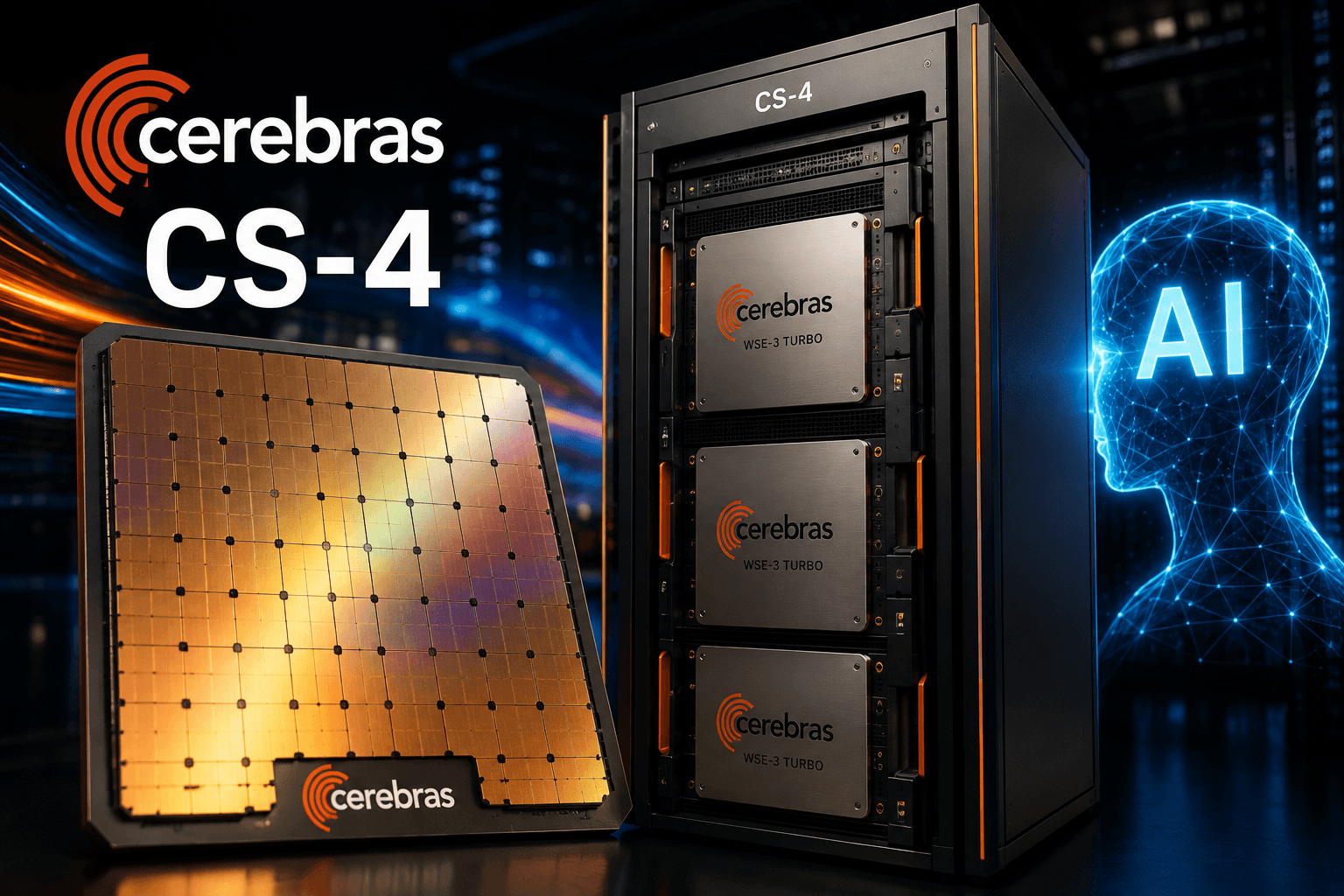
AI chatbots are becoming more powerful, but generating answers quickly remains one of the biggest computing challenges. Now, Cerebras Systems has launched the CS-4, a new AI system designed specifically to accelerate this process, known as inference.
Unlike conventional AI hardware that connects many smaller chips, Cerebras is betting on an unusual idea: make the chip enormous.
What is the Cerebras CS-4?
The CS-4 is a new rack-scale AI system built around three wafer-scale processors, including Cerebras’s WSE-3 Turbo. The system uses the company’s new Nexus architecture, with modular hardware designed to simplify installation and improve communication between processors.
Cerebras says the system will begin shipping in the third quarter of 2026 and uses chips fabricated by TSMC on a 5-nanometre process. The company has also reduced the number of components by around 50%, potentially making AI infrastructure faster to deploy.
Why does a giant chip matter?
Most AI systems spread a workload across multiple GPUs. That creates a problem: data must constantly move between chips and memory.
For AI inference, this movement can become a major source of delay.
Cerebras takes a different approach with its wafer-scale architecture. Its WSE-3 places enormous computing resources and memory on a single piece of silicon. The processor contains 4 trillion transistors and 900,000 AI-optimised compute cores, according to the company.
The basic idea is simple: if less data needs to travel between separate chips, an AI model can potentially generate its next words—or tokens—much faster.
Why is inference becoming so important?
Training an AI model receives enormous attention, but inference happens every time someone actually uses it.
When you ask Claude, ChatGPT or another chatbot a question, inference is the computing process that generates the response. As AI agents begin performing longer tasks, writing code and repeatedly calling tools, demand for fast inference is growing rapidly.
Cerebras says this is especially important for agentic AI, where a single task can generate far more tokens than a traditional chatbot conversation.
A direct challenge to Nvidia?
Cerebras competes in an AI chip market dominated by Nvidia, but its strategy is not to copy the GPU model.
Instead, it is focusing heavily on speed and throughput for AI inference. Cerebras says the CS-4 combines improved networking with its wafer-scale processors to reduce bottlenecks and handle more AI requests.
CEO Andrew Feldman said the company aims to deploy 600 megawatts of computing capacity by the end of 2027. Cerebras also plans another generation of chips and systems in 2027.
The CS-4 therefore represents a bigger shift in the AI hardware race: the future may not belong only to whoever builds the most chips, but also to whoever can move AI data fastest.