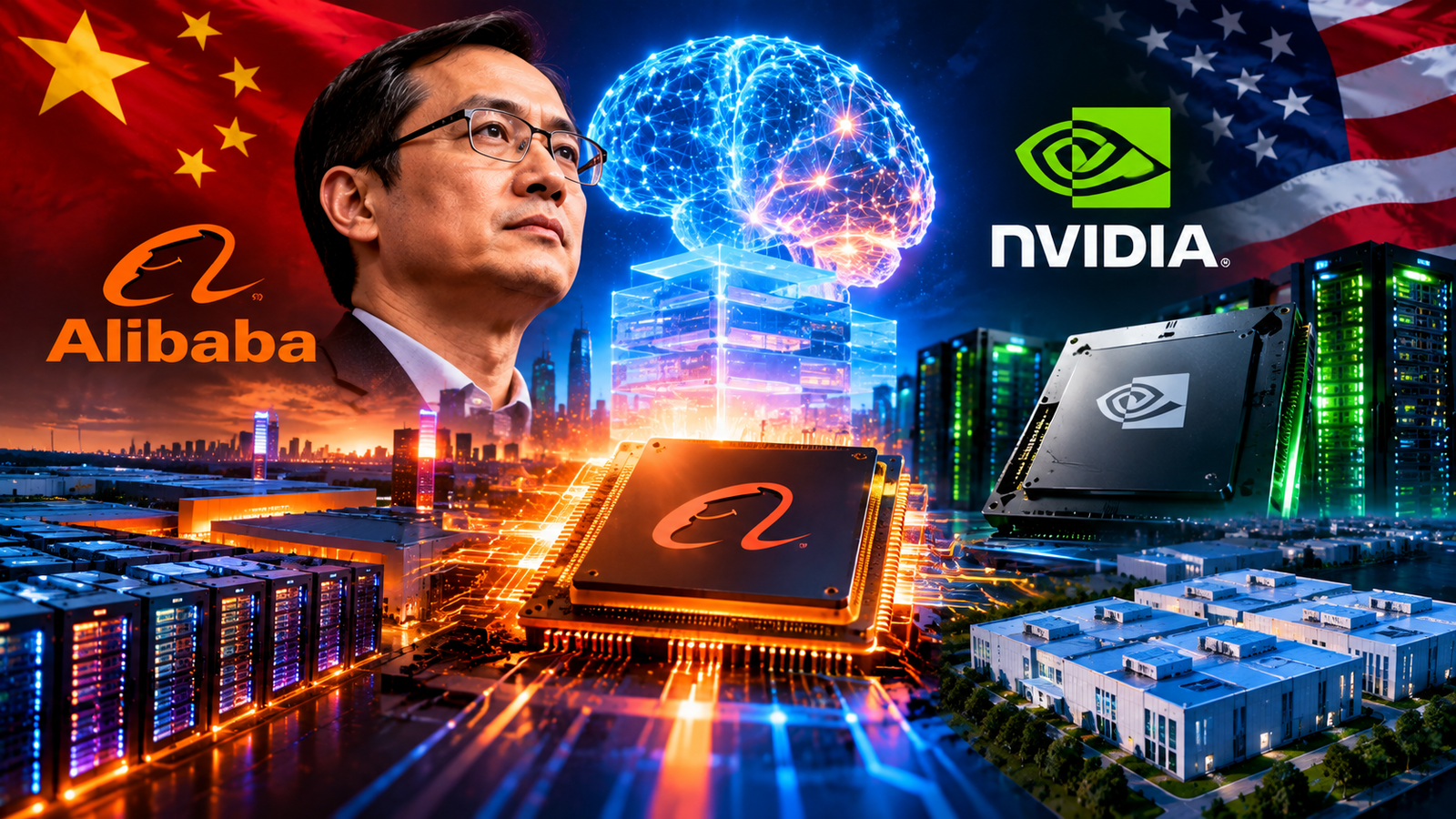
Alibaba is planning an artificial intelligence model with 5 trillion to 10 trillion parameters, while unveiling a new AI chip and outlining a massive expansion of its data-centre infrastructure. The announcement highlights China’s growing effort to build an independent AI ecosystem amid restrictions on access to advanced Nvidia processors.
Speaking at the Apsara Conference in Hangzhou, Alibaba CEO Eddie Wu said the company’s future Qwen models could handle more complex, longer-duration tasks and support progress toward artificial superintelligence (ASI). The company said Qwen 4 is currently in training, while the Qwen 4.5 and Qwen 5 series could eventually scale to the proposed parameter range.
Zhenwu V900: Alibaba’s New AI Chip
Alibaba’s semiconductor division, T-Head, introduced the Zhenwu V900, which the company describes as China’s most powerful AI chip. According to Alibaba, it delivers three times the performance of the previous M890 processor and could support clusters containing up to 500,000 cards for advanced model training and inference.
Mass production and commercial release are planned for the first quarter of 2027. The development follows Alibaba’s earlier push to design chips for AI agents, which require substantial memory capacity and fast communication between processors.
Why Data Centres Matter
Alibaba Cloud aims to exceed 20 gigawatts of global data-centre capacity by 2032. However, Wu acknowledged that shortages across the AI infrastructure supply chain are restricting expansion, even as customer demand continues to grow.
The challenge extends beyond China. AI companies worldwide are competing for advanced processors, high-bandwidth memory (HBM), electricity and cooling infrastructure. Chinese chipmakers, including Huawei and Cambricon, have recently raised prices amid HBM shortages intensified by export restrictions.
China’s Broader AI Strategy
Alibaba’s announcement comes alongside Huawei’s plans for new Ascend processors and large-scale AI superclusters. These developments show how Chinese companies are attempting to compensate for restricted access to leading-edge foreign hardware through domestic chips, networking technologies and integrated cloud platforms.
Still, parameter count alone does not determine AI capability. Training efficiency, data quality, architecture, memory bandwidth, software optimisation and inference costs also influence real-world performance.
Alibaba’s strategy therefore represents more than a race to build a larger model. It is an attempt to control the complete AI stack—from semiconductors and data centres to foundation models and commercial applications—as competition between Chinese and American technology ecosystems intensifies.