
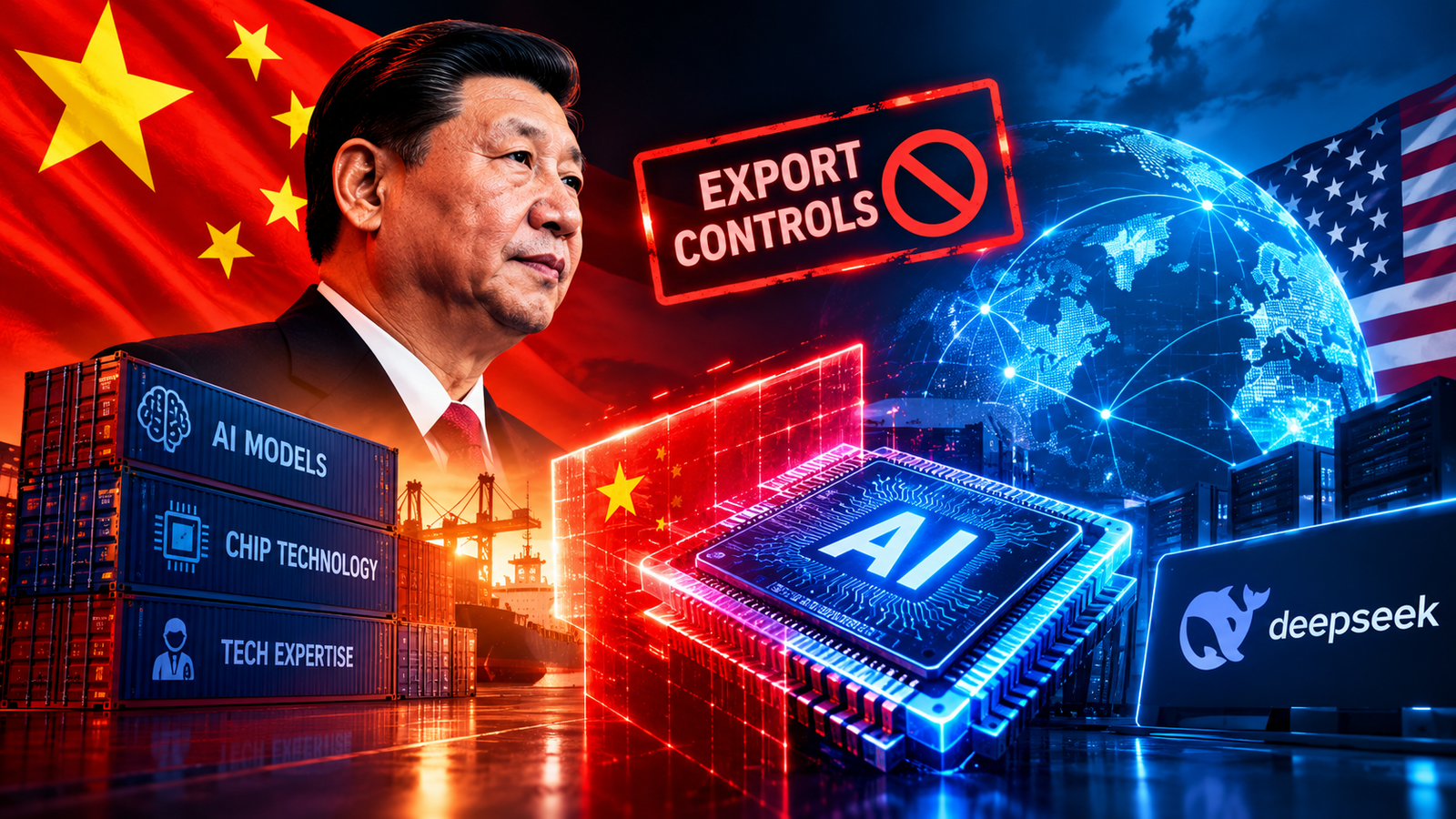
China is preparing tighter controls on artificial intelligence exports, signaling a shift in how Beijing wants its AI industry to compete globally: sell access to AI models overseas while keeping strategically valuable technology under domestic control.
The draft rules, published on October 16, 2026, propose restrictions on 23 AI-related technologies, including advanced models, autonomous AI agents, semiconductor-design tools and technologies used to manage large computing facilities.
The proposals remain open for public consultation until November 15, with adoption expected by the end of the year, according to reporting by Reuters.
What Would China’s AI Export Rules Change?
Under the proposed framework, overseas customers could generally continue using Chinese AI services through websites and cloud platforms. However, transferring certain underlying technologies or deploying them abroad could require government approval.
This distinction could reshape international partnerships involving Chinese AI developers such as DeepSeek, Moonshot and Z.AI.
Instead of distributing every technological component freely, companies may increasingly provide AI capabilities as cloud-based services while retaining greater control over their models, research and infrastructure.
Why DeepSeek and Other AI Firms Could Be Affected
Some Chinese developers use overseas data centres to access computing resources that are difficult to obtain domestically because of US restrictions on advanced semiconductor exports.
The proposed controls could complicate decisions about where advanced models are trained, hosted and operated. Companies may also need to clarify whether foreign-owned computing infrastructure can be used for their most sophisticated AI systems.
The draft identifies three potential tests for restricted models: training requirements exceeding (10^{26}) calculations, model sizes of at least two trillion parameters, or rankings among the world’s top 10 systems under specified performance assessments.
Uncertainty over these thresholds could create compliance challenges, particularly for specialised models and systems that activate only selected components during operation.
A New Front in the US–China AI Rivalry
Washington has restricted China’s access to certain advanced chips and related technologies. Beijing’s proposed rules would strengthen its ability to control the export of valuable AI models and technical expertise.
The result could be a more fragmented global AI market, with different rules governing chips, computing infrastructure, models and cross-border investments.
The strategic objective is clear: China wants international revenue from AI without automatically surrendering control of the technology behind it.
If implemented broadly, the rules could influence AI partnerships, overseas data-centre investments and the global distribution of advanced Chinese models.