
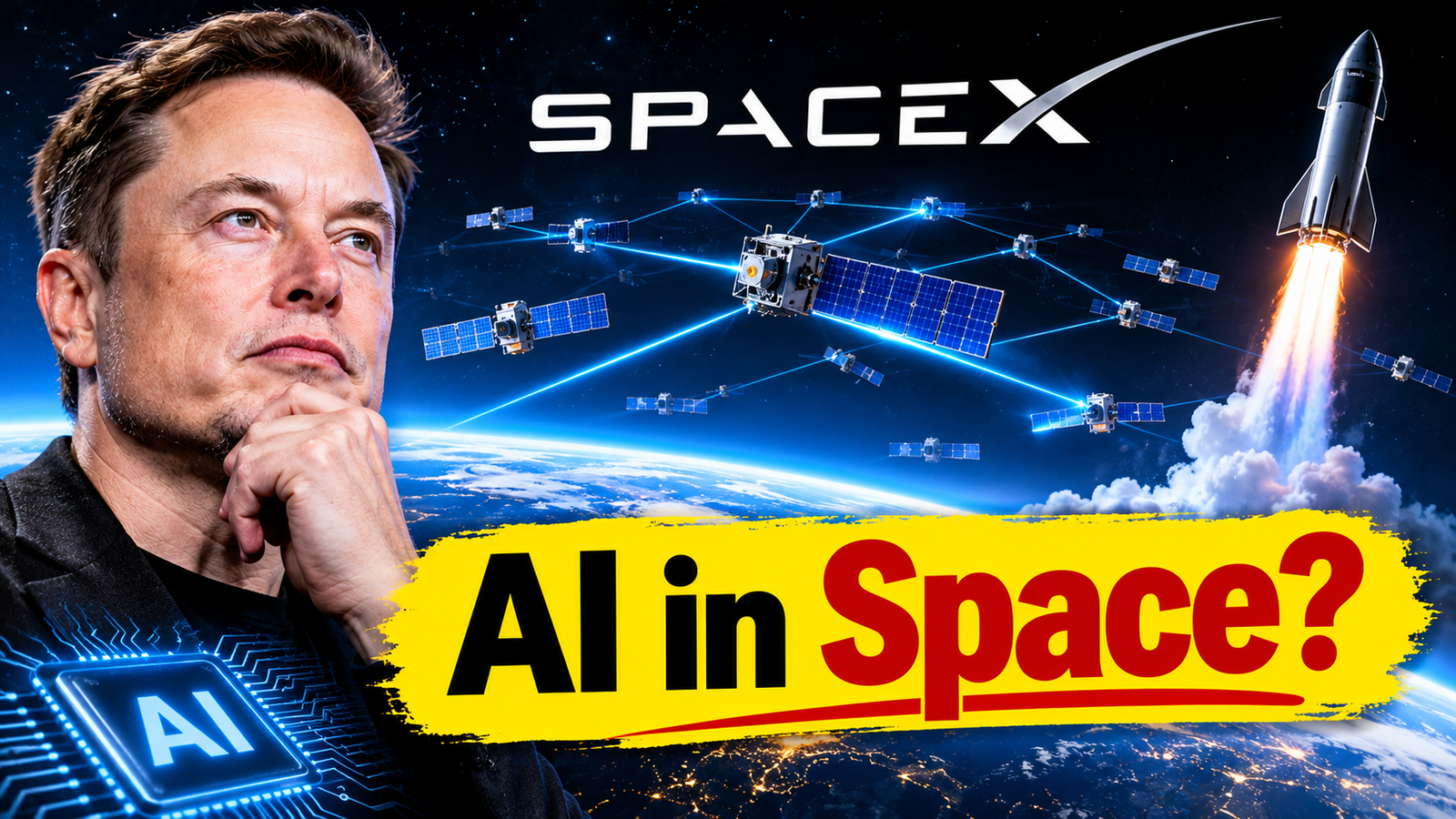
Elon Musk believes the future of artificial intelligence computing could lie beyond Earth. In a recent exchange with Sequoia Capital partner Shaun Maguire, Musk argued that computing infrastructure for superintelligence will eventually move overwhelmingly into orbit.
The prediction comes as SpaceX advances plans to build solar-powered satellite data centres designed to process AI workloads in space, potentially changing how the industry meets its rapidly growing demand for computing power.
SpaceX’s Plan for One Million AI Satellites
In January 2026, SpaceX submitted a filing to the US Federal Communications Commission (FCC) seeking approval for a constellation of up to one million satellites equipped with AI computing capabilities.
The proposed system, branded Star Mind, would use solar energy to power onboard processors. Satellites would communicate through high-bandwidth laser links, connecting with the Starlink network to transmit data back to Earth.
SpaceX argues that orbital computing could reduce dependence on terrestrial electricity grids, land availability and energy-intensive cooling infrastructure.
The company’s official plans identify late 2027 as a potential starting point for large-scale satellite production and deployment, although the project’s timeline and regulatory approval remain important uncertainties.
Why Put AI Data Centres in Space?
The central argument is energy and cooling.
Solar panels in suitable orbits can receive sunlight for much longer periods than ground-based installations, avoiding clouds and atmospheric losses. Meanwhile, satellites can reject heat through radiative cooling, potentially reducing the need for conventional cooling equipment.
These advantages could become increasingly valuable as AI models demand more computing power and data centres compete for electricity, grid connections and suitable locations.
Major Engineering Challenges Remain
Building AI infrastructure in orbit presents substantial obstacles. Launching heavy computing hardware remains expensive, while radiation can damage electronic components. Repairing or replacing failed equipment is also considerably more difficult than maintaining a conventional data centre.
The project depends heavily on Starship achieving reliable, high-volume and low-cost launches. Space debris, orbital congestion and the environmental effects of large satellite constellations present additional concerns.
Can Orbital Computing Overtake Earth?
Musk has predicted that newly deployed orbital computing capacity could exceed new terrestrial capacity around late 2028, potentially growing much faster in 2029. This remains a forecast, not an established outcome.
If successful, orbital AI infrastructure could become a significant part of the global computing industry. For now, its commercial viability will depend on launch costs, hardware reliability, energy performance and the ability to transmit data efficiently between space and Earth.
The larger question is no longer simply how powerful AI models can become, but where the infrastructure needed to run them will be built.