
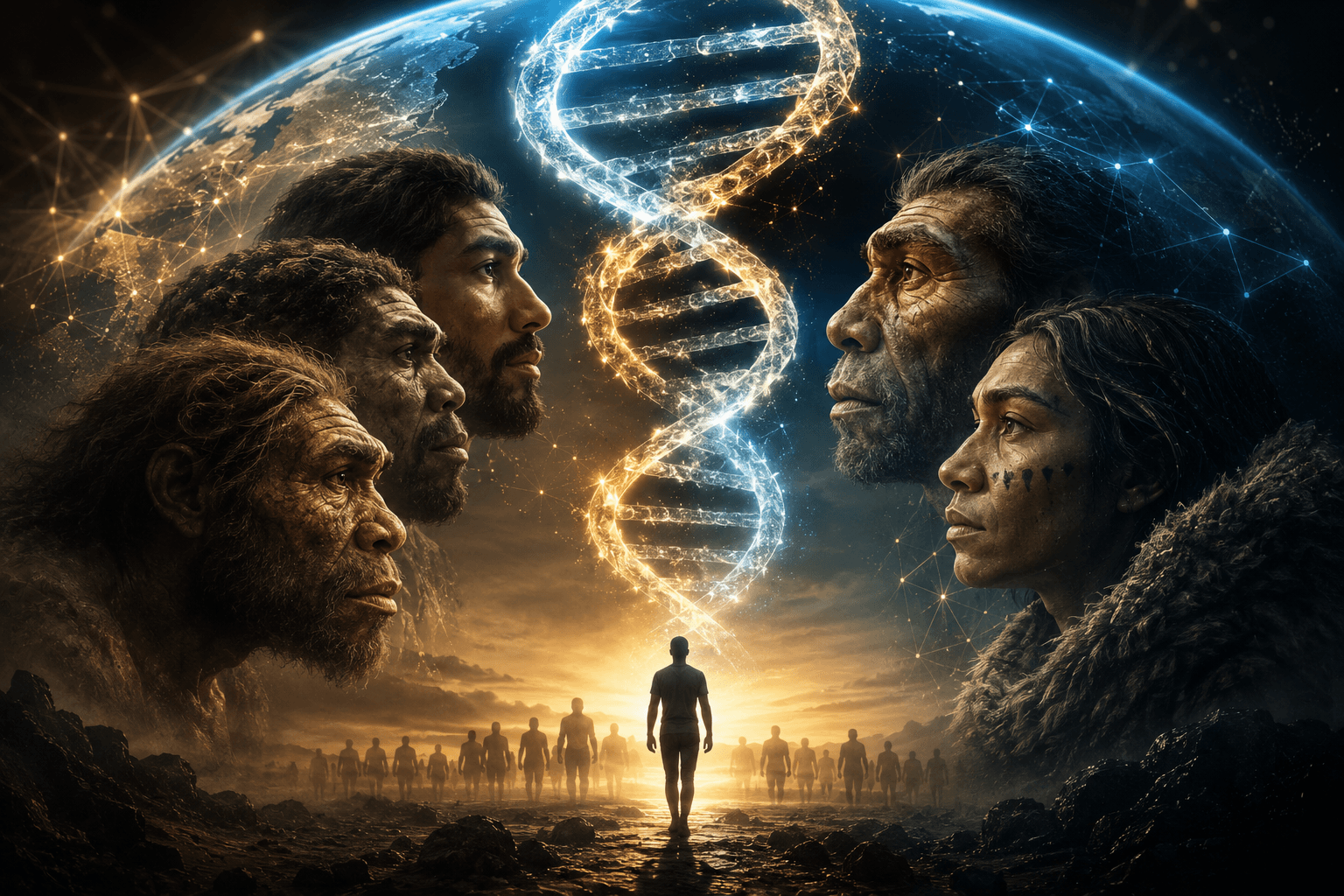
Scientists have discovered evidence of two previously unknown extinct human lineages, known as “ghost ancestors,” whose DNA still survives in modern humans. The findings, published in Science, suggest that human evolution was far more interconnected than previously believed.
What Are Ghost Ancestors?
Ghost ancestors are extinct human populations for which scientists have no direct fossil DNA, yet their genetic fingerprints remain hidden within modern human genomes. Researchers detected these mysterious lineages by analyzing DNA from living people rather than relying on ancient skeletal remains.
Using a newly developed computational method called TRACE (TRacking Archaic Contributions via ARG Estimation), scientists reconstructed ancient genealogical relationships across thousands of DNA segments, allowing them to identify genetic contributions from previously unknown human groups.
Two Hidden Human Relatives
Ghost Ancestor
- Split from modern human ancestors around 800,000 years ago.
- Interbred with Homo sapiens in Africa over 50,000 years ago.
- Contributes 0.5–1% of DNA in both African and non-African populations.
Super-Archaic Ancestor
- Descended from a lineage dating back 1.8 million years.
- Mixed with Denisovans more than 200,000 years ago.
- A small portion of this ancient DNA later reached modern humans through Denisovans.
Why It Matters
Researchers found that many inherited DNA segments are linked to immunity and metabolism, suggesting ancient interbreeding helped humans adapt to new diseases, climates, and environments.
Key Takeaway
The study challenges the traditional “family tree” model of human evolution. Instead, scientists now describe our ancestry as a complex web of migration and interbreeding among multiple human populations over nearly a million years. As more genomes are studied, researchers believe additional ghost ancestors may still be waiting to be discovered.