Reusable rockets have transformed the economics of spaceflight. Traditionally, rockets were discarded after a single mission, making every launch expensive. Today, major space powers are developing reusable launch systems that can fly multiple times, dramatically reducing launch costs, increasing mission frequency, and supporting ambitious plans for lunar exploration, satellite deployment, and human spaceflight.
The United States currently leads this revolution, but China, Europe, Japan, and India are rapidly narrowing the technology gap through innovative reusable launch programs.
🇺🇸 United States: The Global Benchmark
The United States remains the undisputed leader in reusable launch technology.
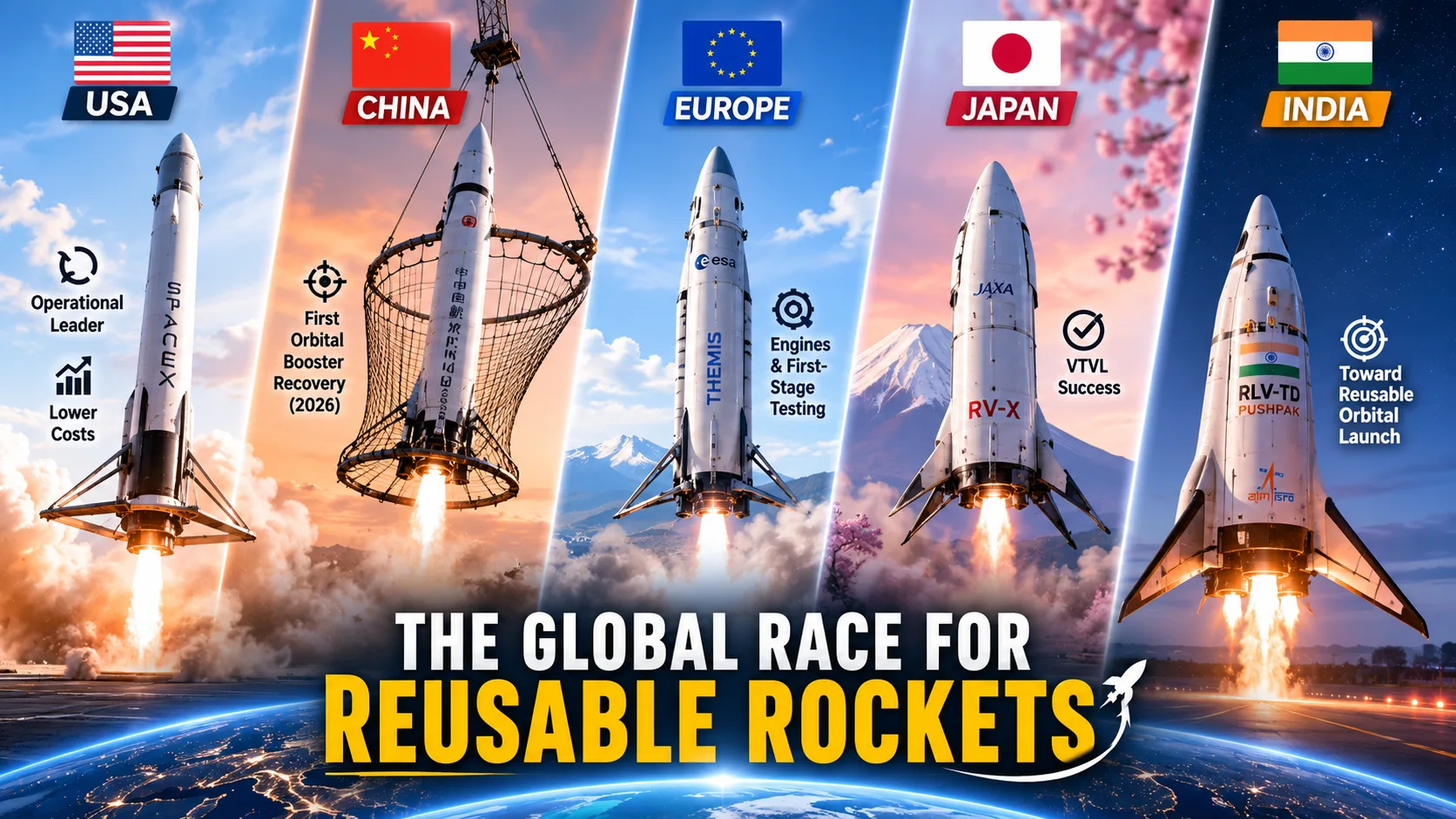
SpaceX has revolutionized the industry with its Falcon 9 and Falcon Heavy, whose first-stage boosters routinely land vertically and are reused for multiple missions. This approach has significantly lowered launch costs and enabled frequent satellite deployments, cargo missions, and crewed flights to the International Space Station.
Meanwhile, Blue Origin operates the fully reusable New Shepard suborbital rocket and has begun orbital missions with New Glenn, further strengthening America’s leadership in commercial reusable spaceflight.
🇨🇳 China: A New Recovery Strategy
China achieved a major milestone in 2026 by successfully recovering an orbital booster during a Long March-10B launch.
Unlike SpaceX, China employed an innovative cable/net-capture system, allowing the returning booster to be caught without heavy landing legs. This design reduces the rocket’s weight, increases payload capacity, and lowers refurbishment requirements.
The achievement marks China’s entry into the elite group of nations capable of recovering orbital-class rocket boosters and reflects Beijing’s growing ambitions in lunar exploration and commercial launch services.
🇪🇺 Europe: Building the Next Generation
Europe is accelerating its reusable launch ambitions under the European Space Agency (ESA).
The centrepiece is the Prometheus reusable rocket engine, designed to be significantly cheaper than conventional engines while supporting multiple flights.
Complementing it is Themis, a reusable first-stage demonstrator currently undergoing advanced testing to validate vertical landing technologies.
In the commercial sector, MaiaSpace is developing Maia, a partially reusable orbital launcher expected to strengthen Europe’s independent access to space and compete with global commercial launch providers.
🇯🇵 Japan: Entering the Reusable Era
Japan has taken an important step through JAXA’s RV-X reusable rocket prototype.
The vehicle successfully demonstrated Vertical Take-Off and Vertical Landing (VTVL), validating key technologies required for reusable launch systems.
Although still in the experimental phase, RV-X provides Japan with valuable experience in guidance, propulsion, and precision landing technologies that could support future reusable orbital rockets.
🇮🇳 India: Building Indigenous Reusable Technology
India’s ISRO is steadily progressing through the Reusable Launch Vehicle–Technology Demonstrator (RLV-TD) programme, popularly known as Pushpak.
The programme has already demonstrated:
- Hypersonic flight
- Autonomous runway landing
- Precision navigation and control
Unlike vertically landing boosters, India’s long-term vision is a two-stage-to-orbit reusable launch vehicle, where a winged first stage returns like an aircraft for reuse. Such a system could substantially reduce launch costs while supporting India’s expanding commercial space sector under the Indian Space Policy 2023.
Why Reusable Rockets Matter
Reusable launch systems offer several strategic advantages:
- Lower launch costs
- Faster launch turnaround
- Reduced space debris
- Increased commercial competitiveness
- Enhanced capability for lunar and Mars missions
As satellite constellations, space tourism, and deep-space exploration continue to grow, reusable rockets are becoming the foundation of the modern space economy.
Snapshot
| Country | Current Status |
|---|---|
| 🇺🇸 United States | Global leader with operational reusable Falcon 9, Falcon Heavy, and New Shepard systems |
| 🇨🇳 China | First successful orbital booster recovery using an innovative net/cable capture system |
| 🇪🇺 Europe | Prometheus engine, Themis demonstrator, and Maia reusable launcher under development |
| 🇯🇵 Japan | Successful VTVL reusable rocket prototype (RV-X) demonstrated |
| 🇮🇳 India | RLV-TD (Pushpak) advancing toward a fully reusable two-stage orbital launch vehicle |
The global race for reusable rockets has entered a new phase. While the United States remains the operational leader, China is introducing novel recovery techniques, Europe is investing in low-cost reusable engines, Japan is validating critical landing technologies, and India is steadily advancing indigenous reusable launch capabilities. As competition intensifies, reusable rockets are expected to become the standard for future space missions, making access to space more affordable, sustainable, and frequent than ever before.