Since the military coup of February 2021, Myanmar has descended into one of the world’s worst humanitarian and security crises. Once a country on a path toward democracy and economic growth, it is now engulfed in a brutal civil war marked by mass displacement, economic collapse, widespread airstrikes, and one of the largest humanitarian emergencies in Asia.
More than 100,000 people have been killed, millions have been displaced, and nearly a third of the population faces acute food insecurity. Yet, despite the staggering human cost, Myanmar receives far less global attention than many other ongoing conflicts.
Here are the most important facts and figures that explain why Myanmar has become Asia’s deadliest conflict—and why understanding it matters.
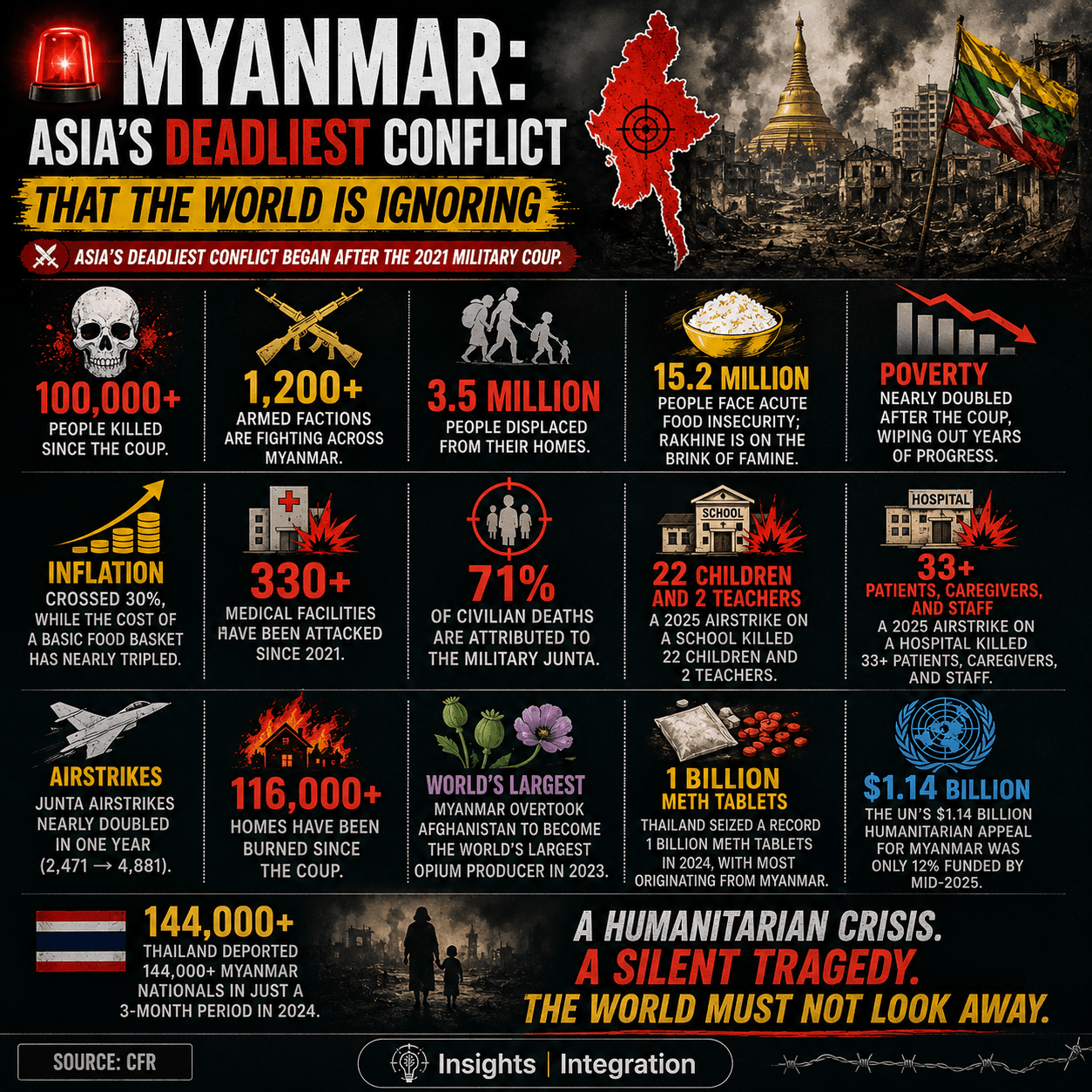
- Asia’s deadliest conflict began after the 2021 military coup.
- 100,000+ people killed since the coup.
- 1,200+ armed factions are fighting across Myanmar.
- 3.5 million people displaced from their homes.
- 15.2 million people face acute food insecurity; Rakhine is on the brink of famine.
- Poverty nearly doubled after the coup, wiping out years of progress.
- Inflation crossed 30%, while the cost of a basic food basket has nearly tripled.
- Medical facilities have been attacked 330+ times since 2021.
- 71% of civilian deaths are attributed to the military junta.
- A 2025 airstrike on a school killed 22 children and 2 teachers.
- A 2025 airstrike on a hospital killed 33+ patients, caregivers, and staff.
- Junta airstrikes nearly doubled in one year (2,471 → 4,881).
- 116,000+ homes have been burned since the coup.
- Myanmar overtook Afghanistan to become the world’s largest opium producer in 2023.
- Thailand seized a record 1 billion meth tablets in 2024, with most originating from Myanmar.
- The UN’s $1.14 billion humanitarian appeal for Myanmar was only 12% funded by mid-2025.
- Thailand deported 144,000+ Myanmar nationals in just a 3-month period in 2024.
Rare Earths, Rebels & Geopolitics: How Myanmar Became a Critical Minerals Battleground
- Rare earth mining sites in Myanmar jumped from ~130 (2020) to 370+ (2024).
- 2,500+ leaching pits have been identified in Chipwi alone.
- Myanmar exported 290,000+ tonnes of rare earths to China between 2017–2024, worth over $4.2 billion.
- 85% of those exports were generated after the 2021 military coup.
- Myanmar now supplies 60%+ of China’s heavy rare earth imports by value. Dysprosium & Terbium mined in Myanmar are essential for EVs, wind turbines, and advanced defence systems.
- In 2024, China temporarily closed its border with Myanmar after rebels captured key rare earth towns.
- The Kachin Independence Army (KIA) now controls major rare earth mines and directly negotiates with China.
- The KIA imposed a 20% export tax, later agreeing on a fixed price of 35,000 yuan (~US$4,830) per tonne with Chinese buyers.
- The KIA could earn over US$200 million annually from rare earth exports alone.
- India entered the race in December 2024, exploring partnerships to reduce dependence on Chinese rare earth supplies.
- Rare earth mining has caused deforestation, groundwater contamination, and toxic runoff, with impacts extending into northern Thailand.
- Myanmar’s rare earth reserves have become a strategic flashpoint in the wider US–China geopolitical rivalry.