
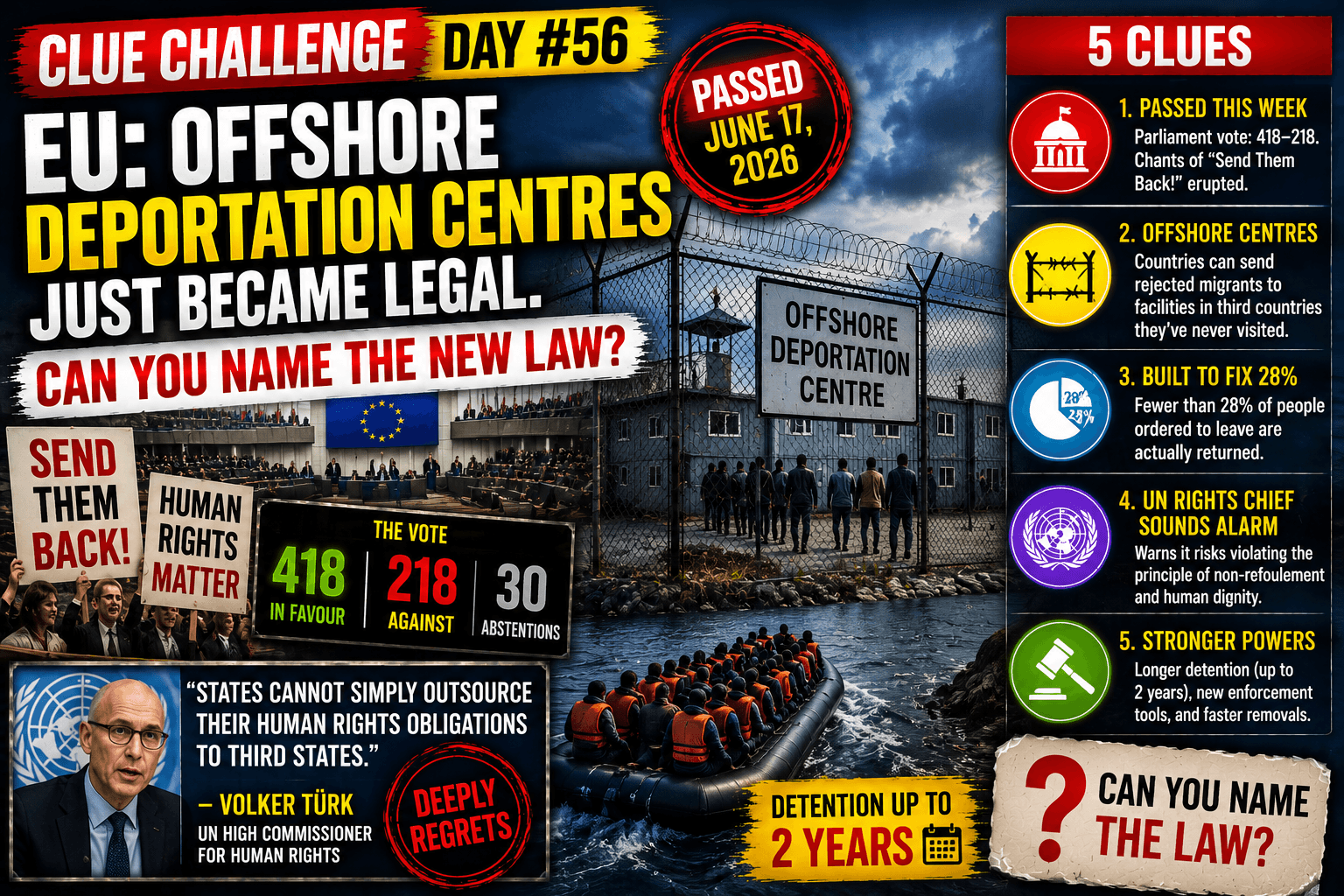
One law. Five clues. Passed June 2026. Praised as necessary. Condemned as dangerous. Already reshaping migration policy across Europe. All real.
A parliament erupted into cheers and protests. Human-rights groups called it a turning point. The UN rights chief publicly expressed concern. Supporters say it will finally fix a broken migration system. Critics warn it could weaken protections built over decades. Can you identify the law before the final clue?
#1 — A deeply divided parliament approved it by a landslide
The vote was decisive: 418 lawmakers supported it, 218 opposed it, and 30 abstained.
The vote triggered chants of “Send them back”.
As the result appeared on screens, celebrations and protests broke out simultaneously inside the chamber. Supporters argued that governments needed stronger tools to manage irregular migration. Opponents called it one of the toughest migration measures ever adopted by the bloc.
One vote. Two completely different visions of Europe.
Migration has become one of the defining political issues across Europe, helping reshape elections, governments, and public policy throughout the decade.
#2 — It allows countries to create offshore deportation centres
In June 2026, lawmakers approved legislation allowing participating countries to establish so-called “return hubs” in third countries outside their political union.
Under the proposal, migrants who have exhausted asylum procedures can be transferred to these facilities while awaiting deportation.
Supporters argue that the measure will reduce irregular migration and speed up returns.
Critics argue that it risks moving vulnerable people far away from legal protections.
A border policy that operates beyond the border itself.
#3 — It was designed to solve a number: 28%
According to European data, fewer than three in ten people ordered to leave actually return to their country of origin.
Governments say this gap undermines public confidence in migration policy and encourages people to ignore removal orders.
The new law attempts to close that gap through stricter procedures, expanded cooperation requirements, and stronger enforcement powers.
One statistic became the justification for an entire legislative overhaul.
#4 — The UN warned that human-rights obligations cannot be outsourced
UN High Commissioner for Human Rights Volker Türk said he was deeply troubled by the legislation.
The principle at the centre of the criticism is known as “non-refoulement”—a cornerstone of international refugee law that prohibits returning people to places where they may face persecution, violence, or serious harm.
He warned that governments remain responsible for protecting human rights, even when people are transferred beyond their borders.
The debate centres on a principle that has existed for decades: individuals should not be sent somewhere they face serious risks to their safety or fundamental rights.
A legal argument now sits at the centre of a political storm.
#5 — It extends detention powers and creates a new enforcement framework
The legislation allows significantly longer detention periods in certain circumstances and introduces new mechanisms intended to prevent people from disappearing before removal procedures are completed.
Supporters describe it as a “fair and firm” solution.
Amnesty International called it a blueprint that risks undermining dignity, protection, and due process.
Its official name contains two ordinary words. Together, they describe the process governments use when people are ordered to leave a country.
So — what is this law?
Passed in June 2026 after months of negotiations. Approved by a vote of 418–218. Enables offshore deportation centres outside the bloc’s borders. Expands detention powers. Designed to increase the number of successful removals. Criticised by the UN and major human-rights organisations. Supported by governments seeking tougher migration enforcement.
Its name sounds administrative, but it may redefine migration policy worldwide
Can you identify the law?
Bonus — can you name:
- The UN High Commissioner for Human Rights who criticised it?
- The European Commission President who described the approach as “fair and firm”?
- The percentage of removal orders that currently result in people leaving?
- The international legal principle at the centre of the controversy?
Drop your answer below. Few laws passed in 2026 have generated a debate this intense.
Missed yesterday’s challenge?

Answer to Yesterday’s Challenge: DAY #55
(Click above to reveal)