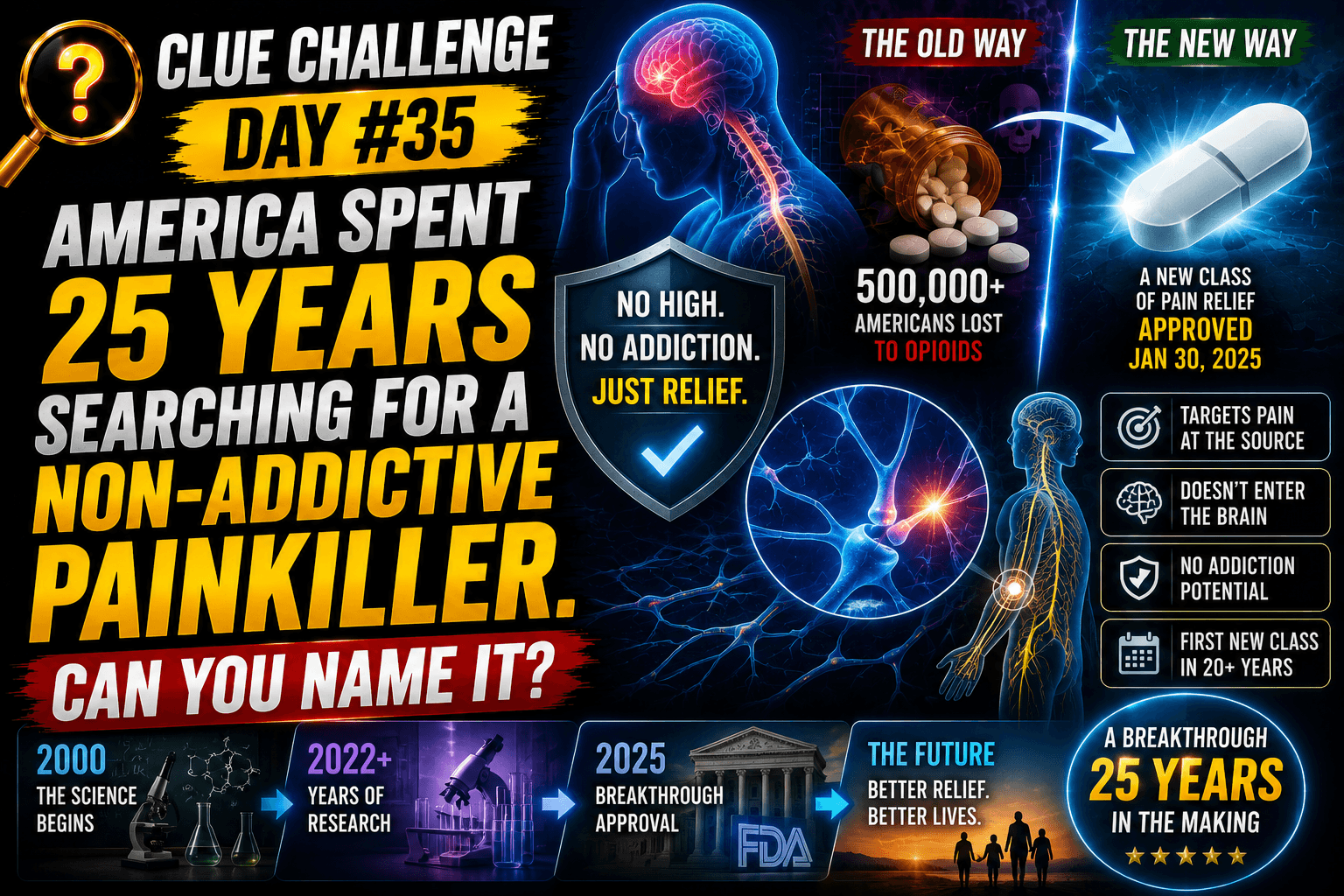
One molecule. Six clues. A crisis that killed 500,000 Americans. A solution that took 25 years to build. All real. All current.
For a quarter century, doctors treating severe pain had one reliable option — a class of drug that worked brilliantly and destroyed lives simultaneously. Then, in January 2025, the FDA approved the first entirely new class of painkiller in over 20 years. Nobody who needed it is addicted to it. Can you name the molecule before the final clue?
Clue #1 — For 25 years, severe pain had only one powerful answer — and it was killing people
Every year, 80 million Americans are prescribed medication for moderate-to-severe acute pain — after surgery, injury, or illness.
For decades, the standard answer was opioids. They worked. They also created one of the worst public health catastrophes in modern history.
The opioid epidemic has been an ongoing public health crisis affecting millions of people worldwide for over two decades. It was officially declared a Public Health Emergency by the US Department of Health and Human Services in 2017. Nearly 8.6 million Americans aged 12 and older reported misusing prescription opioids in 2022 alone.
Doctors knew the problem. They had no alternative. Until now.
Clue #2 — The science behind this drug began in a Yale laboratory — 25 years ago
A Yale School of Medicine neuroscientist and his research team laid the foundation for this drug more than 25 years ago when they showed that a specific molecular channel — a “molecular battery” that produces nerve impulses — is needed for pain signalling within peripheral nerves, but not within the brain. Based on that finding, multiple biopharma companies attempted to develop new drugs that block it — hoping to stop pain at its source without touching the brain at all.
Twenty-five years of attempts. Most failed. One succeeded.
Clue #3 — It stops pain before the signal ever reaches the brain
Here is what makes this molecule unlike everything that came before it.
It targets pain signals in the peripheral nervous system — without directly activating the central receptors associated with euphoria and respiratory depression. Because it has minimal penetration into the brain, patients are more alert and less likely to experience the cognitive fog associated with narcotics.
Novocaine — the local anaesthetic used in dental offices — is also a sodium channel blocker, but it is not selective. It numbs everything around it. This new molecule is different: it targets one specific channel, found exclusively in pain-sensing nerve endings, and blocks only that.
Pain intercepted at the source. Brain untouched. No high. No addiction.
Clue #4 — The FDA approved it on January 30, 2025 — with Breakthrough Therapy designation
On January 30, 2025, the FDA approved a 50-milligram oral tablet as the first non-opioid analgesic for treating moderate-to-severe acute pain in adults — the first drug in this novel class in 25 years.
This approval was granted under both Breakthrough Therapy and Fast Track designations — signals that the FDA considered it a significant advancement in a field of urgent unmet need.
The approval came just one week after Purdue Pharma and the Sackler family — the dynasty that helped ignite the opioid epidemic — settled opioid-related lawsuits for $7.4 billion.
The old era settling its debts. A new one beginning.
Clue #5 — It has already changed how hospitals operate after surgery
Without opioid-induced side effects, patients can get up and move sooner after surgery — reducing the risk of blood clots and pneumonia. Gut motility returns faster. Dietary advancement happens earlier. Fewer adverse events mean a quicker path to discharge.
Clinical trials demonstrated significant efficacy in postsurgical pain relief across two large studies, each involving approximately 1,000 patients — comparing it head-to-head against a placebo and the opioid Vicodin.
In a survey of physicians, 50% called its approval “a really big deal.”
Clue #6 — The next generation is already in trials — and could reach beyond acute pain into nerve damage and diabetes
The company behind this molecule is now evaluating it in peripheral neuropathic pain — with a Phase 3 pivotal programme for patients with painful diabetic peripheral neuropathy currently underway.
Its original discoverer at Yale has stated: “We have more work to do, but I expect next-generation drugs will be even better.”
One molecule. A 25-year scientific journey. The opioid crisis as the backdrop. The FDA’s fastest approval track. Hospitals already changing how they treat post-surgical pain.
So — what is this molecule?
It is an oral tablet taken twice daily. It selectively blocks a single voltage-gated sodium channel found only in peripheral pain-sensing neurons. It has no addictive potential. It was approved in January 2025 — the first new class of painkiller in over 20 years. Its brand name begins with J. Its scientific name is your answer.
Bonus — can you also name:
- Its brand name approved by the FDA
- The pharmaceutical company that developed it
- The specific sodium channel it blocks
- The Yale neuroscientist whose 25-year-old research made it possible
Drop your answer below. Unlike Wordle, this one could change how every human being on Earth manages pain. Day #36 arrives tomorrow.
Missed yesterday’s challenge?
Clue Challenge Day #34: Physics Found a Third Magnet, Can You Name It?
Answer to Yesterday’s Challenge: DAY #34
(Click above to reveal)