China’s semiconductor self-reliance is no longer a slogan. It’s shipping.
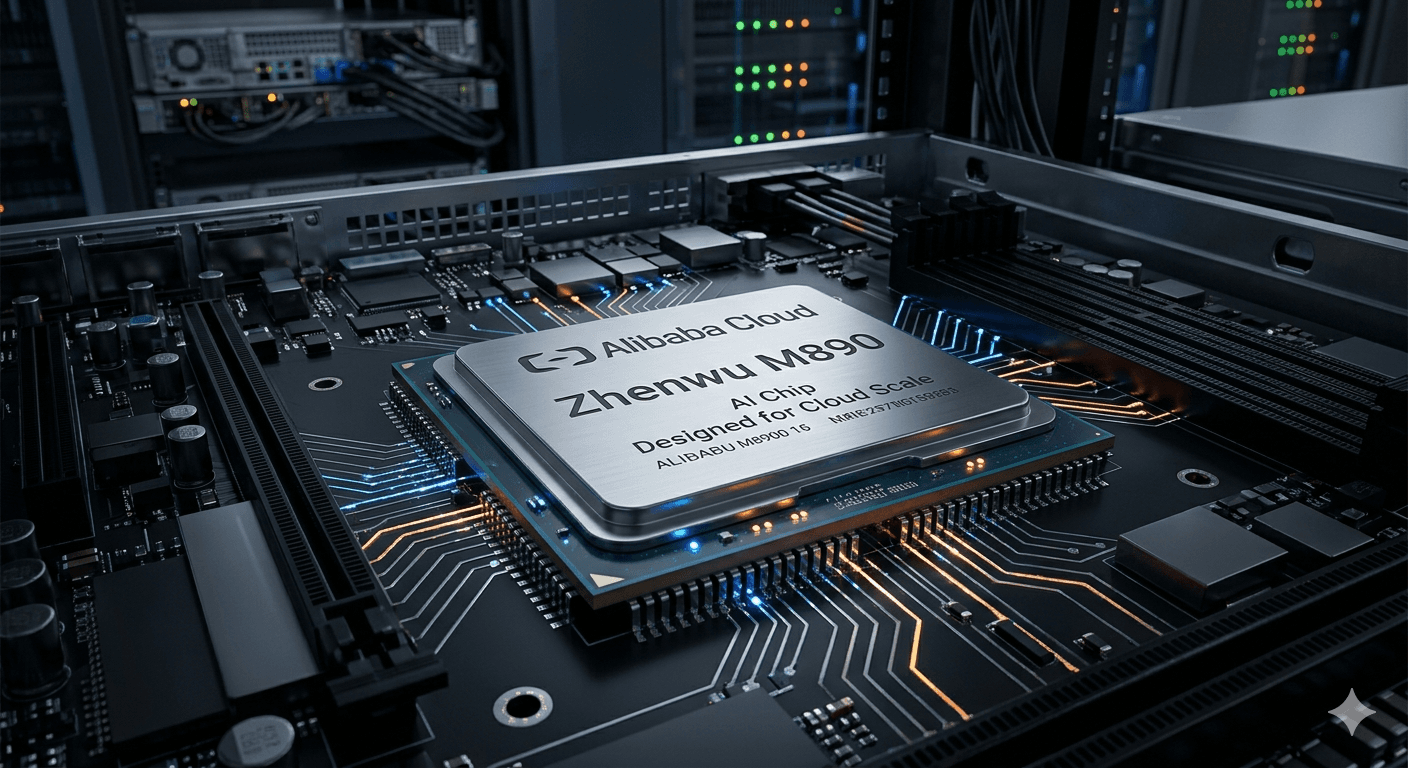
At its annual cloud summit in Hangzhou this week, Alibaba’s chip subsidiary T-Head unveiled the Zhenwu M890 — its most powerful artificial intelligence processor to date — claiming three times the performance of its predecessor and positioning it squarely as a domestic answer to Nvidia’s embattled H200. The launch arrives at one of the most charged moments in the US-China technology rivalry, and its timing was anything but accidental.
A Chip Built for the Agentic AI Era
The Zhenwu M890 is engineered for a new class of AI workloads: agentic systems capable of long-horizon reasoning, multi-step planning, and real-time coordination. Unlike earlier generations focused narrowly on model training, the M890 handles both training and inference on a single chip — a practical advantage for enterprise customers managing costs at scale.
Technically, it packs 144 GB of high-bandwidth GPU memory and inter-chip bandwidth of 800 GB per second, making it one of the most capable domestically produced AI accelerators available in China. Alibaba also revealed it has already shipped over 560,000 units across the Zhenwu series to more than 400 customers in industries ranging from automotive to financial services. A multi-year roadmap followed: the more powerful Zhenwu V900 is planned for Q3 2027, and the J900 for Q3 2028 — signalling Alibaba’s intent to match Nvidia’s annual upgrade cadence.
Alongside the chip, Alibaba previewed its next-generation large language model, Qwen3.7-Max, extending a portfolio that has already surpassed one billion cumulative downloads since 2023.
Nvidia’s China Problem: From 95% to Near Zero
The context matters as much as the chip itself. Before export restrictions began tightening in 2022, Nvidia controlled roughly 95% of China’s advanced AI chip market and derived close to a quarter of its data centre revenue from the country. That position has since collapsed. In early 2025, the US government further restricted the H20 — a chip Nvidia had specifically designed to comply with export rules — dealing a $5.5 billion charge to Nvidia’s books. Access to the more advanced H200 has been similarly uncertain despite a temporary US-side licence.
Jensen Huang, Nvidia’s CEO, travelled to Beijing last week as part of a US business delegation accompanying President Donald Trump. He declined to confirm whether H200 discussions took place directly, but his message carried a diplomatic edge: “The Chinese government has to decide how much of their local market they want to protect.”
Nvidia has reportedly received purchase orders for H200 processors from Chinese customers including ByteDance, Alibaba, and Tencent, and is restarting manufacturing for the market following clearances from both US and Chinese authorities. But industry observers note the situation remains fragile. “It’s during a window when the prospects of the H200 entering the Chinese market are highly uncertain and Nvidia’s business in China has effectively dropped to zero,” said Zhang Guobin, founder of Chinese tech specialist site eetrend.com.
China’s “Plan B” Is Now a Reality
That uncertainty is precisely why Alibaba’s launch carries strategic weight beyond its spec sheet. Analysts at Counterpoint Research note that while the M890 is “not a true competitor to H200 on raw silicon power,” it functions as “a believable replacement for H200” in the Chinese domestic market. The distinction is important: Chinese AI companies do not need to match Nvidia’s bleeding-edge Blackwell or forthcoming Rubin processors — they need reliable chips that are immune to the next Washington policy swing.
Analysts suggest US export controls may have accelerated China’s semiconductor independence, with estimates that China can now source 70–85% of its domestic AI chip demand from local manufacturers. Huawei’s Ascend series and Cambricon’s Siyuan line sit alongside Alibaba’s Zhenwu as pillars of a market that is rapidly indigenising.
The chip war has also prompted serious enforcement action. The US Commerce Department’s Bureau of Industry and Security has announced nearly $420 million in combined penalties over the past year related to illegal semiconductor smuggling, including a $252 million penalty against Applied Materials for routing equipment to China via a Korean subsidiary.
What Comes Next
Alibaba is by no means alone in this race. Huawei continues refining its Ascend 910 series, and Baidu has its own accelerator ambitions. Meanwhile, Alibaba’s T-Head plans to upgrade the Zhenwu chip on an annual basis — roughly matching Nvidia’s development pace — a commitment that would have seemed implausible just three years ago.
For global investors and policymakers, the Zhenwu M890 is a signal. China’s domestic AI hardware ecosystem is no longer in catch-up mode — it is building forward. Whether Nvidia regains meaningful footholds in China or finds itself permanently displaced will depend less on silicon and more on the decisions made in Washington and Beijing boardrooms in the months ahead.
Sources: AFP, CNBC, Bloomberg, TrendForce, Counterpoint Research, US Bureau of Industry and Security (May 2026)