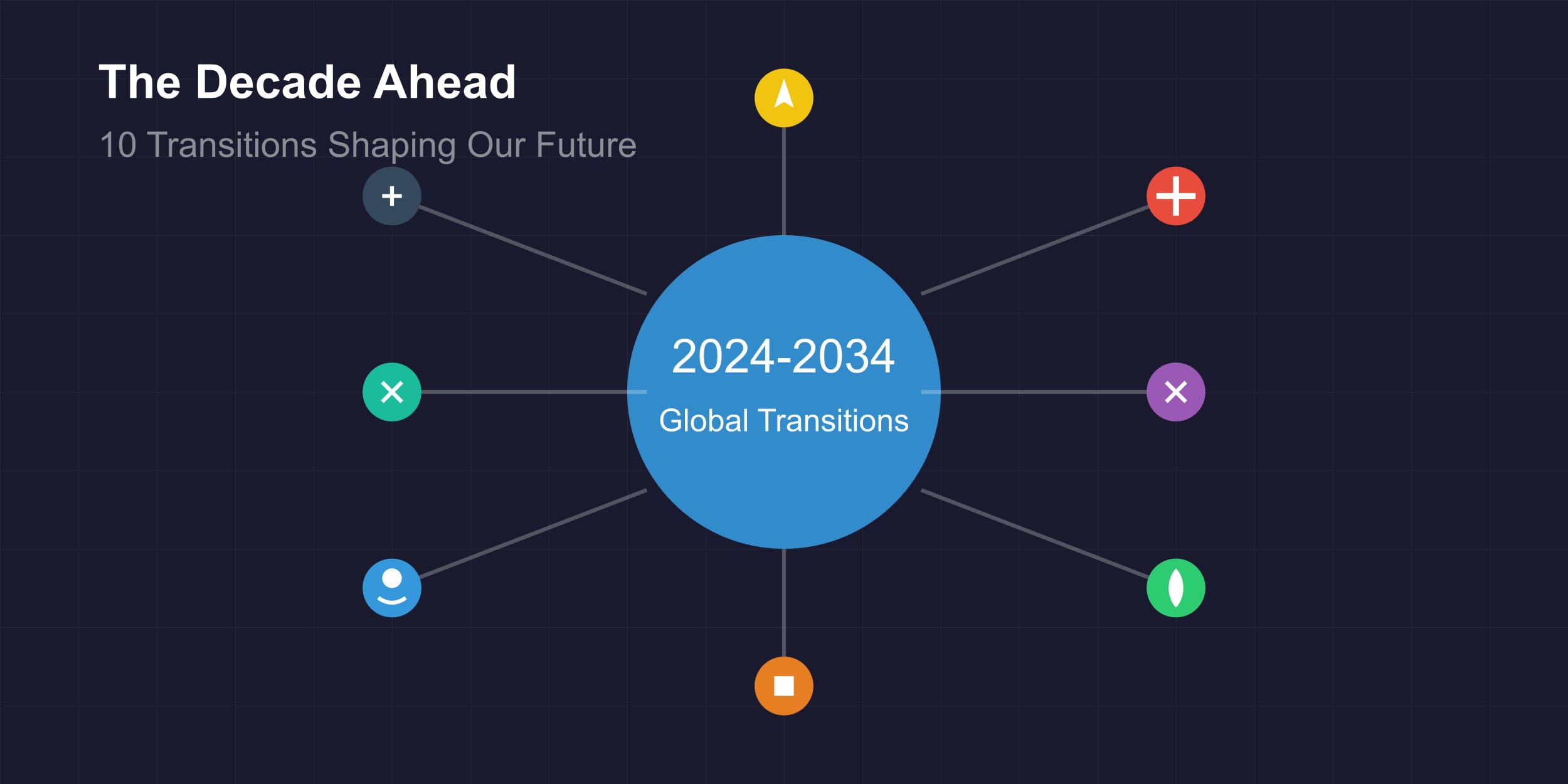
We stand at a pivotal moment in human history, where multiple transformative transitions are converging to reshape our world. This convergence is driven by pressing global challenges such as climate change, technological breakthroughs, shifting demographics, and the lingering effects of the COVID-19 pandemic. Together, these interconnected changes are fundamentally altering how we live, work, and interact. Let’s explore these 10 transitions that will define the decade ahead.
1. Energy Transition
The shift from fossil fuels to renewable energy sources is accelerating at an unprecedented pace, heralding a cleaner and more sustainable future.
- Renewable Energy Expansion: Wind and solar power installations are breaking records worldwide, driven by declining costs and government incentives.
- Grid Modernization: Smart grids and microgrids are enhancing energy distribution and reliability.
- Energy Storage Solutions: Advanced batteries, such as solid-state and recyclable options, are enabling longer-term renewable energy storage.
- Nuclear Innovation: Small modular reactors and advancements in fusion energy are creating safer and more scalable options.
- Hydrogen Economy: Investments in green hydrogen are laying the groundwork for decarbonizing heavy industries.
- Global Energy Equity: Despite progress, ensuring energy access in the Global South remains a critical challenge. Simultaneously, the renewable energy revolution is generating millions of green jobs worldwide.
2. Health Transition
Healthcare is undergoing radical transformation, prioritizing innovation, equity, and prevention.
- Digital Health Revolution: Telemedicine, AI-driven diagnostics, and wearable devices are redefining healthcare delivery.
- Preventive Healthcare: Greater emphasis on wellness, lifestyle medicine, and mental health is shifting the focus from treatment to prevention.
- Biotechnology Advances: Technologies like mRNA vaccines, gene editing, and precision medicine are ushering in personalized treatments.
- Healthcare Access: Efforts to achieve universal health coverage are gaining momentum, particularly in low-income regions.
- Mental Health Integration: Mental health is increasingly recognized as a key component of primary care, reducing stigma and improving outcomes.
- AI in Public Health: AI is aiding in epidemic prediction and resource allocation, potentially preventing future global health crises.
3. Technology Transition
Technology is evolving exponentially, reshaping industries and everyday life.
- Artificial Intelligence: AI is revolutionizing industries with advanced language models, autonomous systems, and data-driven decision-making.
- Quantum Computing: Breakthroughs in quantum processors are opening new possibilities for problem-solving in logistics, cryptography, and pharmaceuticals.
- Extended Reality: VR and AR applications are transforming education, healthcare, and entertainment.
- Edge Computing: Distributed infrastructure is enabling faster and more efficient data processing at the device level.
- Blockchain Beyond Crypto: Beyond cryptocurrencies, blockchain is finding applications in secure voting, supply chain transparency, and decentralized governance.
- Ethical Challenges: Addressing concerns around AI bias, accountability, and societal impacts is crucial to ensuring equitable progress.
4. Climate Transition
Climate action has never been more urgent or comprehensive.
- Decarbonization: Industries are committing to reducing carbon footprints through innovations in manufacturing and energy.
- Circular Economy: Efforts to minimize waste and promote recycling are central to sustainable production.
- Nature-based Solutions: Ecosystem restoration and biodiversity conservation are essential for addressing climate challenges.
- Climate Adaptation: Resilient infrastructure and community preparedness are helping societies adapt to climate change.
- Carbon Capture: Technologies like direct air capture are advancing to remove CO₂ from the atmosphere.
- Climate Justice: Marginalized communities disproportionately affected by climate change are at the heart of global adaptation efforts.
5. Storage Transition
Innovations in data and energy storage are unlocking new possibilities.
- Advanced Batteries: Development of recyclable and solid-state batteries is reducing environmental impact.
- Data Storage: Quantum storage and DNA-based technologies are pushing the boundaries of capacity and longevity.
- Green Storage: Energy-efficient systems are becoming a priority in both energy and data infrastructure.
- Geopolitical Implications: Advances in storage are transforming global energy security and independence.
6. Society Transition
Social structures and norms are being reshaped by digital and demographic shifts.
- Digital Society: Virtual communities and social interactions are redefining relationships and civic engagement.
- Aging Population: Societies are adapting to the challenges and opportunities of aging demographics.
- Urban Development: Smart cities and sustainable urban planning are creating livable and efficient urban spaces.
- Social Justice: Movements for equality and inclusion are driving systemic change across the globe.
- Digital Rights: Privacy, data ownership, and governance are becoming central to debates on digital society.
7. Cultural Transition
Global culture is evolving, blending tradition and innovation.
- Digital Culture: Online content creation and consumption are reshaping narratives and community-building.
- Global Integration: Cross-cultural exchange is promoting greater understanding and collaboration.
- Indigenous Knowledge: Traditional practices are being recognized for their contributions to sustainability.
- Sustainable Living: Eco-conscious lifestyles are influencing global consumer behavior.
- Creative Economy: New digital platforms are enabling artists to monetize their work in unprecedented ways.
8. Workforce Transition
The nature of work is being transformed by technology and societal shifts.
- Remote Work: Hybrid and flexible work models are becoming the norm.
- Automation Impact: Job displacement is being balanced by the creation of new roles requiring advanced skills.
- Skills Revolution: Continuous learning and reskilling are critical to staying relevant.
- Worker Rights: Labor protections are being redefined for the gig and digital economy.
- Universal Basic Income: UBI is gaining traction as a potential solution to automation-driven job displacement.
9. Economic Transition
Global economies are being restructured to address emerging challenges.
- Digital Currency: Cryptocurrencies and central bank digital currencies are reshaping financial systems.
- Green Finance: Sustainable investment is driving efforts to manage climate risks.
- Sharing Economy: Collaborative consumption models are gaining prominence.
- Global Taxation: New frameworks aim to tax multinational corporations fairly in the digital economy.
10. Education Transition
Learning systems are evolving to meet the needs of the future.
- Personalized Learning: AI-driven platforms are tailoring education to individual needs.
- Lifelong Learning: Continuous education is becoming essential for career adaptability.
- Soft Skills: Emotional intelligence, creativity, and critical thinking are gaining importance.
- Global Access: Online education is breaking barriers to learning worldwide.
These transitions are deeply interconnected, collectively shaping our future. Navigating them successfully will require:
- Systems Thinking: Recognizing the interplay between these changes.
- Adaptability: Embracing rapid shifts with resilience.
- Collaboration: Engaging across sectors, regions, and cultures.
- Innovation: Developing novel solutions to emerging challenges.
- Inclusivity: Ensuring equitable benefits for all.
By understanding and actively engaging with these transformations, we can shape a future that is sustainable, equitable, and prosperous for everyone. The decade ahead holds unprecedented challenges and opportunities—let’s rise to meet them.