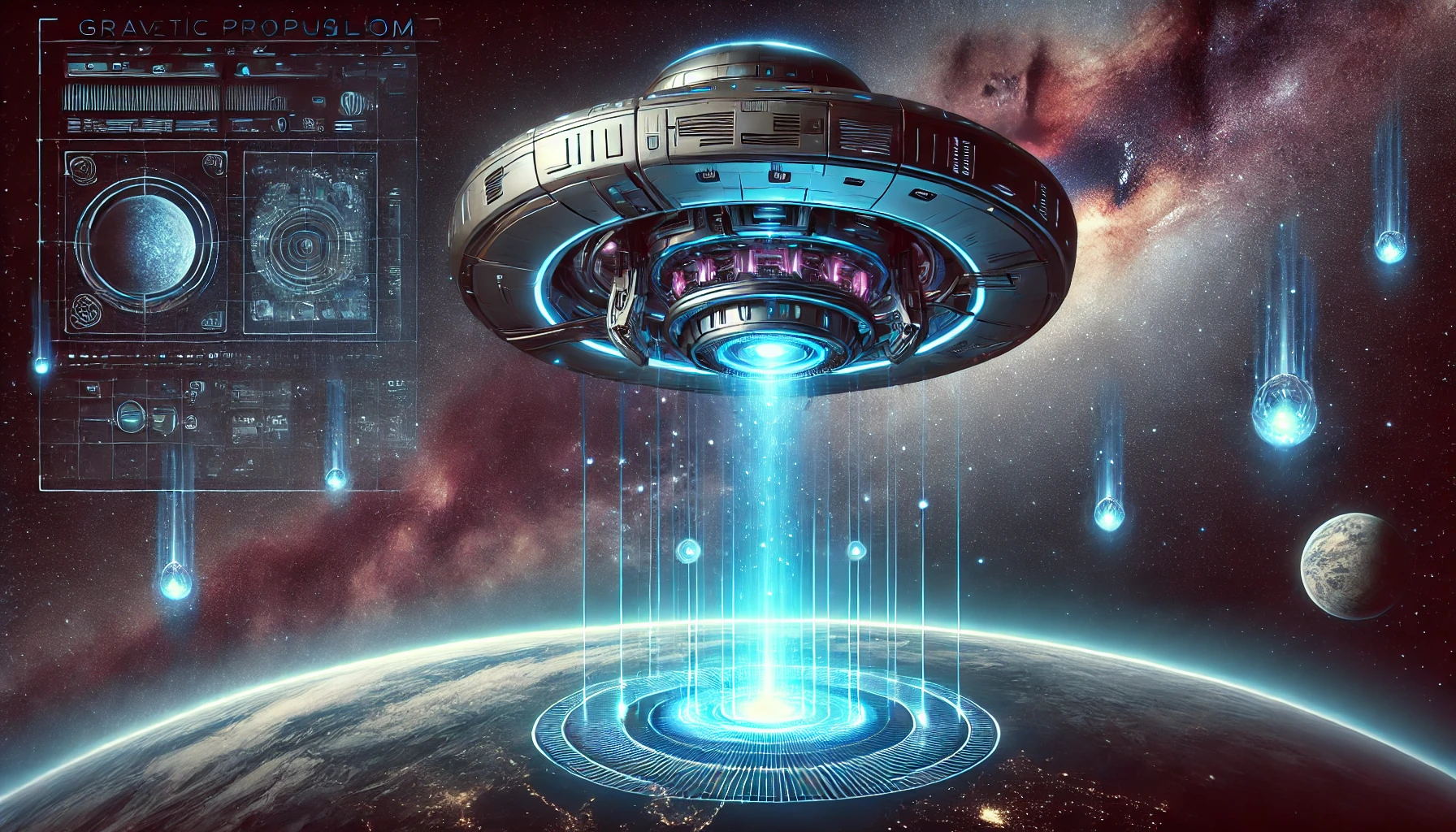
Humanity has always searched for faster, cleaner, and more efficient ways to travel through space. From chemical rockets to ion engines, every generation of propulsion technology has pushed the limits of exploration. Among the most fascinating and controversial concepts is the Gravitic Propulsion System — a theoretical technology that could one day revolutionize transportation by manipulating gravity itself.
While no working gravitic propulsion system exists today, the idea has captured the imagination of scientists, aerospace engineers, futurists, and science-fiction creators for decades.
What Is a Gravitic Propulsion System?
A gravitic propulsion system refers to a hypothetical method of movement that uses gravity manipulation instead of traditional thrust-based propulsion.
Conventional spacecraft move by Newton’s Third Law:
Every action has an equal and opposite reaction.
Rockets burn fuel and eject gases backward to move forward.
A gravitic propulsion system, however, would theoretically:
- Alter gravitational fields
- Warp spacetime
- Reduce effective mass
- Create artificial gravity gradients
- “Fall” through space without expelling propellant
In simple terms, instead of pushing a vehicle forward, the craft could manipulate gravity so space itself pulls or moves the craft.
The Physics Behind the Concept
The idea is deeply connected to Einstein’s General Theory of Relativity.
Einstein proposed that gravity is not simply a force but a curvature of spacetime caused by mass and energy.
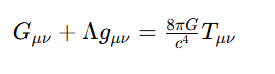
This equation describes how matter and energy influence the geometry of spacetime.
If an advanced civilization could manipulate this curvature artificially, it might:
- Bend spacetime around a vehicle
- Reduce inertia
- Achieve near-instant acceleration
- Travel vast distances without conventional engines
This forms the foundation for many gravitic propulsion theories.
Major Theoretical Approaches
1. Gravity Field Manipulation
This theory suggests creating artificial gravitational fields around a craft.
Possible effects include:
- Levitation
- Silent movement
- Sudden directional changes
- Reduced g-forces on passengers
Some UFO/UAP reports often describe movement patterns that resemble this hypothetical behavior:
- No visible exhaust
- Instant acceleration
- Hovering without sound
- Sharp turns beyond known aerodynamic limits
However, there is currently no public scientific evidence proving such systems exist.
2. Warp Drive Concepts
One of the most famous gravity-based propulsion ideas is the Alcubierre Warp Drive, proposed by physicist Miguel Alcubierre.
The concept suggests compressing spacetime in front of a spacecraft while expanding it behind.

Instead of moving faster than light locally, the spacecraft would ride a “wave” of spacetime itself.
Challenges:
- Requires enormous energy
- May need exotic negative energy
- Stability remains uncertain
- No experimental validation yet
Still, it remains one of the most serious theoretical frameworks related to gravitic propulsion.
3. Anti-Gravity Concepts
Anti-gravity refers to technologies that counteract or neutralize gravitational effects.
Popular ideas include:
- Electromagnetic-gravity coupling
- Rotating superconductors
- High-energy plasma fields
- Quantum vacuum engineering
Many experimental claims have appeared over decades, but none have been independently verified under rigorous scientific standards.
4. Quantum Vacuum Propulsion
Quantum physics suggests empty space is not truly empty. Tiny energy fluctuations constantly occur in the vacuum of space.
Some speculative theories propose spacecraft could:
- Extract vacuum energy
- Interact with spacetime fluctuations
- Generate propulsion without fuel
This area remains highly theoretical and controversial.
Why Scientists Are Interested
Even though gravitic propulsion is speculative, researchers remain interested because the potential benefits would be enormous.
Potential Advantages
Fuel-Free or Ultra-Efficient Travel
Traditional rockets carry massive fuel loads. Gravity-based systems might dramatically reduce fuel requirements.
Interstellar Exploration
Current propulsion systems are too slow for practical interstellar missions. Gravitic propulsion could theoretically shorten travel times from centuries to years.
Reduced Mechanical Stress
If inertia could be manipulated, spacecraft might accelerate rapidly without crushing passengers.
Silent Atmospheric Flight
A true gravity-driven craft might operate without jet engines or propellers.
The Biggest Scientific Challenges
Despite excitement, gravitic propulsion faces major obstacles.
1. No Experimental Proof
No confirmed experiment has demonstrated controllable gravity manipulation for propulsion.
2. Energy Requirements
Most theories require energy levels far beyond modern capabilities.
Einstein’s mass-energy relation highlights the scale involved:
E = mc^2
Manipulating spacetime may require extraordinary amounts of energy.
3. Lack of Unified Physics
Modern physics still struggles to unify:
- General Relativity
- Quantum Mechanics
A deeper understanding of quantum gravity may be necessary before gravitic systems become possible.
4. Material Limitations
Advanced propulsion systems could require:
- Exotic materials
- Room-temperature superconductors
- Ultra-high-energy field generators
- Unknown states of matter
Many of these technologies do not yet exist.
Military and Aerospace Interest
Over the years, several aerospace organizations and defense agencies have explored advanced propulsion concepts.
Organizations linked to speculative research discussions include:
- NASA
- DARPA
- Lockheed Martin
- Boeing
Most public research focuses on theoretical physics, advanced materials, or experimental propulsion rather than proven anti-gravity technology.
Could UFOs Use Gravitic Propulsion?
One reason gravitic propulsion attracts public attention is its connection to unidentified aerial phenomena (UAPs).
Some observed characteristics reported by military pilots include:
- Instant acceleration
- Hovering without visible propulsion
- Lack of sonic booms
- Extreme maneuverability
Supporters argue these behaviors could indicate gravity manipulation.
Skeptics point out:
- Sensor limitations
- Optical effects
- Data interpretation issues
- Lack of confirmed physical evidence
As of today, no government has publicly confirmed operational gravitic propulsion technology.
The Future of Gravitic Propulsion Research
Most experts believe practical gravitic propulsion — if possible at all — remains far in the future.
However, several scientific fields may contribute to future breakthroughs:
- Quantum gravity research
- Superconductivity
- High-energy physics
- Spacetime engineering
- Advanced electromagnetic systems
- AI-assisted materials discovery
Even partial breakthroughs could transform:
- Space travel
- Aviation
- Energy systems
- Military technology
Final Thoughts
Gravitic propulsion sits at the boundary between theoretical physics, futuristic engineering, and science fiction. While no confirmed system exists today, the concept challenges scientists to rethink humanity’s understanding of gravity, spacetime, and propulsion itself.
Many ideas once considered impossible — flight, satellites, reusable rockets, quantum computing — eventually became reality through scientific persistence.
Whether gravitic propulsion becomes humanity’s next great technological leap or remains an elegant theoretical dream, it continues to inspire researchers exploring the deepest mysteries of the universe.