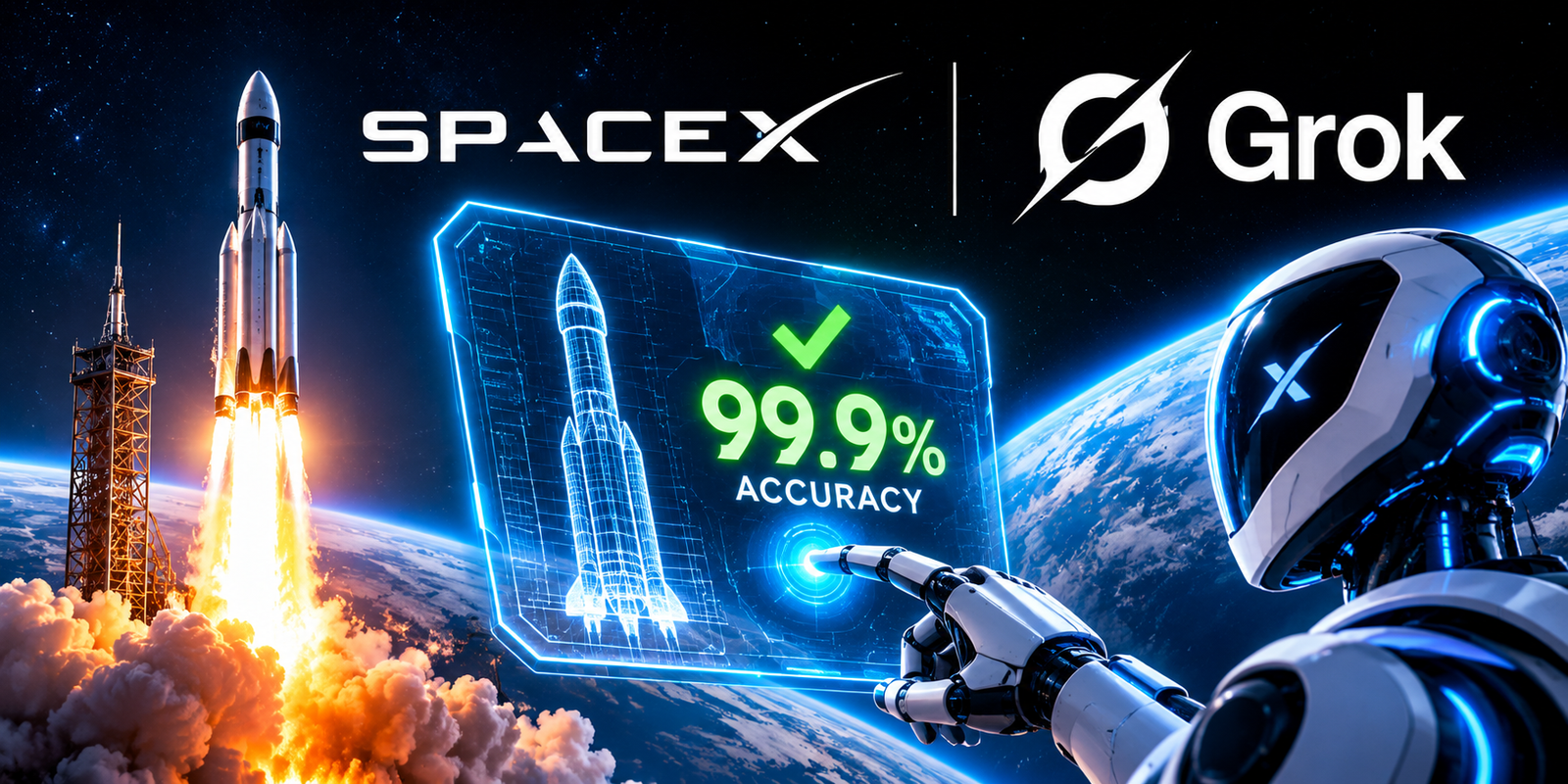
SpaceX uses Grok to review borescope footage of rocket components, achieving 99.9% accuracy in detecting debris compared to humans’ 94%. Vice President Kiko Dontchev shared this at last week’s UP Summit in Florida, noting how it prevents engine failures without tiring. The AI speeds up tasks from hours to seconds, aiding SpaceX’s push for more launches and goals like reaching the Moon and Mars faster. Similar gains appear in Starlink terminal checks, blending human oversight with AI for safer scaling.
SpaceX is leveraging Grok, the AI developed by xAI, to dramatically improve the detection of foreign object debris (FOD) in rocket components. According to company Vice President of Launch Kiko Dontchev, the system reviews borescope footage of aerospace parts and achieves 99.9% accuracy—surpassing the roughly 94% accuracy of human inspectors.
Dontchev shared the update last week at the UP Summit in Florida. Inspectors traditionally insert a borescope into tubes and other hardware to search for debris that could lead to catastrophic engine failures or other damage. Human performance on this repetitive visual task sits around 94% effectiveness. When the same video is analyzed by Grok, accuracy rises to 99.9%. The AI does not tire, maintain consistent focus, and processes the footage far faster than people can.
What once required hours or even days of careful review now takes seconds to minutes. This speed and reliability help SpaceX scale its operations more safely as it pursues higher launch rates. Faster, more dependable inspections support the company’s ambitious goals of increasing flight cadence and advancing toward crewed missions to the Moon and Mars.
The same approach is already delivering gains beyond propulsion hardware. SpaceX has applied automated visual inspection techniques to Starlink customer terminals, again finding meaningful improvements in accuracy and throughput. Across these applications, the company pairs AI analysis with human oversight rather than fully replacing inspectors. Flagged frames can still be reviewed by technicians, creating an efficient hybrid process that reduces risk while freeing skilled workers for higher-value assembly and integration tasks.
Foreign object debris has long been a critical concern in aerospace manufacturing. Even small particles can cause serious problems in high-performance engines and spacecraft systems. Automating the most tedious part of detection addresses both safety and production bottlenecks at once. By handling the bulk of the analysis, Grok allows SpaceX teams to maintain rigorous quality standards without slowing the pace of manufacturing.
The development illustrates how advanced AI tools are moving from experimental use into core operational workflows at SpaceX. As the company continues expanding production of vehicles and satellite hardware, consistent, high-accuracy inspection becomes increasingly important. Grok’s performance on borescope video offers a concrete example of AI contributing measurable gains in both precision and efficiency.
With human-AI collaboration already in place for rocket components and Starlink terminals, SpaceX appears positioned to apply similar methods more broadly. The result is a safer, faster path toward the higher launch rates and deeper-space ambitions that define the company’s current trajectory.